

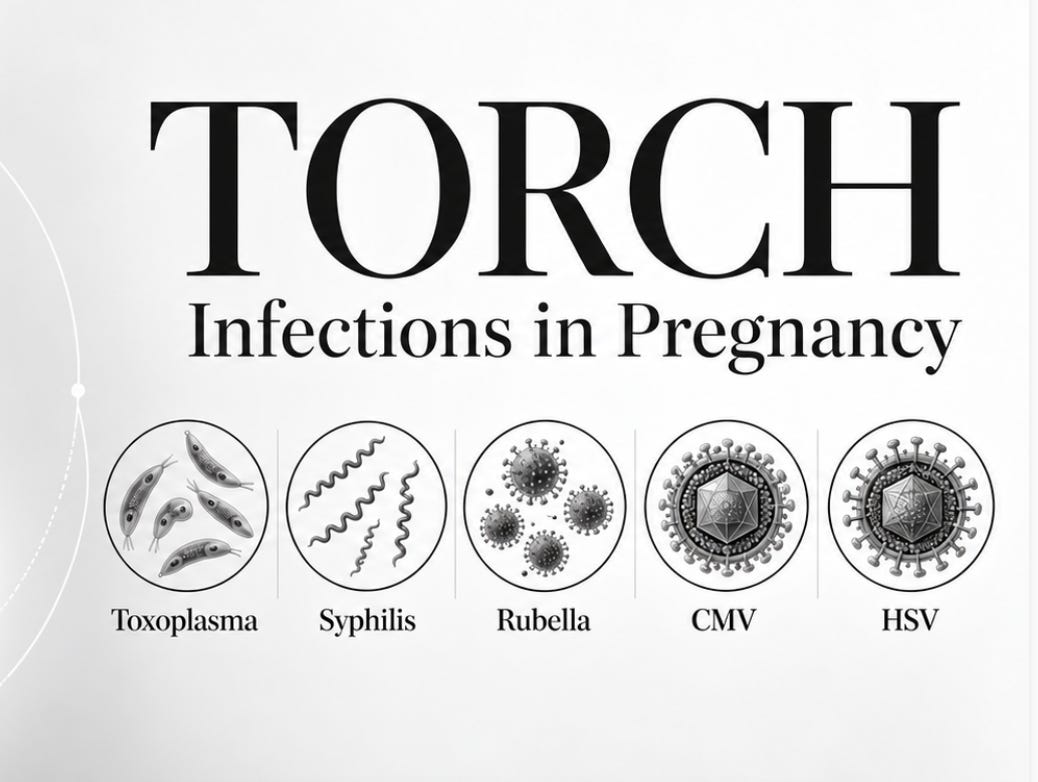
A Swedish study published this week followed more than 3.6 million people born between 1987 and 2021. Of them, 975 had a recorded congenital infection in the group often called TORCH:
toxoplasmosis,
syphilis,
rubella,
cytomegalovirus (CMV), or
herpes simplex.
Children with a recorded infection were more likely to receive a diagnosis of intellectual disability or autism than children without one. The association remained when researchers compared siblings in the same family.[1]
That finding matters. But it does not mean that an ordinary fever during pregnancy causes autism. The researchers studied diagnosed congenital infections, meaning infections recorded in the child, rather than every infection a pregnant woman might have had. These were rare events, and the strongest finding was for intellectual disability.
In the main analysis, the rate of an autism diagnosis was about three times higher among children with a recorded congenital TORCH infection.
The association was stronger for autism with intellectual disability than for autism without it.
Yet the authors estimated that the recorded infections accounted for only about 0.034% of autism diagnoses in their study population.[1] A large increase in risk within a small group can coexist with a very small contribution to autism overall.
What the study can, and cannot, tell us
This is a strong observational study. Its size, long follow-up, and sibling comparisons make the results more persuasive than a simple comparison of unrelated children. The findings support what clinicians have long known: some infections that reach a fetus can cause serious harm to the developing brain.
Sibling comparisons cannot, however, prove that infection caused every later diagnosis. The study relied on clinical records rather than uniform infection testing of every newborn. It could not fully assess infections that were never diagnosed, identify exactly when each infection occurred, or tell us how much current prevention or treatment would change the measured outcomes.[1] In an accompanying editorial, pediatric infectious disease specialist Mark Schleiss also raised questions about how consistently congenital infections were established across the long study period.[2]
The practical lesson is therefore narrower, and more useful, than the headline “infection causes autism.” Prevent infections we can prevent, detect those we can test for, and treat those we can treat. These steps are justified by the known harms of congenital infection, regardless of whether they prevent a measurable number of autism diagnoses.
What you can do during pregnancy
1. Reduce exposure to CMV, especially if you care for young children.
CMV is common and often causes no symptoms. Young children can carry it in saliva and urine. The Centers for Disease Control and Prevention (CDC) advises pregnant people to avoid sharing food, cups, utensils, or pacifiers with a child, and to wash their hands with soap and water after changing diapers or helping a child use the toilet. These are practical precautions, not a reason to avoid caring for or showing affection to your child. No precaution removes all risk.
There is currently no CMV vaccine available for routine use. Routine blood screening for CMV during pregnancy is not recommended by the American College of Obstetricians and Gynecologists (ACOG). If you have a suspected infection or an ultrasound finding that raises concern, ask your obstetric clinician about an individualized evaluation. A positive CMV antibody result needs careful interpretation; it does not by itself establish that a fetus is infected.
2. Prevent toxoplasmosis through food and soil precautions.
Cook meat thoroughly using a food thermometer. Wash produce, hands, knives, and cutting boards after contact with raw meat or soil. If possible, ask someone else to change the cat litter. If you must do it yourself, use gloves, change it daily, and wash your hands afterward. You do not need to give up your cat.
3. Make sure syphilis testing has been done, and repeat it when indicated.
Syphilis may have no obvious symptoms, but it can be passed to the fetus. In the United States, CDC guidance calls for testing at the first prenatal visit. Repeat testing at 28 weeks and at delivery is recommended for pregnant women in communities with high syphilis rates or with risk of acquiring syphilis during pregnancy. If a test is positive, prompt treatment and partner evaluation matter. Ask whether your testing is current, especially if you have a new exposure after your first test.
4. Check your rubella status.
The measles, mumps, and rubella (MMR) vaccine protects against rubella, but it is not given during pregnancy. Prenatal care includes checking for rubella immunity. If you are not immune, discuss vaccination after delivery. Contact your clinician promptly if you are exposed to someone with rubella while pregnant. Before a future pregnancy, vaccination offers the chance to prevent this infection.
5. Tell your obstetric clinician about genital herpes or a possible new exposure.
This matters most when genital herpes is first acquired late in pregnancy, because prevention of neonatal herpes depends in part on avoiding a new infection and on planning care at delivery. If you or your partner has genital or oral herpes, discuss the specific precautions that apply to you. Report new genital sores, pain, or burning promptly, including when labor begins. People with a known history of genital herpes may be offered antiviral medication near the end of pregnancy.
These steps should be part of good prenatal care, not a test of whether an individual woman can keep every infection away. Clinicians and health systems are responsible for explaining risks clearly, providing timely testing, interpreting results correctly, and making treatment accessible.
The Swedish study adds evidence that rare, diagnosed congenital infections are linked to substantial risks for affected children. It does not explain most autism. Its most useful message for pregnancy today is concrete: take CMV hygiene seriously, practice food safety, check immunizations, complete recommended infection screening, and seek care promptly when an exposure or new symptom needs evaluation.
References
Sjöqvist H, Dalman C, Mataix-Cols D, Gardner RM, Karlsson H. Congenital TORCH infections and neurodevelopmental outcomes. JAMA Pediatr. Published online September 21, 2026. doi:10.1001/jamapediatrics.2026.4229
Schleiss MR. TORCH infections in pregnancy and autism spectrum disorders. JAMA Pediatr. Published online September 21, 2026. doi:10.1001/jamapediatrics.2026.4468