

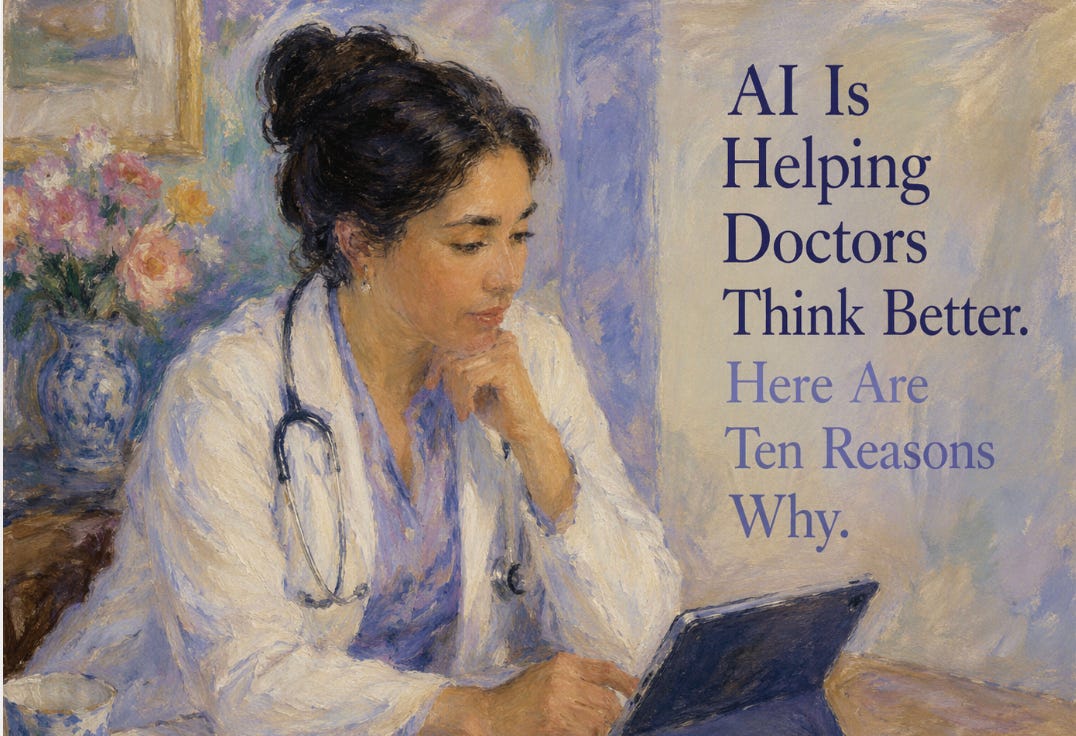
My feeds are full of warnings about AI in medicine.
Doctors will become lazy.
Clinical skills will atrophy.
The art of medicine will die.
I have been using large language models in clinical work and research since before most of these critics tried them. I was among the first to publish on LLMs in obstetrics in the American Journal of Obstetrics and Gynecology. And I have spent the past two years building AI-powered clinical tools — now in use by obstetricians around the world. What I have learned is the opposite of what the critics predict.
AI does not make physicians lazier. It makes them more creative. It frees them from the mechanical burden of recall so they can do what they were trained for: think about the patient in front of them.
Here are ten real clinical scenarios from obstetrics and gynecology where this is already happening.
ObGyn Intelligence: Safety analysis, the evidence critique, and the verdict are below -- for subscribers who want the full picture.
1. The Depressed Pregnant Patient Who Needs More Than a Prescription
Try it: https://liveevidence.com/tools/perinatal-antidepressant
A pregnant woman with moderate depression needs medication. Without decision support, the obstetrician is mentally cycling through SSRIs, SNRIs, and tricyclics — trying to recall which crosses the placenta least, which has the best lactation data, which interacts with her antiemetic. That is pure retrieval work, and it crowds out the harder question: what does this patient actually need?
The Perinatal Antidepressant Decision Support tool handles the pharmacology — combining clinical predictors with patient preferences to personalize the recommendation. Now the physician can focus on listening. Is her insomnia the primary driver? Does she have a history of activation side effects? Is she terrified of taking any medication during pregnancy? That conversation is creative clinical reasoning. No algorithm can have it.
2. The 39-Week Patient Who Wants to Know Her Odds
Try it: https://liveevidence.com/tools/labor-probability
Before AI, the conversation about induction timing was often a blunt instrument: ‘We recommend induction at 39 weeks.’ The physician was either guessing from memory or defaulting to the institutional protocol. There was no time — and no cognitive space — to individualize.
The Labor Probability Calculator computes day-by-day spontaneous labor onset probability adjusted for more than ten clinical factors including BMI, cervical length, and parity. With the math done, the physician can have a genuinely creative counseling conversation — one where the patient understands her specific likelihood of going into labor this week, and can participate as a partner in the decision. That is respect for patient autonomy at its best. It only happens when the physician’s brain is not running the numbers.
3. The Placenta Accreta That Does Not Follow the Script
Try it: https://liveevidence.com/tools/pas-screen
Placenta accreta spectrum is life-threatening, and missing it kills. The traditional approach requires the physician to hold a mental checklist of risk factors, remember the scoring system, and maintain the ultrasound evaluation protocol — all while reading images and counseling the patient.
The PAS Screening Tool calculates the Placenta Accreta Index score and guides the ultrasound protocol systematically. Now the MFM specialist can focus entirely on the creative work: interpreting findings that do not fit the textbook, planning the surgical approach for this anatomy, anticipating complications that no checklist can predict. That is problem-solving at the highest level. It only happens when the physician’s mind is not occupied being a calculator.
4. The Hemorrhage You Can Prevent If You Have Time to Think
Try it: https://liveevidence.com/tools/pph-risk
Nineteen risk factors. Combined odds ratios. No physician can hold all of them in working memory while managing an active labor. The result is that hemorrhage preparation becomes inconsistent — driven by what the physician happens to recall, not by the patient’s actual risk.
The Atonic PPH Risk Assessment tool runs that calculation in seconds. The physician is now free to think about what actually prevents hemorrhage in this case: Should we preposition uterotonics? Is the anesthesia team aware of the risk? Does this patient have a religious objection to transfusion that changes the entire management plan? That last question — the one requiring creativity and human connection — never gets asked when the physician’s brain is doing arithmetic.
5. The Preterm Birth Case That Needs a Doctor, Not a Guideline
Try it: https://liveevidence.com/tools/ptb-decision-support
A patient at 28 weeks with a shortened cervix, prior preterm delivery, and irregular contractions. The evidence base is enormous and contradictory — progesterone, cerclage, pessary, tocolysis, steroids, magnesium. Each has its own indication, contraindication, and level of evidence. Sorting through all of it in real time is not clinical reasoning. It is clerical work.
The Preterm Birth Decision Support tool synthesizes the risk assessment and management pathways. The physician, freed from retrieval burden, can now do what no algorithm can: look at the whole picture. Is this patient’s stress level contributing? Is she on her feet ten hours a day because she cannot afford not to work? Can we address the social problem that the medical protocol ignores entirely? That is where creative problem-solving saves pregnancies.
6. The VBAC Patient Who Deserves a Real Conversation
Try it: https://tools.obmd.com/vbac-calculator
A woman with one prior cesarean wants to attempt vaginal birth. Without decision support, the physician is mentally running the MFMU nomogram — estimating success probability, recalling uterine rupture rates, adjusting for her labor history, her BMI, whether her prior cesarean was for a recurring indication. That cognitive load consumes the appointment.
The VBAC Calculator produces the individualized estimate in seconds. Now the physician can focus on what matters for this patient: her fear of another cesarean, the birth trauma she has never fully processed, what it would mean to her to labor. Beneficence in this setting is not just handing her a number. It is having the conversation the number makes possible.
7. The Shoulder Dystocia That Has No Time for Hesitation
Try it: https://tools.obmd.com/shoulder-delivery-timer
Shoulder dystocia strikes without warning. The head delivers and the anterior shoulder does not follow. Time is measured in seconds. The protocol has six maneuvers in sequence. A physician who is simultaneously managing the emergency, counting time, tracking which maneuvers have been tried, and documenting for the record cannot also be fully focused on the physical execution of those maneuvers.
The Shoulder Delivery Timer runs the clock, sequences the protocol, and logs the sequence in real time. The physician performs. She does not administer. In an emergency where delay costs lives, removing even one cognitive task from the physician’s working memory is not a convenience. It is patient safety.
8. The First-Trimester Patient Whose Preeclampsia Risk No One Has Calculated
Try it: https://liveevidence.com/tools/aspre
Aspirin reduces the risk of preterm preeclampsia by approximately 62 percent when started before 16 weeks of gestation.1 The window is narrow. The calculation — combining mean arterial pressure, uterine artery pulsatility index, placental growth factor, and clinical risk factors — is not something most practices perform systematically. High-risk patients leave the first-trimester visit without the one intervention that could prevent a life-threatening complication later.
The First Trimester Preeclampsia Screening tool applies the validated ASPRE algorithm and identifies who needs aspirin. The physician’s time is then spent on what the tool cannot do: explaining to the patient what preeclampsia is, what 162 mg of aspirin daily actually means for her pregnancy, and why starting it now matters. That explanation requires trust. Trust requires time. The tool creates the time.
9. The Postpartum Patient Whose Depression Looks Like Exhaustion
Try it: https://tools.obmd.com/depression-screen
Postpartum depression affects roughly 1 in 7 women and remains dramatically underdetected.2 Part of the reason is structural: the postpartum visit is rushed, the validated Edinburgh Postnatal Depression Scale takes time to administer and score, and the physician is already behind. The result is that the screen does not happen, or it happens so quickly that the patient’s answers are not really heard.
When the Edinburgh tool administers and scores the screen automatically, the physician enters the room with the result already in hand. She can now do what the instrument cannot: look at the woman who scored a 14 and ask, ‘Tell me what the past four weeks have actually felt like.’ That question, asked without the physician glancing at a clipboard, changes what the patient is willing to say.
10. The PCOS Patient Who Has Heard Everything Except What She Needs to Know
Try it: https://tools.obmd.com/pcos-screener
Polycystic ovary syndrome affects roughly 1 in 10 women of reproductive age and is simultaneously over-diagnosed in some populations and missed entirely in others.3 Applying the Rotterdam criteria correctly requires holding four diagnostic domains in working memory while conducting an examination, reviewing labs, and managing a patient who has often been told conflicting things by multiple physicians.
The PCOS Screener applies the Rotterdam criteria systematically and returns a clear diagnostic assessment. The physician can now focus on the conversation that actually changes outcomes: What are this patient’s fertility goals? Does she understand her metabolic risk? Has anyone explained to her that PCOS is a lifelong condition with implications beyond her reproductive years? Those are the questions that determine whether she leaves the office with an understanding of her condition or just another label.
The Real Threat Is Not AI
Daniel Kahneman demonstrated that cognitive load degrades judgment.4 When the brain is occupied with retrieval, it defaults to heuristics — mental shortcuts that are fast but systematically biased. Anchoring, availability bias, premature closure. These are not character flaws. They are the predictable consequences of asking a human brain to do two jobs at once: remember everything and think clearly.
AI takes one of those jobs off the table. The critics who warn that AI will make doctors stop thinking have the argument exactly backwards. The current system — in which physicians are expected to be walking encyclopedias — is what makes them stop thinking. They default to protocols because independent thought requires cognitive bandwidth they do not have.
My Perspective
After fifty years in clinical medicine, I can tell you what separates a good physician from a great one. It is not memory. It is the willingness to sit with a problem that has no obvious answer and think until the answer appears. It is creativity applied to biology. It is the courage to say I do not know — but I know how to figure it out.
The ten scenarios above are not hypothetical. They represent what happens every day in practices that have integrated AI decision support into clinical workflow. The physicians using these tools are not becoming lazier. They are becoming better — because for the first time, they have the cognitive space to be creative.
AI will not ruin medicine. It will ruin the idea that medicine is about memorization. That idea should have been retired a long time ago. All ten tools described here are available free at tools.obmd.com and liveevidence.com. Use them. Then use the time they give you to think.
If you want honest analysis of AI in medicine — not fear, not hype, just evidence — subscribe to ObGyn Intelligence. Independent. Evidence-first. No agenda except the data.
— POST ENDS —
References
1. Rolnik DL, Wright D, Poon LC, et al. Aspirin versus placebo in pregnancies at high risk for preterm preeclampsia. N Engl J Med. 2017;377(7):613-622.
2. Gavin NI, Gaynes BN, Lohr KN, et al. Perinatal depression: a systematic review of prevalence and incidence. Obstet Gynecol. 2005;106(5 Pt 1):1071-1083.
3. Bozdag G, Mumusoglu S, Zengin D, et al. The prevalence and phenotypic features of polycystic ovary syndrome: a systematic review and meta-analysis. Hum Reprod. 2016;31(12):2841-2855.
4. Kahneman D. Thinking, Fast and Slow. New York: Farrar, Straus and Giroux; 2011.