

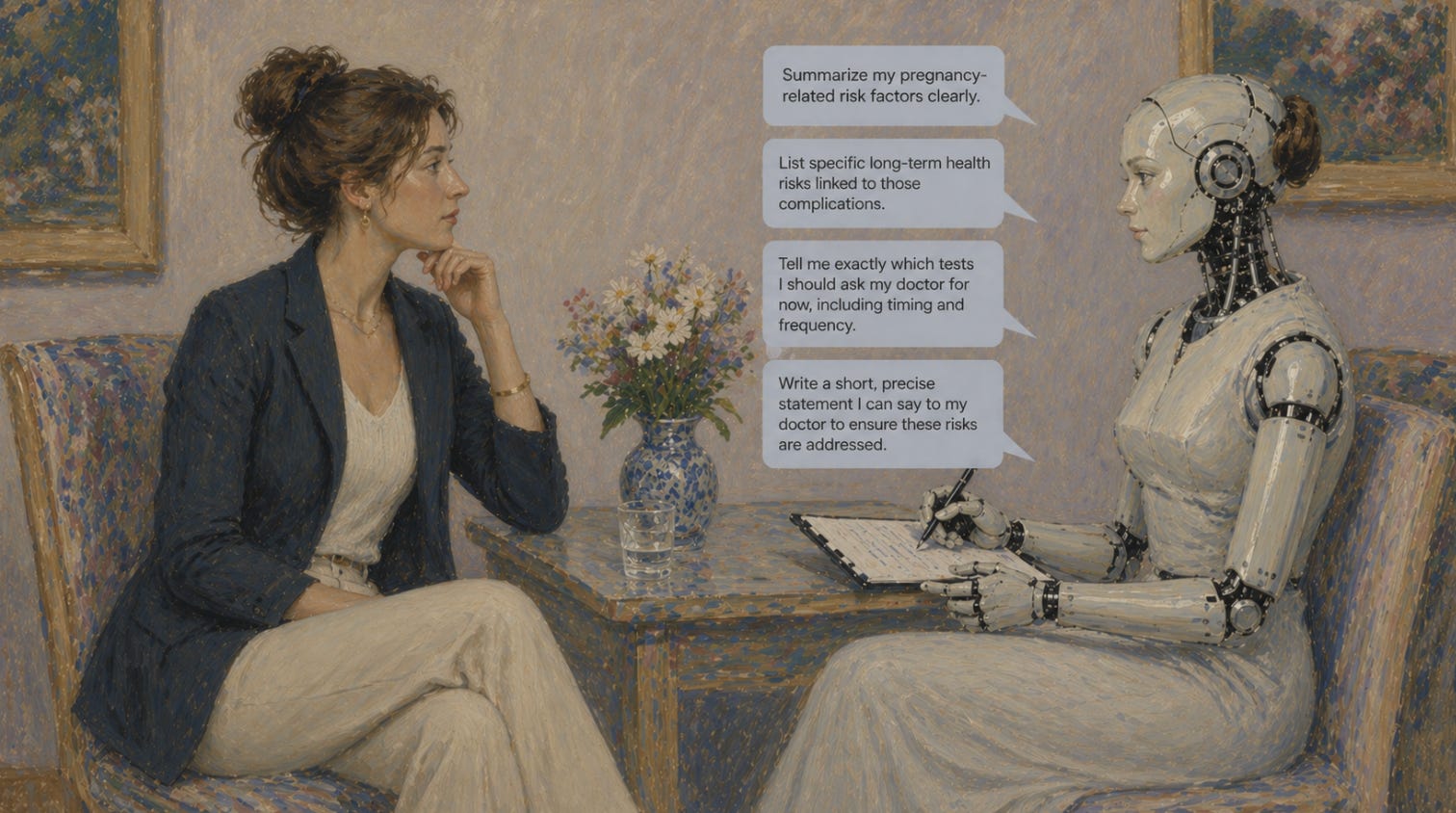
A care gap is not a lack of knowledge. It is a failure to apply what we already know, consistently, to the patient in front of us.
A woman has preeclampsia. She delivers. She is discharged. Six weeks later, she is told she looks well. Years later, she presents with advanced kidney disease. No one made an obvious mistake. The system performed exactly as designed. That is the problem.
The evidence is not unclear. Pregnancy complications such as preeclampsia are long-term risk markers for chronic disease, including kidney disease. Screening exists. It is simple. It is inexpensive. It is not being done. This is not a knowledge gap. It is a reliability failure.
We rely on memory. That is unsafe.
Clinicians are busy, interrupted, and managing competing priorities. Even excellent clinicians will not reliably connect a pregnancy complication from ten years ago to a silent long-term risk today. That is not negligence. It is a structural limitation.
AI changes this immediately.
Not by replacing clinicians. By enforcing consistency where humans cannot.
AI does what guidelines cannot do on their own. It operationalizes them.
It identifies patients with prior preeclampsia from the record. It keeps that risk visible across time. It prompts the clinician at the point of care. It links that prompt to the correct tests. It does this every time, for every patient, without fatigue.
This is not innovation. It is basic systems engineering applied to medicine.
If a system allows a known 5- to 9-fold risk signal to disappear after discharge, that system is defective.
What implementation looks like now and where patients can help themselves:
The rest of this post is for paid subscribers.
