

“At least you have a healthy baby.”
Every obstetrician has said it. Every mother has heard it. I said it myself, more than once, in fifty years of practice. It took me longer than I would like to admit to understand what the sentence actually does.
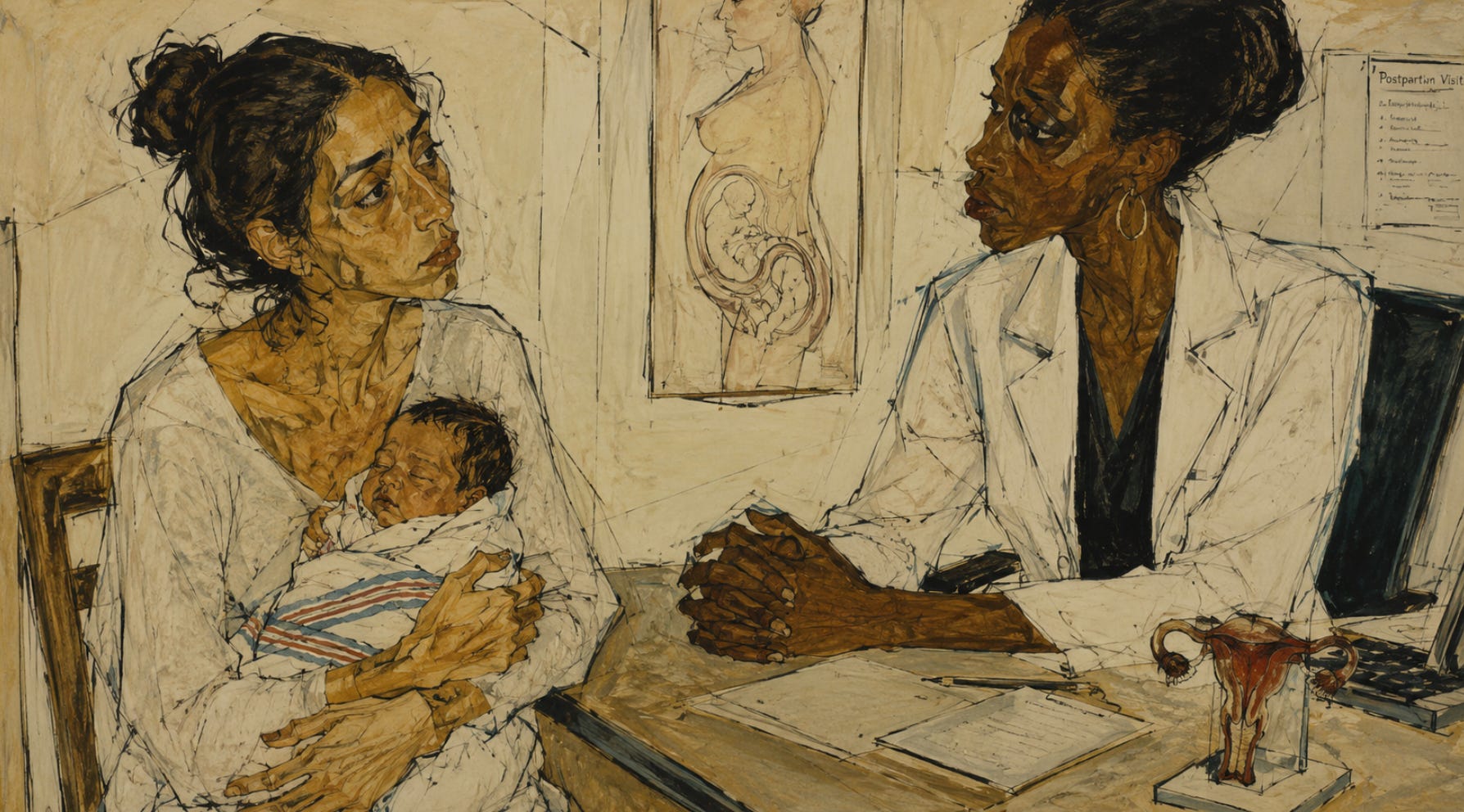
Picture the six-week postpartum visit. On paper, the birth went well. Healthy baby. Stable mother. No complications. The chart is closed and every quality metric is green.
But the woman in the chair wants to talk about something the chart never recorded. The moment her water was broken without anyone asking her. The cervical exam done in the middle of a contraction while she said “wait.” The three strangers who walked into the room during the most exposed moment of her life, and none of them said their name. Lying on the table, hearing her body discussed as if she had already left the room.
She starts to speak. Someone says the sentence. The conversation is over. She is now a grateful mother with a healthy baby, and what happened to her has been filed under “irrelevant.”
She will not file it there. She will carry it into her next pregnancy, if she allows herself a next pregnancy at all.
Where the Sentence Came From
The sentence began as something honest. It is worth remembering how honest.
At the start of the twentieth century, six to nine American women died of pregnancy complications for every 1,000 live births. About 100 babies out of every 1,000 died before their first birthday. Those are CDC numbers, and they describe a world most of us can no longer imagine. A family with five children expected to lose at least one. A pregnant woman knew women who had died giving birth, sometimes in her own family.
By 1997, maternal mortality had fallen almost 99 percent, to fewer than 8 deaths per 100,000 live births. That decline is one of the great achievements in the history of medicine. When my career began, the memory of the old numbers was still alive in the delivery room. “A healthy baby” was not a platitude then. It was a genuine triumph, and everyone knew it.
But obstetrics kept the sentence after the circumstances changed. In a country where the overwhelming majority of births now end with a living mother and a living baby, the sentence no longer describes a triumph. It performs a function. It closes a conversation the clinician does not want to have. What began as gratitude became a shield. And a shield, held long enough, becomes a way of not looking.
What Counts as an Outcome
Before we go further, we should define the word, because the whole argument lives inside it.
An outcome is anything a person carries out of an encounter with medical care. In obstetrics, we measure the outcomes we can count: deaths, hemorrhage, infection, Apgar scores, NICU admissions, cesarean rates.
These matter enormously. They are the floor of good care, and I have spent a career defending that floor. Nothing in this post argues otherwise.
But the floor is not the ceiling. Every birth also produces a second set of outcomes that never appear in the chart. Was the woman told what was about to happen to her body before it happened? Were her questions answered? Were her refusals respected? Was she treated as the central person in the room, or as the surface on which obstetrics was performed?
The World Health Organization made this explicit in 2018. Its intrapartum care recommendations named a “positive childbirth experience” as a real goal of maternity care, standing next to safety, not beneath it.
This was not sentimentality from Geneva. It was a recognition that safety and experience happen in the same room, delivered by the same people, at the same time.
Women remember these outcomes for decades. Ask any woman over seventy about her births. She will not tell you her estimated blood loss. She will tell you who was kind to her and who was not, often with the name of the nurse attached. Memory is the outcome measure with the longest follow-up in our specialty, and we have never once audited it.
What the Numbers Show
This is not sentiment. It is data, and the data are recent and American.
In 2023, the CDC published a Vital Signs report on maternity care experiences, based on a survey of more than 2,400 women who had given birth. About one in five reported at least one form of mistreatment during their maternity care. The survey asked about specific behaviors: being shouted at or scolded, being ignored, having requests for help refused or left unanswered, having physical privacy violated, being threatened with withholding of treatment. These are not vague complaints about bedside manner. They are concrete acts, reported by mothers, in American hospitals, in this decade.
Nearly three in ten women in the same survey reported discrimination during their care, based on age, weight, income, or race and ethnicity. Rates of mistreatment were higher for Black, Hispanic, and multiracial women. They were also higher for women with no insurance or public insurance.
That last finding deserves a paragraph of its own, because it points at the structure rather than at individuals. Mistreatment tracks payer status. The women our system pays the least for are the women our system respects the least. I have written before that insurance, not race alone, is the primary structural driver of American maternal outcome disparities. Medicaid pays roughly half of what private insurance pays for the same birth, and the consequences reach every corner of care. The mistreatment data fit that pattern precisely.
The CDC report did not appear out of nowhere. The Giving Voice to Mothers study, published in 2019, surveyed more than 2,100 American women and found that about one in six reported mistreatment. The pattern by race was stark: about 23 in every 100 Black women reported mistreatment, compared with about 14 in every 100 White women. And one finding in that study should stop every clinician cold. Mistreatment rates rose sharply when unexpected interventions occurred, when labor deviated from the plan.
Read that carefully. The moments when a woman most needs to be informed and included, the moments when things change quickly, are exactly the moments when she is most likely to be silenced. We treat the unexpected as a license to stop explaining. It should be the trigger to explain more.
What Happens After
A birth experience does not end at discharge. It has a natural history, and we have measured it.
A large meta-analysis of 59 studies covering more than 24,000 women found that about 4 in every 100 women in community samples meet criteria for post-traumatic stress disorder after birth. In high-risk groups, such as women with complicated or frightening deliveries, the rate was close to 19 in every 100. To put that in perspective: in a hospital doing 3,000 deliveries a year, a 4 percent rate means roughly 120 women each year leaving with a diagnosable trauma response to their own birth. Not sadness. Not the “baby blues.” Post-traumatic stress.
The downstream effects are documented across this literature: postpartum depression, damaged early bonding, avoidance of medical care, fear of future childbirth, and decisions against future pregnancies. A woman who leaves the hospital physically intact but afraid to ever return has not had a good outcome. She has had half of one, and the half we ignored will shape her health, and her family, for years.
Notice what connects the trauma literature to the mistreatment literature. It is rarely the emergency itself that women describe as traumatic. It is the experience of losing all voice and control while the emergency happened. The cesarean is not the wound that lasts. Being treated as furniture during the cesarean is.
This Is About Informed Consent, Not Customer Service
Hospitals sometimes respond to this evidence with amenities. Nicer rooms. Better food. A satisfaction survey at discharge with a smiling logo. That response misses the point so completely that it almost proves the point.
Women in these surveys were not reporting bad food. They were reporting that things were done to their bodies without their knowledge or against their stated wishes. That is not a hospitality failure. That is an informed consent failure, and informed consent is not a courtesy. It is the ethical foundation of everything we do.
Informed consent is not a signature collected at admission. It is a continuous conversation that runs through the whole labor: this is what I recommend, this is why, this is what happens if we wait, what questions do you have. The conversation does not pause when labor becomes complicated. Frank Chervenak and I have argued for decades that the ethical work of obstetrics should be done before the crisis, not during it. That is the entire idea of preventive ethics. A woman who has been informed, heard, and included from the beginning almost never becomes the woman in conflict with her team at the moment of decision. Most conflict on labor floors does not come from women refusing good care. It comes from women who were never told what was happening until it was already happening.
And to be clear about what I am not saying: respecting a woman’s voice does not mean abandoning her to a menu of options. The physician’s duty is to recommend, plainly and with reasons, not to hide behind “it’s your choice” when the evidence clearly favors one course. Being heard and being guided are not opposites. A woman can be told directly what her doctor recommends and why, and still be the author of what happens to her body. In fact, that combination is exactly what most women say they want.
Here is the part that should embarrass our profession: respect costs nothing. It needs no randomized trial, no capital budget, no new device, no committee. Ask permission before every exam, every time. Introduce every person who enters the room. Narrate what is happening while it happens, in plain words. When something unexpected occurs, debrief before discharge: sit down, explain what happened and why, and answer questions. And at the postpartum visit, replace the closing sentence with an opening one: “Tell me about your birth.” Then say nothing and listen. We have managed far harder things than this.
Measure It, or It Will Not Change
There is one more step, and it is the one hospitals resist. In medicine, what is not measured is treated as if it does not exist. We count hemorrhage because we decided hemorrhage counts. We do not count whether women were asked before their membranes were ruptured, so in the official record of American obstetrics, that question does not exist.
The instruments exist. Validated measures of respectful care and patient autonomy in childbirth have been published and used in research for years. A labor unit that can report its rate of postpartum hemorrhage to the decimal can also ask every mother, before discharge, whether she was informed before procedures and whether her requests were answered. If the answers embarrass us, that is not an argument against asking. That is the argument for asking.
My Take
Safety comes first. It should, always. I spent fifty years and more than ten thousand deliveries on exactly that, and I will not romanticize birth into a wellness experience where outcomes take a back seat to ambiance. When safety and preference truly conflict, safety wins, and the physician’s job is to say so clearly.
But here is what fifty years taught me: safety and respect almost never conflict. That is the false choice hiding inside the old sentence. The same conversation that makes a woman feel respected is the conversation that makes her care safer, because an informed patient and an informed team make better decisions together, especially when things go wrong.
A healthy baby is the beginning of a good outcome, not the definition of one. The woman is not the packaging the baby arrived in. She is our patient. How she was treated is part of what we delivered, whether or not we ever measured it.
“At least you have a healthy baby” is not reassurance. It is a door closing. The better sentence takes four words longer: “Tell me what happened.”
Bottom Line
One in five American women reports mistreatment during maternity care, and the profession’s standard reply is a sentence designed to end the conversation. Start asking the other question instead. If you want the evidence behind women’s health delivered straight, without the shield, subscribe to ObGyn Intelligence at obmd.com.
References
1. Mohamoud YA, Cassidy E, Fuchs E, Womack LS, Romero L, Kipling L, et al. Vital Signs: Maternity Care Experiences – United States, April 2023. MMWR Morb Mortal Wkly Rep. 2023;72(35):961-967. doi:10.15585/mmwr.mm7235e1
2. Vedam S, Stoll K, Taiwo TK, Rubashkin N, Cheyney M, Strauss N, et al. The Giving Voice to Mothers study: inequity and mistreatment during pregnancy and childbirth in the United States. Reprod Health. 2019;16(1):77. doi:10.1186/s12978-019-0729-2
3. World Health Organization. WHO recommendations: intrapartum care for a positive childbirth experience. Geneva: World Health Organization; 2018.
4. Centers for Disease Control and Prevention. Achievements in public health, 1900-1999: healthier mothers and babies. MMWR Morb Mortal Wkly Rep. 1999;48(38):849-858.
5. Yildiz PD, Ayers S, Phillips L. The prevalence of posttraumatic stress disorder in pregnancy and after birth: a systematic review and meta-analysis. J Affect Disord. 2017;208:634-645. doi:10.1016/j.jad.2016.10.009