
Can I continue to eat sushi / smoked salmon / deli meat in pregnancy?
Sushi should not be mentioned together with deli meat, smoked salmon, dairy, or raw vegetables

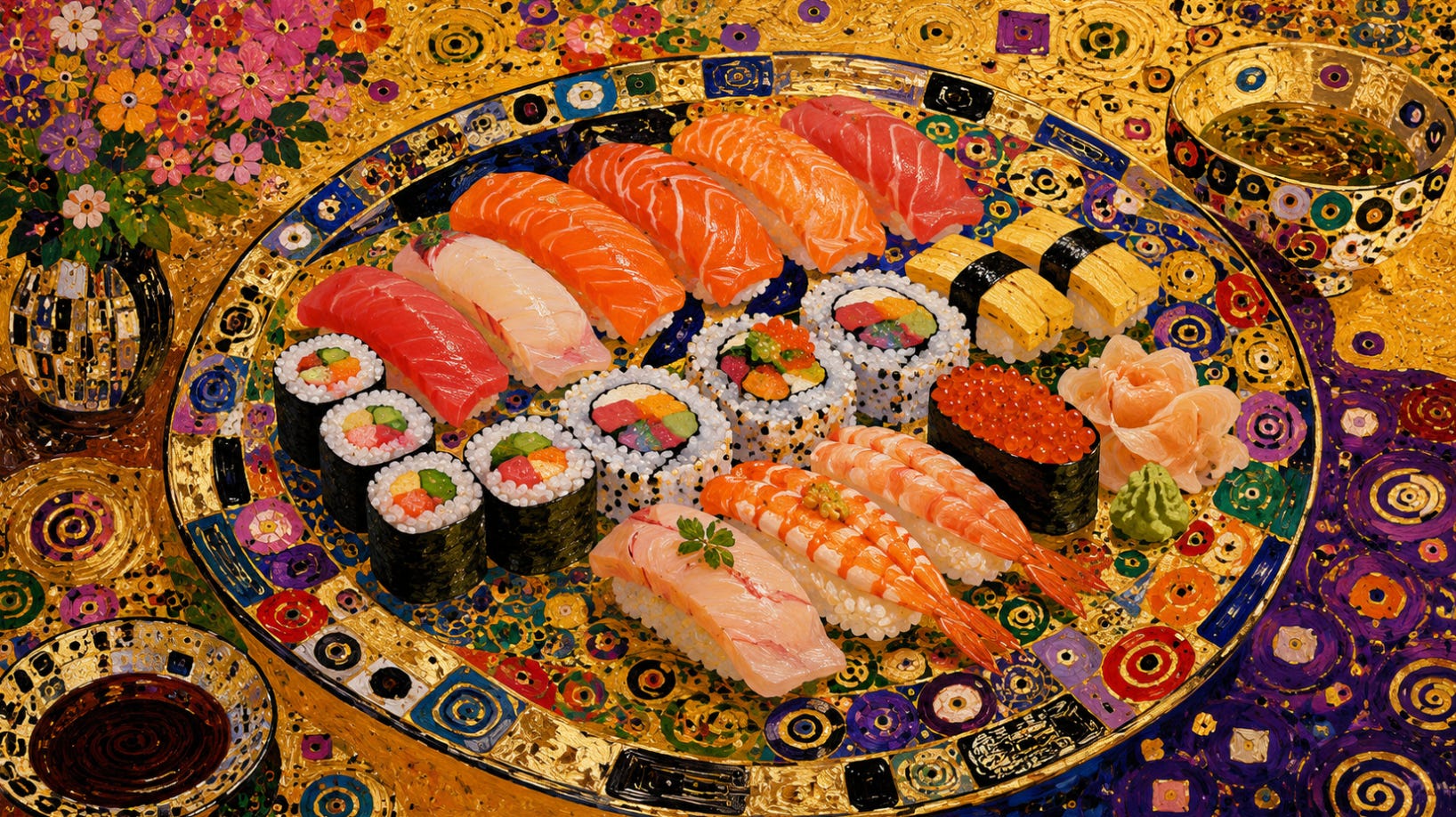
I monitor dozens of communities for clinically meaningful posts: dangerous myths, gaps between belief and evidence, stories guidelines cannot capture. This series -- ObGyn Intelligence on Reddit -- dissects them against the literature, because ObGyns who ignore social media ignore the most unfiltered window into what patients think, fear, and do between appointments.
Summary
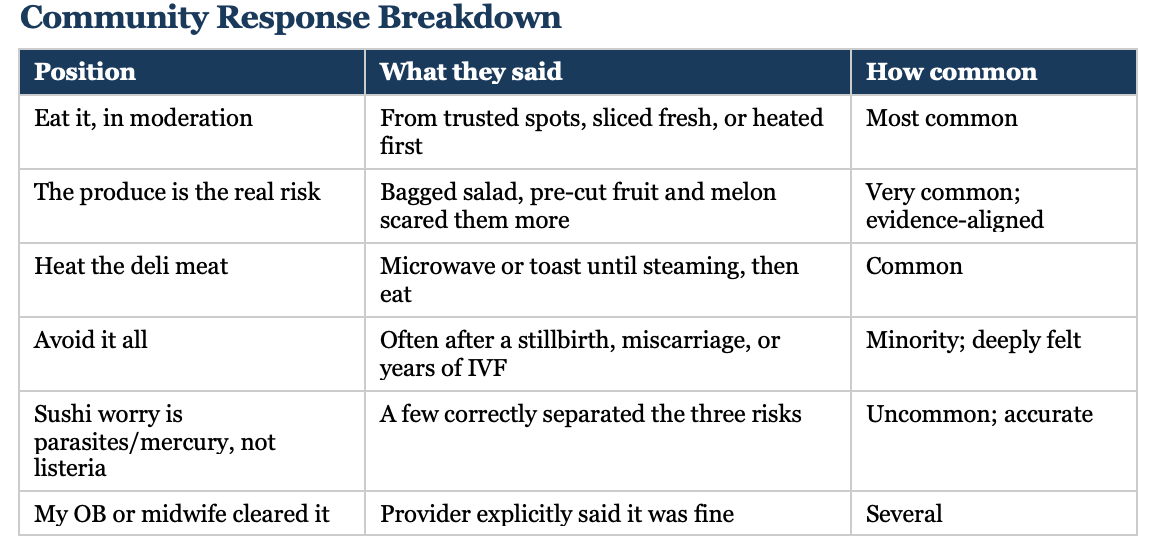
A pregnant Redditor asked a simple question and got more than a thousand answers: does anyone still eat sushi, smoked salmon, and deli meat? The overwhelming reply was yes, in moderation, from places they trust.
What stood out was how many women pushed back on the official warnings.
Again and again, commenters noted that bagged salads, pre-cut melon, and cantaloupe cause more listeria outbreaks than any sandwich, yet nobody tells pregnant women to stop eating salad.
A few said they avoid everything, often after a loss or years of trying to conceive, and the thread met that choice with real tenderness. But the question hides a problem, and so does the advice these women were given. It lumps three very different foods together, as if the risk were the same for all of them. It is not, and the body issuing that advice knows it is not.
Three Foods, Three Different Risks
These foods belong in one sentence as risks for Listeria.
Counter-sliced deli meat qualifies: the slicer itself can carry listeria, which is why warming the meat until it steams removes most of the risk.
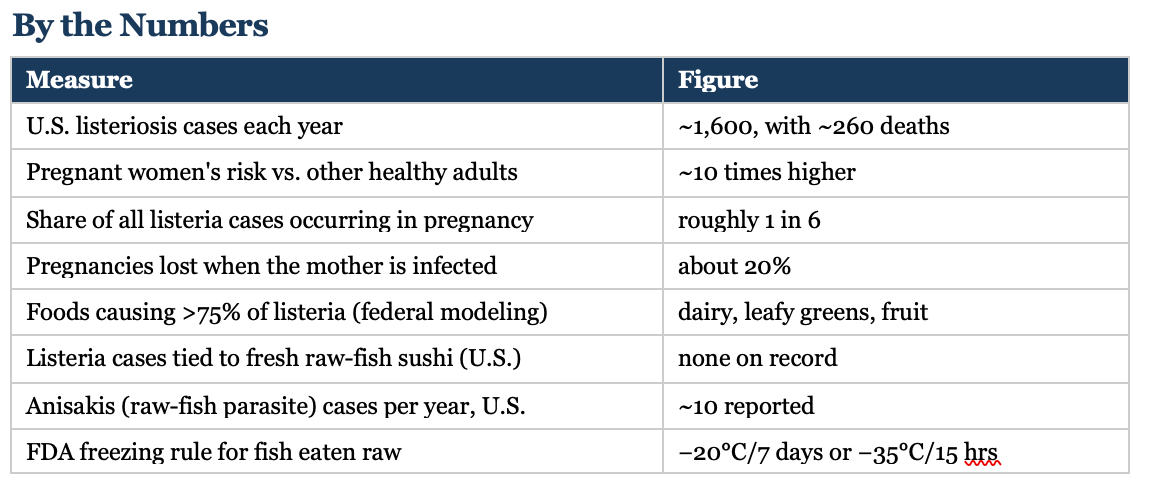
Cold-smoked salmon qualifies too, and more so; smoking does not reliably kill listeria, and the product is stored cold and eaten as is. One German genomic study estimated that smoked or cured salmon accounted for more than a quarter of that country’s listeriosis cases between 2018 and 2020. Of the three foods named, the smoked salmon is the real listeria concern.
Liusteria does not belong here.
Listeria monocytogenes is a soil and water organism that survives refrigeration and is killed only by cooking or pasteurization, so the genuine danger lives in refrigerated, ready-to-eat foods that sit cold for days with no further heating.
Fresh raw-fish sushi is the outlier. In the federal modeling that traces more than three-quarters of U.S. listeriosis to dairy, leafy greens, and fruit, fresh fish and other seafood account for essentially none of it. Sushi is served quickly, not held cold for days, so listeria has little chance to multiply, and it has not been implicated in U.S. listeria outbreaks. Its real risks are different: the Anisakis parasite, which the FDA’s mandatory deep-freezing of sushi-grade fish all but eliminates; ordinary stomach bugs such as salmonella that make the mother ill but rarely reach the fetus; and methylmercury, which is a matter of fish species, not of raw versus cooked.
What ACOG Says — and Why It Is Wrong
This confusion is not invented by patients. It is printed in the patient materials of the American College of Obstetricians and Gynecologists, so it is worth reading their exact words. On the page ACOG titles “Listeria and Pregnancy,” the instruction is unambiguous:
“Do not eat sushi made with raw fish (cooked sushi is safe).”
— ACOG, “Listeria and Pregnancy” FAQ
The placement is the whole problem. This sentence sits on a page about listeria, and the same page tells the reader that cooking and pasteurization are the only ways to kill the bacterium. Read together, those two statements tell a pregnant woman that raw-fish sushi transmits listeria. It does not.
ACOG has reached for the right bacterium and attached it to the wrong food.
In its general “Having a Baby” guidance, ACOG offers this:
“Raw fish may be harmful during pregnancy.”
— ACOG, “Having a Baby” FAQ
“May be harmful” is the language of liability, not of risk communication. It carries no magnitude, no mechanism, and no comparison. It cannot be acted on and it cannot be proven wrong, which is precisely why it survives in a guideline. A patient deserves a number and a reason, not a phrase engineered to be unfalsifiable.
And in its dedicated sushi FAQ, ACOG explains that raw fish, including sushi and sashimi, are:
“more likely to contain parasites or bacteria than fully cooked fish.”
— ACOG, “Can I eat sushi while I’m pregnant?” FAQ
That single phrase fuses three separate hazards into one alarming blur.
Pull them apart and the case collapses.
The parasite, Anisakis, is largely engineered out by the FDA-mandated freezing of any fish sold for raw consumption.
The bacteria that raw fish can actually carry are salmonella and campylobacter, which cause maternal stomach illness and, in the United States, do not behave like listeria and rarely reach the fetus. Listeria, the one organism that genuinely threatens the pregnancy, is the bug that raw sushi is not known to carry. Lumping these together lets the most frightening member of the group lend menace it has not earned here.
Laid out plainly, the failures are these:
1. Right bug, wrong food. ACOG invokes listeria to justify avoiding sushi, but fresh raw fish is not a documented listeria vehicle and contributes essentially none of the attributed U.S. cases.
2. Hedged, unquantified language. “May be harmful” protects the author from liability while giving the patient nothing she can weigh or act on.
3. Conflated hazards. Parasites, enteric bacteria, and listeria are merged into “parasites or bacteria,” obscuring that the dangerous one is absent and the present ones are mild and freezing-controlled.
4. Inverted risk hierarchy. The warning is loudest on salmon nigiri and quietest, in the same patient breath, on the foods that actually drive listeriosis: cantaloupe, bagged salad, pre-cut melon, soft cheeses, deli meat, and smoked fish.
5. The wrong sorting variable. ACOG sorts seafood on raw-versus-cooked. But mercury tracks fish species, not preparation, and listeria tracks refrigerated ready-to-eat shelf life, not rawness, which is why cooked-but-cold smoked salmon is a real listeria vehicle and raw nigiri is not.
To be fair to the kernel: ACOG is correct that pregnant women are roughly ten times more susceptible to listeriosis, that the consequences can be catastrophic, and that avoiding raw and undercooked seafood does reduce salmonella and parasite exposure.
A simple, conservative rule has value across a large and varied population. The problem is not that the advice is cautious. It is that it is mis-aimed, conflated, and unquantified, and it spends its credibility on the wrong target while staying quiet on the foods that fill the morgue.
What To Actually Avoid: The Listeria List
Here, explicitly, are the foods that transmit Listeria monocytogenes, grouped from highest concern down. The bacterium grows in the refrigerator and dies only with thorough cooking or pasteurization, so the through-line is simple: refrigerated, ready-to-eat, no kill step before the mouth.
Dairy (the largest single category)
Refrigerated ready-to-eat meats
Refrigerated smoked and ready-to-eat seafood
Produce (the under-recognized vehicles)
Refrigerated prepared and store-deli foods
Here they are:
Dairy (the largest single category)
• Unpasteurized (raw) milk and anything made from it
• Soft cheeses unless labeled made with pasteurized milk: queso fresco, queso blanco, panela, cotija, brie, camembert, feta, and blue-veined cheeses
• Any soft cheese under an active recall, even pasteurized (recent brie and camembert outbreaks)
Refrigerated ready-to-eat meats
• Deli and luncheon meats and cold cuts, especially counter-sliced, unless heated until steaming (165°F)
• Hot dogs straight from the package, unless heated until steaming
• Refrigerated pâté, meat spreads, and liverwurst
• Refrigerated pre-cooked chicken and ready-to-eat prepared meals, unless reheated
Refrigerated smoked and ready-to-eat seafood
• Cold-smoked salmon (lox, nova), gravlax, smoked trout, smoked whitefish, unless cooked or in a fully heated dish
• Refrigerated ready-to-eat crab, surimi, and pre-cooked shrimp, unless heated
Produce (the under-recognized vehicles)
• Pre-packaged and bagged salads and pre-cut leafy greens
• Pre-cut and pre-packaged fruit, especially melon; cantaloupe caused the deadliest U.S. listeria outbreak on record
• Raw sprouts of all kinds (alfalfa, bean, clover, radish); rinsing does not decontaminate them
• Enoki and other raw mushrooms implicated in repeated recalls
Refrigerated prepared and store-deli foods
• Store-made deli salads: chicken, ham, egg, tuna, and seafood salads
• Refrigerated hummus and dips during active recalls
• Pre-packaged hard-boiled eggs (recall history)
Across every category
• Anything currently under an active FDA or USDA listeria recall — check before assuming a food is safe
• Anything kept past its use-by date in the refrigerator, since listeria multiplies in the cold and time is the real risk multiplier
The rule patients should carry out of the office: refrigeration does not kill listeria. Only cooking or reheating to steaming (165°F) and pasteurization do. Keep the refrigerator at or below 40°F. And note what is absent from this entire list: fresh raw-fish sushi, the very food ACOG warns against on its listeria page.
What It Means
For patients, the risk is real but small, and it is not spread evenly across the menu. The precautions that move the needle are the unglamorous ones on the list above: wash produce, skip the bagged salad and pre-cut melon, heat deli meat until it steams, and choose smoked fish from a trusted source or warm it through. Raw-fish sushi from a reputable restaurant sits far down the list of things worth losing sleep over. For clinicians, the lesson is about credibility. Patients now read the same outbreak data we do. When we hand them a guideline that bans salmon nigiri but stays silent on cantaloupe, they learn that the list is about caution and liability, not about their baby, and that costs us the trust we need for the warnings that matter.
My Take
I have spent fifty years inside this system, and I have read a lot of these handouts. ACOG put sushi on a page about listeria, a bacterium that sushi does not carry, and told mothers that raw fish might be harmful without ever saying how, how often, or compared to what. That is not science. That is a phrase written to survive a deposition. Meanwhile cantaloupe, which caused the deadliest listeria outbreak this country has ever seen, rarely earns a sentence. There is something almost poetic about a woman trusting a sushi chef with twenty years at the same counter over a deli slicer cleaned, if she is lucky, once a day. She is reasoning better than the pamphlet. So tell her the truth, all of it: skip the bagged salad, heat the ham, and enjoy the salmon nigiri. A calmer pregnancy is worth more than a list nobody can defend.
Sources
1. American College of Obstetricians and Gynecologists. Listeria and pregnancy (FAQ). https://www.acog.org/womens-health/faqs/listeria-and-pregnancy
2. American College of Obstetricians and Gynecologists. Having a baby (FAQ). https://www.acog.org/womens-health/faqs/having-a-baby
3. American College of Obstetricians and Gynecologists. Can I eat sushi while I’m pregnant? (Ask ACOG). https://www.acog.org/womens-health/experts-and-stories/ask-acog/can-i-eat-sushi-while-im-pregnant
4. Centers for Disease Control and Prevention. About Listeria infection. https://www.cdc.gov/listeria/about/index.html
5. U.S. Food and Drug Administration. Listeria (Listeriosis). https://www.fda.gov/food/foodborne-pathogens/listeria-listeriosis
6. Interagency Food Safety Analytics Collaboration (CDC, FDA, USDA-FSIS). Foodborne illness source attribution estimates for Salmonella, E. coli O157, and Listeria monocytogenes — United States, 1998–2023. https://www.cdc.gov/ifsac/php/data-research/annual-report-2023.html
7. World Health Organization. Listeriosis fact sheet. https://www.who.int/news-room/fact-sheets/detail/listeriosis
8. Food Standards Agency. The risk to vulnerable consumers from Listeria monocytogenes in ready-to-eat smoked fish. 2024. https://www.food.gov.uk/research/foodborne-pathogens/the-risk-to-vulnerable-consumers-from-listeria-monocytogenes-in-ready-to-eat-smoked-fish
9. Lachmann R, et al. Invasive listeriosis outbreaks linked to salmon products, Germany, 2010–2021. [Full citation and DOI to be verified against PubMed before any manuscript use.]
10. Oster E. How dangerous is sushi during pregnancy, really? ParentData. https://parentdata.org/pregnancy/how-dangerous-sushi-during-pregnancy/