
Compassion Is Not a Communication Skill
AI is revealing how far medicine has drifted from its most important standard — and showing us exactly where it can help close the gap.

Patients rated a chatbot as more empathic than their own physicians.
Medicine’s first response was to call this a communication training problem.
My response: we are measuring the wrong thing and naming the wrong standard.
AI has accidentally done us a favor by making the problem visible. Now we have to understand what it can fix and what only we can.
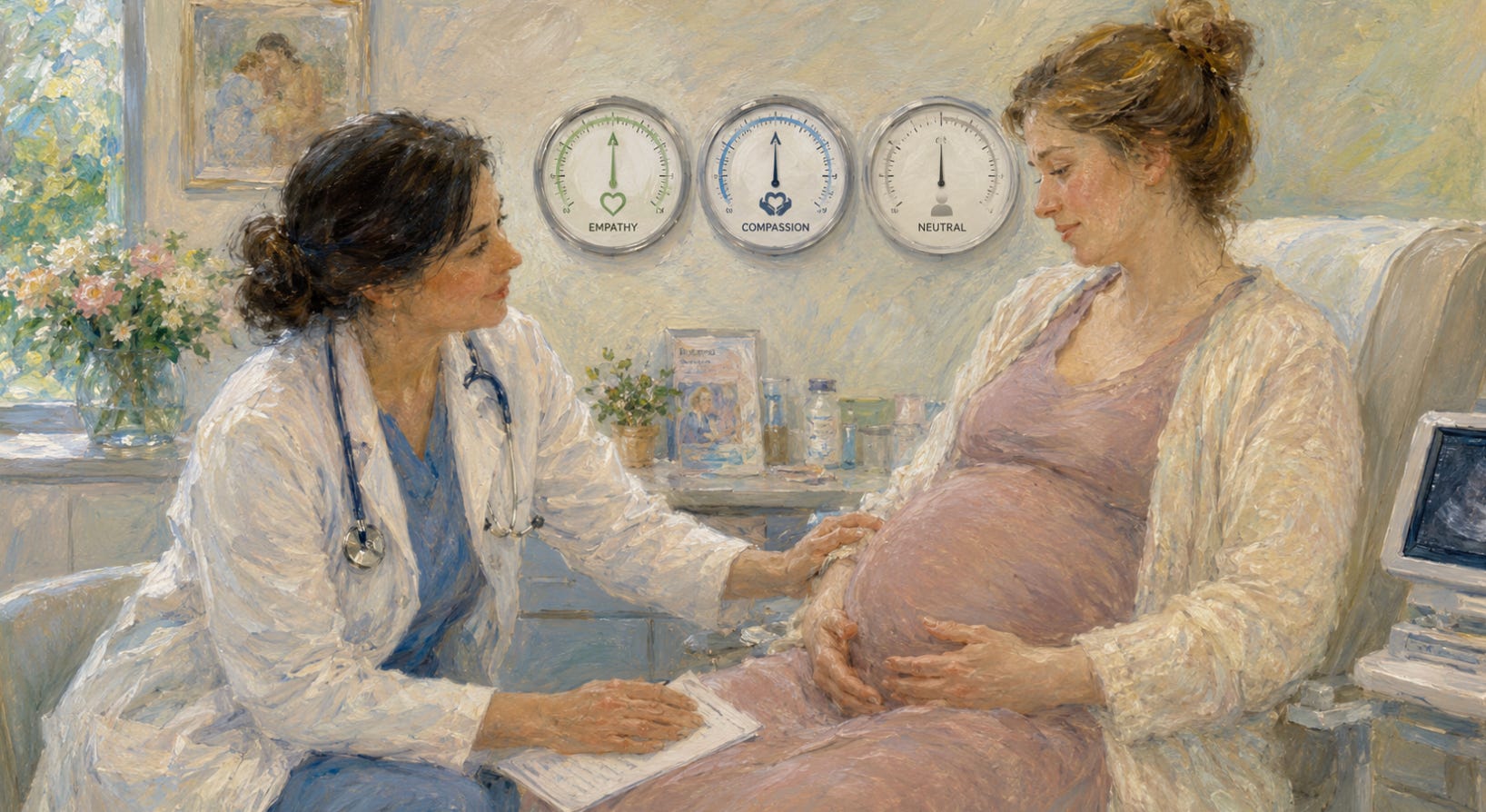
Compassion Is Not a Communication Skill
A patient in active labor at 38 weeks asked her nurse why the fetal heart rate was doing what it was doing. The nurse had three other patients. The answer she gave was accurate, brief, and insufficient. The patient remembered it for years.
That gap is real. It predates AI by decades. A study published in JAMA Internal Medicine made it measurable: patients shown physician responses and AI chatbot responses to medical questions rated the chatbot as more empathic. The finding has been replicated in oncology, in patient portal research, and in fertility care.
Medicine’s reflex has been to treat this as a training problem. If patients prefer AI responses, the argument goes, physicians need better communication skills. Teach them to be warmer. Script the acknowledgments. Train the tone.
That response is wrong, but not because AI has nothing to contribute. AI has a great deal to contribute, and this series takes that seriously. The response is wrong because it misidentifies the problem. The problem is not that physicians are insufficiently empathic. The problem is that we have been measuring empathy when we should have been demanding compassion. Those are not synonyms. Understanding the distinction is what unlocks AI’s real potential in clinical care.
The Distinction That Runs Through Everything
Empathy is the capacity to perceive and resonate with another person’s emotional state. It is cognitive and affective: you recognize what someone is feeling, and you feel some version of it yourself. An LLM trained on millions of human conversations can produce empathic-sounding language with impressive reliability. It has learned the form. That is what the studies are measuring, and it is genuinely useful as far as it goes.
Compassion goes further. It is empathy plus the motivation to act, and the act itself. The word comes from the Latin: to suffer with. A compassionate clinician does not just recognize that her patient is frightened. She is moved by that recognition to do something about it. She explains. She stays an extra two minutes. She calls back. She changes her language because this particular patient, in this particular moment, needs a different kind of communication. Compassion is a moral act, not a communicative one.
You can score high on an empathy scale and be a compassionless clinician. You can sound warm and be entirely absent. Patients know the difference even when they cannot name it. What they remember, sometimes for the rest of their lives, is not whether the tone was right. It is whether someone was actually with them.
What the Study Actually Measured
Bioethicist John Lantos argues that most empathy scales capture communicative empathy: warm tone, verbal acknowledgment, scripted validation. Those things matter. They are also reproducible by a language model. What the scales do not capture is what philosopher and psychiatrist Jodi Halpern calls emotional reasoning: a disciplined, medically-informed attunement to what illness means in a specific patient’s life.
The JAMA study measured patients’ perceptions of written responses to medical questions. That is a useful measurement of one thing. It is not a measurement of what happens when a woman has been laboring for 22 hours and the team is discussing cesarean. It is not a measurement of what happens when a sonographer takes too long at 19 weeks and says the doctor will come in. It is not a measurement of what happens when a 49-year-old woman brings the same symptom list to her third appointment and leaves with a pamphlet.
The AI empathy finding is a signal. What it is signaling is not that AI communicates better than physicians. It is that compassion has eroded so far in clinical training and clinical systems that a language model can outscore a physician on its outward form. That erosion is the problem this series addresses. And AI, understood correctly, is part of how we fix it.
ObGyn Intelligence: Safety analysis, the evidence critique, and the verdict are below -- for subscribers who want the full picture.
Seven Clinical Moments. One Standard.
This series examines seven areas of ObGyn medicine where the compassion deficit is most consequential and where AI has a specific and honest role to play.
Labor and delivery. The laboring patient who needs someone present under pressure, not performing presence. AI can reduce documentation burden and surface communication gaps. It cannot be present.
Gynecologic oncology. The woman who asks her oncologist whether she is going to die. AI can synthesize her chart and ensure follow-up. It cannot accompany her through treatment.
Reproductive endocrinology. The patient with two failed transfers who already knows the statistics. AI can model success probabilities and flag protocol deviations. It cannot have the honest conversation about stopping.
Stillbirth. The moment the sonographer cannot find the heartbeat. AI can ensure consistent bereavement protocols. It cannot be present to a loss that medicine cannot fix.
Miscarriage. The 10-minute confirmation appointment. AI tools are filling the midnight gap. That contribution is real and not enough.
Prenatal diagnosis. The anatomy scan that changes everything. AI can prepare patients and generate plain-language summaries. It cannot close the 72-hour window when a patient is alone with her search results.
Menopause. The perimenopausal woman whose symptom burden has been dismissed at three appointments. AI is filling the gap her clinical encounters left. The answer is a clinical encounter that deserves the time and training to be compassionate.
Each post asks the same two questions: what does compassion actually require here, and what can AI genuinely contribute? The answers are different in each clinical territory. The standard is the same throughout.
What AI Can Do — and This Is Substantial
The most important thing AI can do for compassionate clinical care is structural: reduce the documentation burden that steals time from the room. A clinician who spends 40 percent of her working hours on documentation is a clinician with 40 percent less time to be present to her patients. AI tools that automate that burden do not replace compassion. They create the conditions for it.
Beyond documentation, AI tools that synthesize patient histories, flag communication gaps, generate plain-language explanations of complex findings, prompt follow-up after high-acuity events, and connect patients to peer support between appointments are making clinicians more accurate and more consistent. In REI, AI-assisted embryo grading reduces interobserver variability. In oncology, clinical decision support ensures no patient with ovarian cancer goes without genetic counseling. In menopause care, symptom-tracking apps help women identify when their burden warrants treatment and prepare them to ask for it. These are real clinical improvements.
What Only Humans Can Do
The limit is presence. AI cannot be moved by a patient’s suffering. It cannot make the judgment, in real time, that this patient needs silence before she needs information. It cannot carry the weight of having been wrong. It cannot commit to being there through whatever comes next. Those acts define compassionate care in every one of the seven clinical territories this series examines. They require a human being with the training and the moral disposition to stay.
The chatbot learned what warmth sounds like. That is genuinely useful. It did not learn what compassion is. In ObGyn medicine, across labor and delivery, oncology, fertility, loss, and menopause, the gap between those two things can determine how a patient remembers the most significant physical experiences of her life.
Why Getting This Right Matters Now
The AI empathy finding is entering clinical policy conversations at exactly the moment when health systems are under pressure to reduce costs and increase efficiency. If we do not have a clear account of what AI can and cannot do, the path of least resistance is to delegate more clinical communication to AI tools and call it an improvement. That path leads to a system where AI handles the communication layer, clinicians handle the technical layer, and no one is responsible for the compassionate layer because empathy scores have been accepted as a sufficient proxy for it.
The right architecture uses AI to give clinicians the time and support to be compassionate, while holding the profession to a standard that AI cannot meet on its own. Getting that architecture right determines what happens in the room when there is no heartbeat, when the staging is incomplete, when the transfer has failed again, and when the symptom list comes out of the purse for the third time.
Conclusion
Medicine is measuring empathy. Patients need compassion. The two are not the same, and understanding the difference is what unlocks AI’s genuine potential in clinical care. AI can reduce the burden that prevents compassion, prepare the clinician, prompt the follow-up, and fill the midnight gap. It cannot be present, cannot be moved, and cannot stay. In every clinical territory this series examines, the task is the same: build a system where AI does what it does well and clinicians are finally given the conditions to do what only they can. That is what patients in labor, in oncology, in fertility clinics, after losses, and through menopause deserve. It is what this series argues for.