

American obstetrics keeps adding interventions. The maternal mortality numbers say we should be subtracting some first.
Peter Drucker the business guru never attended a delivery. But he understood institutions better than most people who run them. His warning, issued decades ago, applies to American obstetrics with uncomfortable precision: if you want something new, you have to stop doing something old.
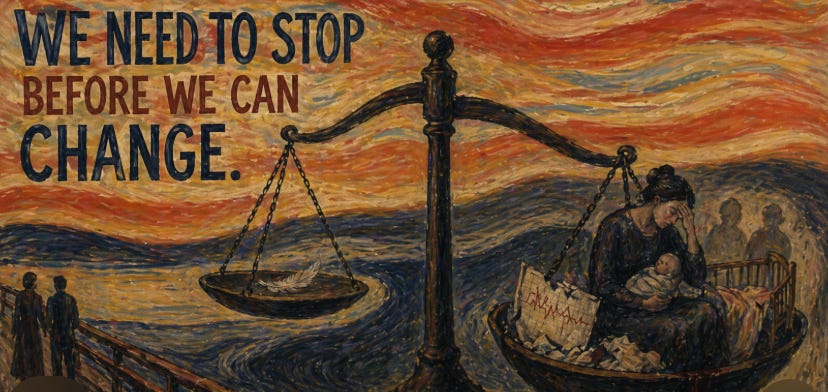
We are not short of new things. New protocols. New screening tools. New committee recommendations. New quality improvement initiatives. What we are short of is the discipline to ask which old things are not working, and the institutional courage to stop them.
The numbers demand that conversation now.
What the Numbers Show
The United States spends more on maternity care than any country in the world. The return on that spending is, by any honest measure, poor.
The U.S. maternal mortality ratio is approximately 23 deaths per 100,000 live births.
The United Kingdom, with its MBRRACE-UK surveillance system and rigorously evidence-anchored NICE guidelines, reports a ratio near 9 per 100,000. (1,2) That is not a rounding error. It is a structural failure.
These are not mortality rates from the same distribution shifted slightly. They represent different systems producing different outcomes. The U.S. figure has not fallen in decades. The UK figure, while still unacceptably high, reflects a national system that reviews every maternal death, publishes its findings transparently, and asks directly: what should we have done differently?
We have reviewed our outcomes too. The difference is what happens next.
What We Keep Adding
The American response to poor maternal outcomes has been, almost without exception, additive.
More screening.
More documentation.
More checklists.
More bundles. More task forces.
More language in guidelines telling clinicians to “consider” and “offer” and “discuss” interventions whose evidence base ranges from solid to speculative.
And now. More Doulas.
ACOG guidelines, across twelve domains scored in my ongoing GAAP analysis, average 1.96 citations per clinical recommendation and achieve evidence-action ratios of 46 percent, meaning fewer than half of their recommendations are fully matched to the evidence they cite. (3) NICE guidelines average 0.99 citations per recommendation and achieve evidence-action ratios of 68 percent. (3) This is not a criticism of individual physicians or guideline authors. It is an observation about a system that has become comfortable with expansion and uncomfortable with subtraction.
We add smoking cessation counseling to prenatal visits without removing the parts of those visits that have never been shown to improve outcomes.
We add implicit bias training without examining which institutional practices produce the disparities we are trying to address.
We add maternal safety bundles without asking whether the baseline care into which those bundles are inserted is itself optimized.
We now add doulas without evidence that they effect outcomes.
Drucker’s insight was not about innovation. It was about capacity. Every organization has finite attention, finite time, and finite resources. When you add without subtracting, you do not improve the old thing or establish the new one. You dilute both.
What the UK Stopped
The MBRRACE-UK programme, which has surveilled UK maternal deaths continuously since 1952, is not primarily a counting exercise. It is a stopping mechanism. Each triennial report identifies care that was suboptimal, names the patterns, and gives clinicians and institutions the data they need to discontinue practices that are not protecting women. (2)
NICE guidelines, by contrast with ACOG’s, are notable for what they do not include. They do not recommend interventions without adequate evidence. They do not use the phrase “reasonable to offer” as a placeholder for clinical uncertainty. When evidence is insufficient, NICE says so and waits. (4)
That restraint is itself a policy decision. It reflects the understanding that recommending something you cannot support with evidence does not empower clinicians. It confuses them. And it adds to the pile of things clinicians are expected to do in a visit that already cannot hold everything it is asked to carry.
What Needs to Stop Here
I am not suggesting we dismantle American obstetrics. (Or maybe it’s not such a bad idea?)
I am suggesting we apply Drucker’s test, seriously and systematically, to what we are currently doing.
Which prenatal screening interventions improve outcomes when broadly applied, and which generate anxiety, follow-up visits, and additional cost without changing what happens to the mother or the baby? Which elements of postpartum care protocols are delivered as ritual rather than as evidence-based intervention? Which guideline recommendations are carried forward from one edition to the next because no one has formally asked whether they should be retired?
The discipline of stopping is harder than the discipline of starting. Starting feels like progress. Stopping feels like defeat, or like admitting that something we did for years did not work. In medicine, that admission is especially uncomfortable because it implies that women who did not benefit from those years of practice were owed something different.
They were. Saying so is not a condemnation of the physicians who followed the guidelines. It is the precondition for building something better.
Adding ‘Racism’ Without a Mechanism Is Not an Explanation
Racial disparities in maternal mortality are real, well-documented, and morally unacceptable. Black women in the United States die from pregnancy-related causes at approximately three times the rate of white women. (5) That disparity demands serious investigation and serious response. It does not demand that we accept every proposed explanation as equivalent, or every proposed remedy as effective.
In recent years, “racism” has been added to the list of maternal mortality causes in a way that functions more as a statement of values than as an operational hypothesis. The claim that racism causes maternal death is not wrong as a broad social observation. The problem is that naming it without specifying the mechanism, the point of clinical intervention, or the measurable outcome produces nothing actionable. It adds a category without subtracting confusion.
The relevant questions are specific ones. Does implicit bias in triage decisions delay recognition of hemorrhage? Do communication failures between patients and clinicians reflect power differentials that can be structurally addressed? Are Black women with hypertensive disorders less likely to receive timely antihypertensive therapy, and if so, at what step in the care pathway does that failure occur? (6) These questions have testable answers. Programs built around them can be evaluated. Programs built around the general premise that racism is the cause cannot be, and when they cannot be evaluated, they cannot be stopped when they fail.
The same Drucker test applies here.
Adding “anti-racism training” to an already overcrowded institutional agenda, without a specified mechanism linking that training to a measurable reduction in maternal deaths among Black women, is addition without evidence. It may make institutions feel they are responding. It does not make them respond.
Doulas Are Not a Mortality Intervention
Doulas provide genuine value within the scope of what they are trained to do. Continuous labor support is associated with shorter labors, lower rates of cesarean delivery, and higher patient satisfaction. (7) Women who want a doula and can access one are better served with one than without one. That is a real finding and it should not be dismissed.
But doulas are not trained to recognize hemorrhage. They are not trained to manage hypertensive emergencies. They cannot interpret a deteriorating fetal heart rate tracing, administer magnesium sulfate, place a uterine balloon, or perform a hysterectomy for placenta accreta. These are not gaps that advocacy can close. They are the direct, proximate causes of maternal death in the United States: hemorrhage, hypertensive disorders, sepsis, thromboembolism, and cardiomyopathy. (8)
Positioning doulas as a maternal mortality intervention is a category error.
It confuses emotional and advocacy support, which doulas provide well, with clinical recognition and clinical response, which only trained clinicians can provide. The conditions that kill women require timely diagnosis and timely treatment. A doula can insist that a nurse check on her patient. She cannot do what happens after the nurse arrives.
The countries with much lower mortality rate have no doulas.
The category error reflects poorly on the policymakers making the argument, not on the doulas themselves. Doulas did not ask to be the answer to a 23-per-100,000 mortality rate. They are being handed that responsibility by legislators and advocates who find it easier to fund a new support role than to fix the clinical system failures that are actually killing women. Expanding Medicaid coverage for doulas is a political achievement. It is not a mortality intervention. Calling it one misrepresents the evidence, misdirects resources, and, when the mortality numbers fail to move, produces the false conclusion that we tried and the problem is intractable.
The problem is not intractable. The interventions that reduce maternal mortality are known: standardized hemorrhage protocols, timely antihypertensive treatment, early warning systems, mandatory case review. These require institutional commitment and clinical accountability. They do not have a constituency as warm and sympathetic as doulas. That is a political fact, not an evidentiary one, and we should not let it determine where the resources go.
My Take
The U.S. maternal mortality rate will not improve through addition alone. We have been adding for decades. The gap between our outcomes and those of comparable countries has not closed. It has, in some analyses, widened.
What we need is an honest inventory: what are we doing, what does the evidence say about each of those things, and what should we stop. That is not a political position. It is a clinical one. Drucker understood it as a management principle. MBRRACE understands it as a surveillance imperative. We should understand it as a professional obligation.
Racial disparities in maternal mortality are a genuine emergency. They deserve interventions proportional to that emergency: specific, mechanistic, measurable, and willing to be evaluated. Naming racism without specifying a clinical pathway is not that. Funding doulas without evidence they reduce mortality is not that. Both can coexist with the harder work of fixing the clinical system failures that are actually killing women, but only if we are honest about what each intervention can and cannot do.
The word “consent” does not appear in a single one of the twelve ACOG guidelines I have scored in this series. That is not a minor omission. It is a signal about whose interests those guidelines are organized around. Stopping the practices that prioritize institutional comfort over patient outcomes is exactly where this inventory should begin.
If you find this analysis useful, consider subscribing to ObGyn Intelligence. Evidence matters. So does acting on it.
References
1. Hoyert DL. Maternal mortality rates in the United States, 2021. NCHS Health E-Stats. 2023. [VERIFY: confirm most recent NCHS data year and rate]
2. Knight M, Bunch K, Patel R, et al. MBRRACE-UK: Saving Lives, Improving Mothers’ Care. National Perinatal Epidemiology Unit, University of Oxford; 2023. [VERIFY: confirm most recent MBRRACE triennial report citation]
3. Grunebaum A. GAAP series: Guideline Accountability and Action-to-Evidence analysis, Posts 1-11. ObGyn Intelligence, obmd.com. 2024-2025.
4. National Institute for Health and Care Excellence. Evidence standards framework for digital health technologies. NICE; 2022. [VERIFY: confirm specific NICE methodology document for guideline restraint]
5. Hoyert DL, Miniño AM. Maternal mortality in the United States: changes in coding, publication, and data release. Natl Vital Stat Rep. 2020;69(2):1-18. [VERIFY: confirm most current race-stratified maternal mortality data citation]
6. Shields LE, Wiesner S, Klein C, Pelletreau B, Hedriana HL. Use of maternal early warning trigger tool reduces maternal morbidity. Am J Obstet Gynecol. 2016;214(4):527.e1-6. [VERIFY: confirm best available citation for race-based disparities in triage/treatment delay]
7. Bohren MA, Hofmeyr GJ, Sakala C, Fukuzawa RK, Cuthbert A. Continuous support for women during childbirth. Cochrane Database Syst Rev. 2017;7:CD003766. [VERIFY: confirm most recent Cochrane update on continuous labor support]
8. CDC Division of Reproductive Health. Pregnancy mortality surveillance system: causes of pregnancy-related deaths. Atlanta: CDC; 2023. [VERIFY: confirm most recent PMSS data on leading causes]