

Across 27 studies and 13,724 women who froze their eggs, about 11 in 100 ever came back for them — and fewer than 3 in 10 of those had a baby. Everything else about egg freezing follows from that one number.
On a Sunday livestream, a member of Congress pointed a fertility injection at her own belly and told her followers not to be weird about it. “don’t be weird about this,” she said.
They were weird about it.
Within two days the conversation had moved from her eggs to her breakup, her politics, and whether she was selling other women a fantasy about having it all.
Her private life is not my business.
What she was told before the needle went in is, and so is what the millions of women watching now believe about egg freezing.
That is not politics.
It is a medical question with numbers attached, and the numbers are not the ones in the advertising.
Begin with what the procedure is.
For ten to twelve days a woman injects hormones so that many eggs mature at once instead of the single egg her body would release on its own.
The eggs are collected under sedation, and the mature ones are flash-frozen in liquid nitrogen and stored.
That is all of it.
An egg is not an embryo, and an embryo is not a baby. About eight in ten eggs survive thawing. Of those, some fertilize. Of those, some become usable embryos. Of those, some implant.
Every step subtracts.
Now the numbers that rarely appear on a clinic homepage.
The largest review to date pooled 27 studies and 13,724 women who froze eggs to delay childbearing, with a median follow-up of seven years. Just under 11 in every 100 came back to thaw them. Of the few who returned, 29 in 100 had a baby. A long-running New York cohort followed women who froze between 2005 and 2009 for ten to fifteen years, long enough for a final answer: 38 in 100 used their eggs and 59 in 100 never did. That is the highest return rate published anywhere, and it is still fewer than four women in ten.
When women do come back, the eggs work better than the pessimists claim.
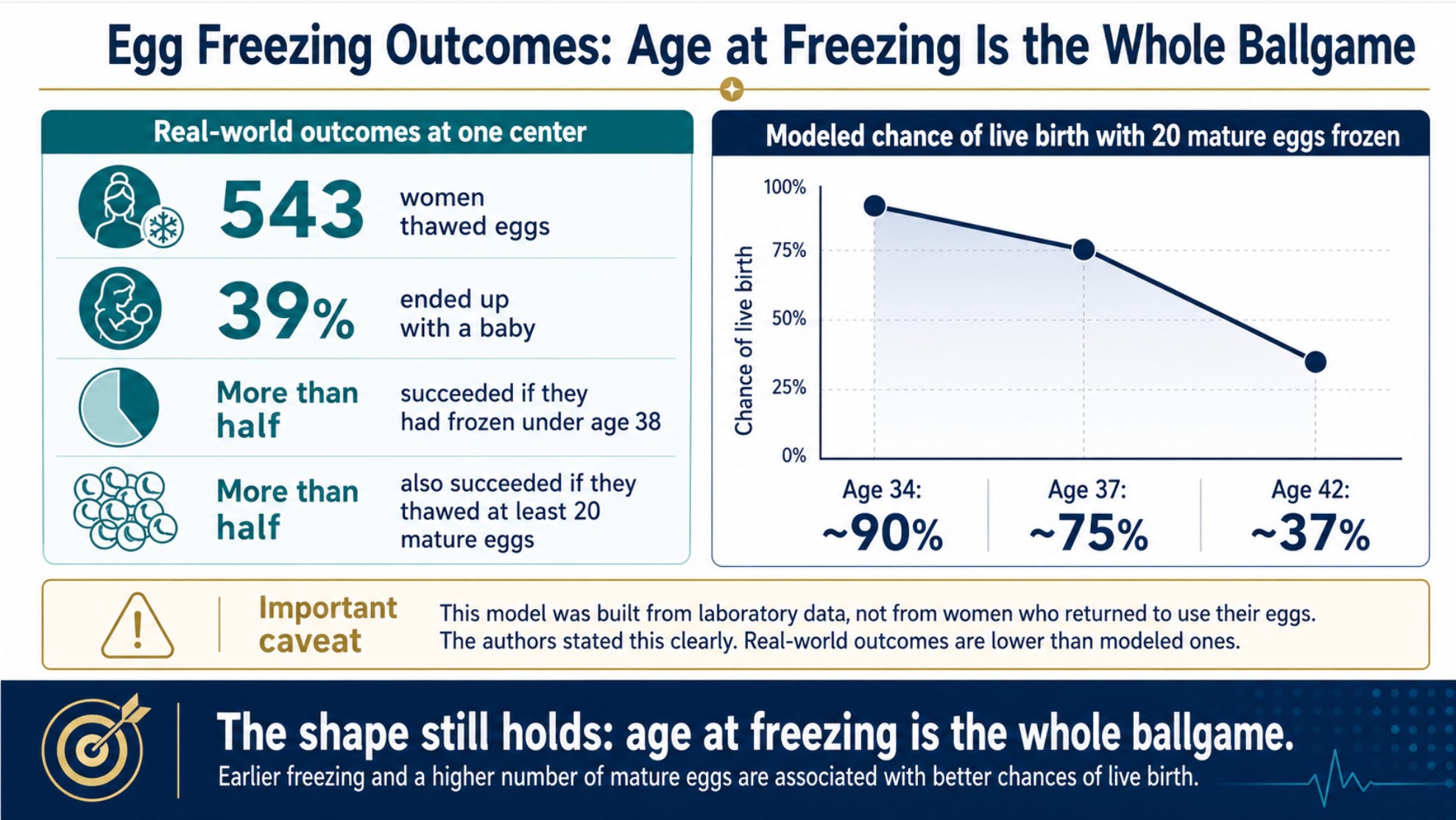
Among 543 women who thawed at that center, 39 in 100 ended up with a baby, and more than half succeeded if they had been under 38 at freezing or thawed at least 20 mature eggs. A widely used counseling model puts 20 mature eggs frozen at 34 at roughly a 90 percent chance of a live birth, about 75 percent at 37, and about 37 percent at 42. That model came from laboratory data rather than from women who returned, as its authors said plainly, and real outcomes run below modeled ones. The shape still holds, and it is the point: age at freezing is the whole ballgame.
The strongest argument against my position deserves a hearing: egg freezing is undersold, not oversold.
In a 2025 survey of 260 women who had frozen eggs, the typical woman guessed her chance of a baby at 50 percent when the model put it at 75. Regret runs opposite to what critics assume — in a study of 173 women, 9 percent regretted freezing and 51 percent regretted not doing it. Those findings are real. But the comparison number is a model, not a birth, and regret was measured six months out, years before anyone learns whether the eggs work. Fear of missing the window is easy to capture early. Disappointment arrives a decade later, quietly, in a different clinic.
Then there is what freezing does not preserve.
Freezing an egg at 35 does not freeze the woman around it. If she returns at 44 she is pregnant at 44, with the higher rates of high blood pressure, diabetes in pregnancy, cesarean delivery and stillbirth that come with pregnancy after 35 and climb steeply after 40.
And there is money, which deserves its own paragraph because clinics almost never put it in one.
The figures below come from clinic and market price lists rather than peer-reviewed cost studies, and they vary by region. Up front, the procedure itself — monitoring, retrieval, freezing — runs about $8,000 to $15,000 for one cycle. The hormone injections are usually billed separately by the pharmacy and add roughly $3,000 to $7,000. All in, one cycle lands near $12,000 to $20,000, and most women need two, so the realistic entry price is about $24,000 to $36,000. Then the meter starts. Storage runs about $500 to $1,000 a year at most clinics, higher in the big cities and lower at off-site cryobanks: call it $40 to $85 every month, roughly a phone bill, for as long as the eggs sit there. Ten years of that is another $5,000 to $10,000. And the thaw itself — warming, fertilization, embryo culture, genetic testing, transfer — is a separate bill years later, closer to a full round of in vitro fertilization than to a retrieval. With an 11 percent return rate, most women pay the entry price and the monthly fee for a decade and use none of it.
This is where the ethics live, and they are not complicated.
The 2024 ethics opinion of the American Society for Reproductive Medicine says planned oocyte cryopreservation is permissible, that patients should be told the benefits are uncertain, and that providers should disclose their own center’s freeze-thaw and live-birth results — or admit they have none.
That is exactly right and almost nowhere honored. Count the clinic pages that open with “peace of mind” and “take control of your future,” then count the ones that open with their own thaw-to-birth rate. The distance between them is the consent failure.
I part company here with the profession’s favorite hiding place, which is choice.
Handing a woman a menu is not counseling her.
Three numbers belong in the first conversation, before any deposit: her chance of a live birth at her age with the number of eggs this center actually retrieves, her chance of never using them at all, and the full cost including the thaw and transfer years later. A clinician who leaves those out has not respected her autonomy. He has handed her a brochure and called it consent.
Behind the small abandonment sits a larger one.
When an employer pays for egg freezing but not for childcare, paid leave, or a career that survives having a child at 30, a structural problem has been relocated into a woman’s ovaries.
That is cheaper for the employer. It is not cheaper for her.
My position is this.
Egg freezing is a real technology with a modest, steeply age-dependent yield, and it is not insurance.
It belongs in a conversation in the early thirties rather than the late thirties, with enough eggs banked to matter, and with the return rate in the first sentence rather than the fifth.
I would tell any woman considering it what I would want told to my own granddaughter: frozen eggs are a chance, not a plan; the chance at 32 is far better than the chance at 38; and the most valuable thing a clinic can give her is not the freezing but the truth about her own numbers, early enough that she still has choices. Whether she freezes her eggs is nobody’s verdict on her ambition. Whether she was told the truth first is a professional obligation, and we are failing it.
If you know someone deciding this right now, send her the return rate before she sends anyone a deposit. ObGyn Intelligence is free because the evidence should travel. A paid subscription keeps it independent.
References
1. Kirubarajan A, Patel P, Thangavelu N, Salim S, Sadeghi Y, Yeretsian T, et al. Return rates and pregnancy outcomes after oocyte preservation for planned fertility delay: a systematic review and meta-analysis. Fertil Steril. 2024;122(5):902-17. doi:10.1016/j.fertnstert.2024.06.025
2. Blakemore JK, Grifo JA, DeVore SM, Hodes-Wertz B, Berkeley AS. Planned oocyte cryopreservation—10-15-year follow-up: return rates and cycle outcomes. Fertil Steril. 2021;115(6):1511-20. doi:10.1016/j.fertnstert.2021.01.011
3. Cascante SD, Blakemore JK, DeVore S, Hodes-Wertz B, Fino ME, Berkeley AS, et al. Fifteen years of autologous oocyte thaw outcomes from a large university-based fertility center. Fertil Steril. 2022;118(1):158-66.
4. Goldman RH, Racowsky C, Farland LV, Munné S, Ribustello L, Fox JH. Predicting the likelihood of live birth for elective oocyte cryopreservation: a counseling tool for physicians and patients. Hum Reprod. 2017;32(4):853-9. doi:10.1093/humrep/dex008
5. Friedman M, Jaffe N, Tairy D, Torem M, Raziel A, Finkelstein M, et al. Do women accurately predict their odds of having a child following planned oocyte cryopreservation? Reprod Fertil. 2025. doi:10.1530/RAF-24-0118
6. Jaswa EG, Pasch LA, McGough A, Wong R, Corley J, Cedars MI, et al. Decision regret among women considering planned oocyte cryopreservation: a prospective cohort study. J Assist Reprod Genet. 2023;40(6):1281-90. doi:10.1007/s10815-023-02789-w
7. Ethics Committee of the American Society for Reproductive Medicine. Planned oocyte cryopreservation to preserve future reproductive potential: an Ethics Committee opinion. Fertil Steril. 2024;121(4):604-12. doi:10.1016/j.fertnstert.2023.12.030
8. American College of Obstetricians and Gynecologists. Pregnancy at age 35 years or older. Obstetric Care Consensus No. 11. Obstet Gynecol. 2022;140(2):348-66. doi:10.1097/AOG.0000000000004873
9. Karni A. With big choices ahead, Ocasio-Cortez navigates new territory. The New York Times. 2026 Aug 12.
Note on costs: the price ranges in the text come from clinic and market price lists, not from peer-reviewed cost analyses, and vary widely by region.
Well said! Truth! Those running to the freezer need the facts!