

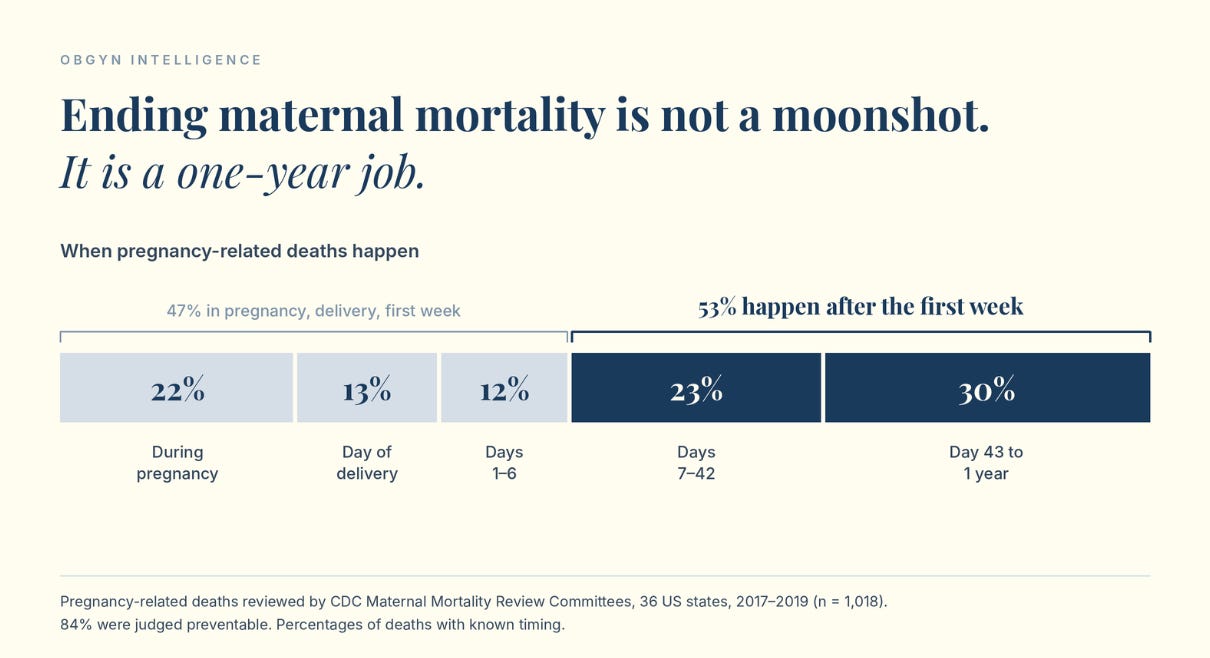
More than half of US pregnancy-related deaths happen after the first week postpartum, and 3 in 10 after day 42. Labor support ends with labor. A plan to halve maternal mortality has to start where women actually die.
Ending Maternal Mortality Is Not a Moonshot. It Is a One-Year Job.
This week, The Preprint published an essay with a title I agree with: “Ending maternal mortality isn’t a moonshot.” Its author, an obstetrician, now leads Healthy Moms, Healthy Babies America, a new campaign to cut US maternal mortality in half in five years.
The campaign has an initial $100 million commitment from the Walton family and has started in Arkansas and Kentucky.
The essay’s core claim is right.
We do not need a breakthrough drug to stop most of these deaths.
We already have tools for hemorrhage, preeclampsia, depression and addiction.
What we lack, the author writes, is a system that reliably brings those tools to the women who need them.
I agree.
But “we already know what works” is the sentence where plans go soft. It is easy to hear it as more midwives and more doulas. Both are good for women. Neither will cut maternal deaths in half. To see why, look at when and how women die.
When women die
A pregnancy-related death is a death caused by pregnancy or its care, during pregnancy or up to one year after it ends. CDC maternal mortality review committees studied 1,018 of these deaths in 36 states from 2017 to 2019. About 22% happened during pregnancy, 13% on the day of delivery and 12% in the first week after birth. Then 23% happened between one and six weeks after birth, and 30% between six weeks and one year. The committees judged 84% of the deaths preventable.
Read that again. The day of delivery accounts for about one death in eight. The time after the first week accounts for one in two.
What kills them
The leading cause was mental health conditions, including suicide and overdose linked to substance use: 23% of deaths. Heart conditions and cardiomyopathy, a weakening of the heart muscle, together caused 21%. Hemorrhage caused 14%. High blood pressure disorders of pregnancy, including preeclampsia, caused 7%.
Hospital tools work for the problems they target. In California, hospitals that joined a statewide hemorrhage program saw a clear drop in severe complications from hemorrhage, while comparison hospitals saw almost no change. That was an observational study, and it counted complications, not deaths. Still, hemorrhage and hypertensive disorders together explain about one death in five. The best delivery room in the country cannot reach a woman who overdoses four months after birth, or who develops heart failure at home in month five.
Doulas and midwives
The best evidence for doulas is a 2017 Cochrane review that pooled more than two dozen randomized trials and more than 15,000 women. Continuous support in labor increased spontaneous vaginal births, reduced cesarean deliveries and improved how women rated their birth experience. These are real benefits. But maternal death was not an outcome the review measured, and labor support ends with labor.
Midwives can bring prenatal and birth care to counties that have none. That is access, and access matters. But I know of no US study showing that adding midwives lowers maternal death. The woman at risk in month four needs a psychiatrist, an addiction specialist, a cardiologist, and someone who notices when she misses an appointment.
The test case is Arkansas
The campaign chose Arkansas as its home. Arkansas is now the only state that has not extended postpartum Medicaid from 60 days to 12 months. Advocates citing state data report that 44% of women on postpartum Medicaid lost coverage in the last quarter of 2025. Put that beside the CDC numbers: 30% of pregnancy-related deaths happen after day 42. In Arkansas, many women lose their insurance just as that window opens.
Coverage alone is not enough. A Medicaid card does not produce a doctor. But without the card, there is no doctor to produce.
Count the right deaths
There is one more trap. The national maternal mortality rate, 17.9 deaths per 100,000 live births in 2024 (649 women), comes from death certificates. It counts deaths only through 42 days after pregnancy and does not capture suicide and overdose. A campaign that halves that number could declare victory while the leading cause of pregnancy-related death goes uncounted. The scorecard should be review committee data through one full year.
Conclusion
The essay is right: this is not a moonshot. I welcome $100 million and a five-year deadline. But money is measured by the deaths it prevents, and the data show where those deaths are. Most happen after the birth, at home, from causes no labor support can touch.
Halving maternal mortality needs much more than midwives and doulas.
It needs 12 months of postpartum coverage in every state, starting with Arkansas.
It needs one named clinician responsible for each woman for the full year.
It needs mental health and addiction care built into postpartum care, and heart follow-up for women at risk.
And it needs a scorecard that counts deaths to day 365.
In the professional responsibility model, the obstetrician’s obligation follows the woman’s risk, not the billing calendar. Today the year after birth belongs to nobody. Someone should own it.
A moonshot needs a rocket. This needs a calendar that runs to 365.
References
1. Shah N. Ending maternal mortality isn’t a moonshot. The Preprint [Internet]. 2026 Oct 13 [cited 2026 Oct 14]. Available from: https://thepreprint.substack.com/p/ending-maternal-mortality-isnt-a
2. Centers for Disease Control and Prevention. Pregnancy-related deaths: data from maternal mortality review committees in 36 US states, 2017–2019 [Internet]. Atlanta (GA): CDC; 2022 [updated 2024 May 28; cited 2026 Oct 14]. Available from: https://archive.cdc.gov/www_cdc_gov/maternal-mortality/php/data-research/mmrc-2017-2019.html
3. Main EK, Cape V, Abreo A, Vasher J, Woods A, Carpenter A, et al. Reduction of severe maternal morbidity from hemorrhage using a state perinatal quality collaborative. Am J Obstet Gynecol. 2017;216(3):298.e1-298.e11. doi:10.1016/j.ajog.2017.01.017
4. Bohren MA, Hofmeyr GJ, Sakala C, Fukuzawa RK, Cuthbert A. Continuous support for women during childbirth. Cochrane Database Syst Rev. 2017;7(7):CD003766. doi:10.1002/14651858.CD003766.pub6
5. Talk Business & Politics. AACF calls for Medicaid extension in Arkansas for postpartum insurance [Internet]. 2026 Feb [cited 2026 Oct 14]. Available from: https://talkbusiness.net/2026/02/aacf-calls-for-medicaid-extension-in-arkansas-for-postpartum-insurance/
6. National Center for Health Statistics. Maternal mortality rates in the United States, 2024. NCHS Health E-Stats No. 113 [Internet]. Hyattsville (MD): NCHS; 2026 Mar [cited 2026 Oct 14]. Available from: https://www.cdc.gov/nchs/data/hestat/hestat113.htm
7. Policy Center for Maternal Mental Health. New maternal mortality death certificate data show no significant change in death rates [Internet]. 2026 [cited 2026 Oct 14]. Available from: https://policycentermmh.org/new-maternal-mortality-death-certificate-data-show-no-significant-change-in-death-rates/