

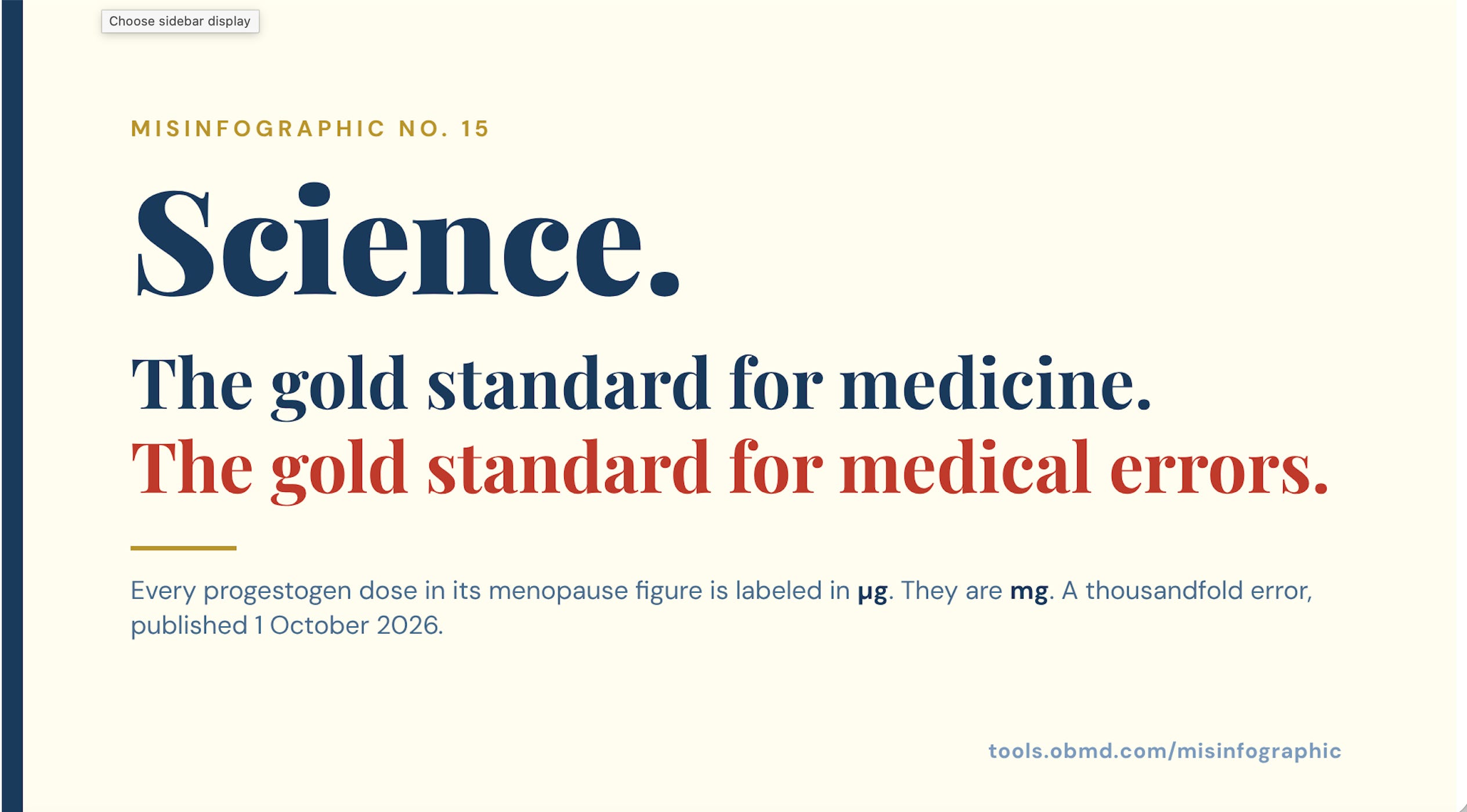
This week, Science published a review on menopause and hormone therapy.
Its second figure lists progestogen doses in micrograms. The numbers are milligrams. Every dose on that line is shown a thousand times smaller than what women actually take.
The same article spells “glomerular filtration rate” as “golmerular filteration rate.” It lists a cytokine, “IL-2C,” that does not exist. It draws hormone therapy as the line that keeps the brain from declining, a benefit the randomized trials looked for and did not find.
The article was distributed by Eric Topol, MD on Linkedin.
This is Science.
The article had authors, editors, reviewers and an illustrator.
Not one of them caught a thousandfold dosing error.
I did not go looking for it. It found me, the way these things do now, shared from one feed to the next.
Or even better, my personal AI prompt found it. With my help.
For the past week I have been collecting MisInfoGraphics: medical graphics that look authoritative and are not.
There are fifteen so far, with 159 errors, each one marked, explained and checked against the published record. Some came from anonymous accounts. Some came from AI image tools.
Two came from peer-reviewed journals, including this one.
The lesson is not that AI makes mistakes. It does. We all do. Several graphics in the collection were plainly machine-made.
The lesson is that our quality control was built for a slower world, and it no longer works.
Peer review is a good idea run on volunteer time. A reviewer reads a manuscript at night, after clinic, unpaid. She checks whether the question matters and whether the methods are sound. She does not check whether every unit in every figure matches the text. Nobody pays her to. Nobody has the hours.
An AI system has the hours. It does not get tired on the tenth manuscript of the week. It does not care whose name is on the paper. Given the right instructions, it will read every number, every unit, every label and every citation, and tell you which ones do not agree.
That last part matters most: the right instructions. Ask an AI “Is this paper good?” and you will get a polite book report. Ask it the right questions and you get an audit.
Here is the core of the prompt I use:
“You are auditing this manuscript for errors before publication. Check that every number in the abstract matches the tables, figures and text. Check every unit of measure against the doses and values the cited sources report. Check that every citation says what the sentence citing it claims. Check every figure label and term for spelling and for things that do not exist. Check that each conclusion is supported by the data in this paper, not by the hopes of its authors. List every error you find, quote the exact text, and say how certain you are.”
That prompt would have caught the Science units error. It would have caught the misspelled kidney label. It would have flagged a cytokine no database lists. It would have asked which trial produced the line that says hormone therapy protects cognition.
The objection I hear most is that AI can be wrong too. Yes. That is why the AI is not the final judge. It is the second reader every manuscript currently lacks. It produces a list. The authors and editors check the list. The humans still decide. They just decide with their eyes open.
The second objection is cost.
In Cologne, where I grew up, there are three levels of nonsense: Kokolores, Quatsch met Soß, and, when it really counts, Driss.
A Science figure that labels every progestogen dose in micrograms when the numbers are milligrams is a thousandfold dosing error that sailed through peer review, so it goes straight to the top level: Driss.
A careful AI audit of a manuscript takes minutes and costs little. Correcting a dosing error after it has traveled around the world costs much more, and the people who pay are not the journal’s staff.
The third objection is pride. Journals do not like being told that a machine reads more carefully than their reviewers. On the narrow task of checking every number and every unit, it does. That is not an insult to reviewers. It frees them to do the part only they can do: judge whether the science matters.
Conclusion
I suggest that every manuscript must undergo an AI audit with a structured prompt before it is accepted.
Not as an option.
Not as a pilot.
As a condition of publication, the same way we require a conflict-of-interest statement and an ethics approval.
Authors should run it before they submit. Journals should run it again before they publish, and keep the report with the file. When an error slips through anyway, the record will show whether anyone looked.
We already ask patients to trust what we publish. The least we can do is check it with every tool we have.
If you want to see what slips through, the full MisInfoGraphics collection is at tools.obmd.com/misinfographic. Subscribe to ObGyn Intelligence for the next one; there will be a next one.
References
1. Gravelsins LL, Perović M, Wood Alexander M, Splinter TFL, McGovern AJ, Rabin JS, et al. Reframing menopause and menopause hormone therapy as opportunities for healthy aging. Science. 2026;394(6819):60-8. doi:10.1126/science.aeg5004.
2. Grünebaum A. MisInfoGraphic No. 15: Micrograms or milligrams [Internet]. ObGyn Intelligence; 2026 Oct 1 [cited 2026 Oct 1]. Available from: https://tools.obmd.com/misinfographic/science-menopause-mht/
3. Grünebaum A. MisInfoGraphics: AI infographics, checked [Internet]. ObGyn Intelligence; 2026 [cited 2026 Oct 1]. Available from: https://tools.obmd.com/misinfographic/