

It is easy to warn people not to tell an artificial intelligence system too much about themselves.
Do not enter your medical history.
Do not describe your symptoms.
Do not disclose your medications, pregnancy, mental health, or sexual history.
Do not trust a chatbot with information that should remain between you and your doctor.
That advice sounds responsible.
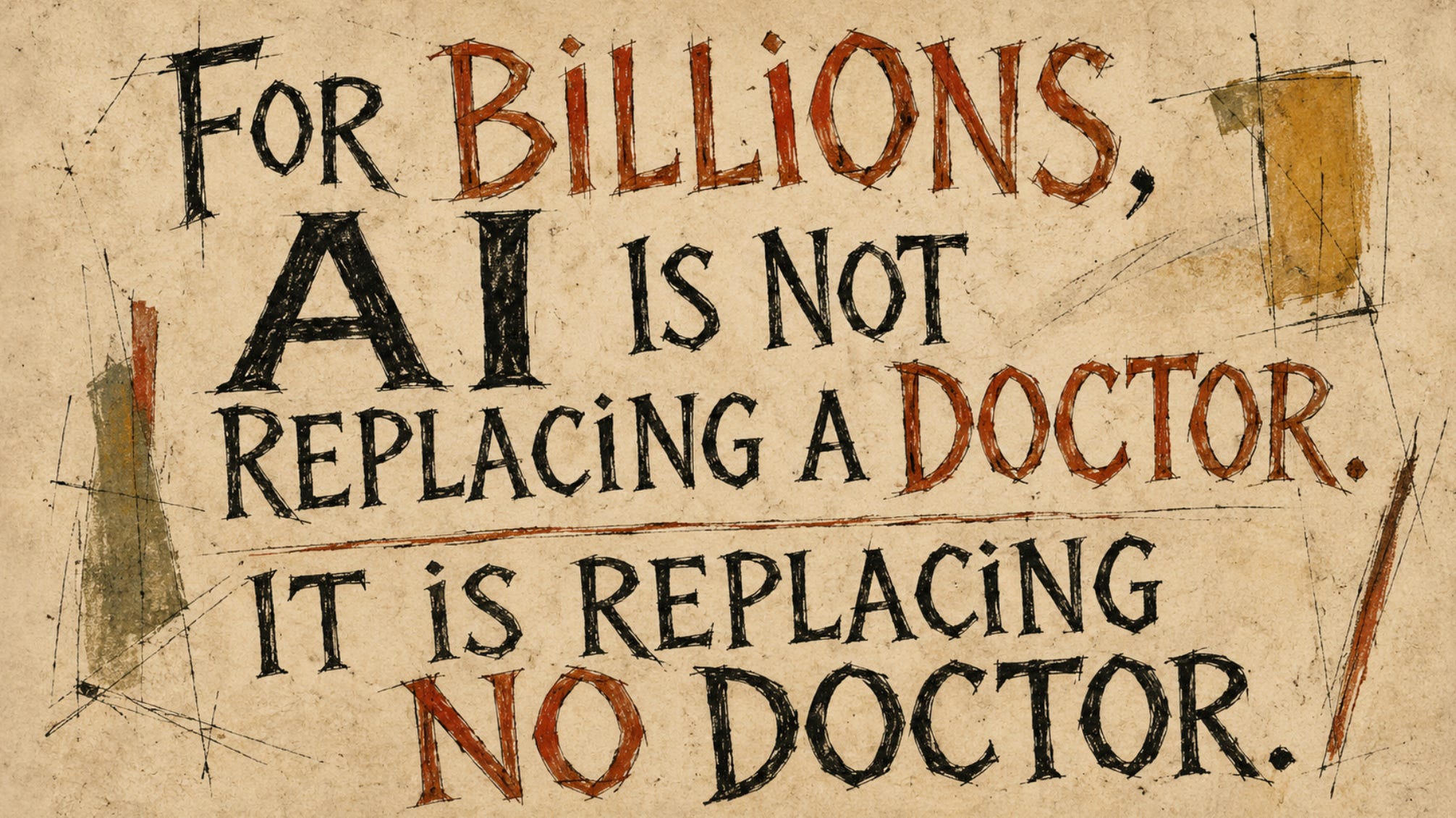
It also assumes that you have a doctor.
For much of the world, that assumption is false.
In 2023, approximately 4.6 billion people were not fully covered by essential health services. In 2022, 2.1 billion experienced financial hardship because of health-care costs. The World Health Organization now projects a global shortage of approximately 11 million health workers by 2030, concentrated mainly in low- and lower-middle-income countries. These figures do not mean that every one of those people has literally never encountered a physician. They mean that dependable, timely, affordable access to needed care remains unavailable to more than half of humanity.
For these people, the relevant comparison is often not:
AI versus a trusted personal physician.
It is:
AI versus no appointment.
AI versus no transportation.
AI versus a clinic that is closed.
AI versus a consultation the patient cannot afford.
AI versus nobody who speaks the patient’s language.
AI versus searching alone at two o’clock in the morning.
Before we accuse people of “oversharing” with AI, we should ask a more uncomfortable question:
Who else were they supposed to ask?
What People Are Actually Asking AI
A 2026 study analyzed 617,827 health-related conversations with Microsoft Copilot from users around the world.
Approximately two in five conversations involved general health information and education. Nearly one in five involved personal symptoms or discussion of a specific medical condition. Additional conversations concerned emotional well-being, health insurance, medical paperwork, and navigating health-care systems.
Personal health questions increased during the evening and nighttime, precisely when conventional services were least available. Questions concerning emotional well-being increased especially sharply at night. Many people were also asking on behalf of children, partners, parents, or other people for whom they were providing care.
The accompanying Nature commentary reached the obvious conclusion: people are using conversational AI to fill gaps in access to health information and health-care systems.
This is not merely a story about technological enthusiasm.
It is a map of unmet need.
The Privacy Debate Is Being Conducted From a Position of Privilege
A person with insurance, a primary physician, specialist access, an after-hours telephone service, reliable transportation, and a nearby emergency department can reasonably decide that the privacy risks of a chatbot are unnecessary.
That person has alternatives.
A woman in a remote community who has developed bleeding during pregnancy may not.
A patient who cannot afford another consultation may not.
A caregiver trying to understand an elderly parent’s new medication at midnight may not.
A person with a stigmatized condition who fears judgment or legal consequences may not.
A patient who waited six months for an appointment and was given seven minutes with a clinician may technically have “access,” but may still have no meaningful opportunity to ask questions.
Privacy matters. Confidentiality matters. Data security matters.
But privacy cannot be discussed as though it were the only ethical value.
People also have interests in obtaining information, understanding symptoms, recognizing danger, navigating a fragmented system, and making decisions before professional help becomes available. When these interests conflict, the answer cannot simply be to tell people with no realistic alternative to remain uninformed.
That is not protection.
It is abandonment expressed in the language of safety.
