

Two new papers in Obstetrics & Gynecology argue that policy and structure drive maternal outcomes.
They are right about that.
They also blur the line between coverage, access, and quality, and they cannot decide whether race is a social construct or an analytic category.
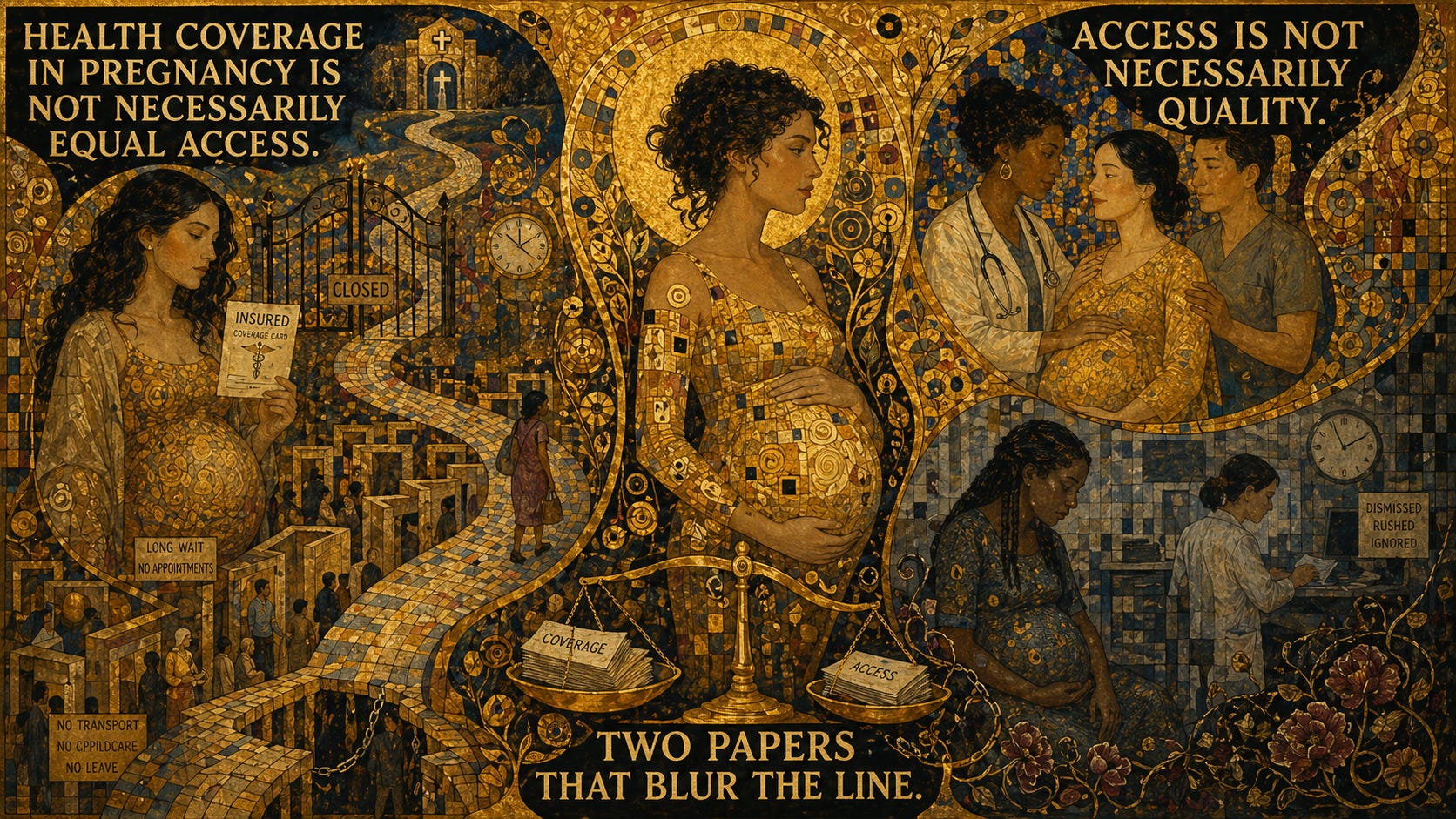
Two papers landed in the same issue of Obstetrics & Gynecology, both arguing that policy and structure drive severe maternal morbidity.
One is a Medicaid claims analysis of nearly seven million deliveries (1). The other is a clinical perspective on inequalities in high-income countries (2).
Read together, they are presented as a coherent case for expanding insurance, addressing structural racism, and reorganizing health systems around equity. Read carefully, they reveal a set of unresolved contradictions that the authors do not name and most readers will not catch.
The underlying question is serious.
American women are dying at rates that the rest of the high-income world does not tolerate, and the burden falls hardest on the women with the least power to push back. I support universal coverage. I support structural action on the social determinants of health. The criticism that follows is not aimed at those goals. It is aimed at the looseness with which these two papers conflate coverage, access, and quality, and the way the inequalities paper builds an argument on racial categories it has just told us are not real.
The Race Problem the Authors Create and Then Ignore
Vousden and colleagues open with a definition. Race is “a group of people connected by common descent or origin.” Ethnicity is “membership of a group, ultimately of common descent or having common national or cultural tradition.” Inequalities, they write, are “neither natural nor biologically determined.” Race, in other words, is a social category without biological grounding.
And then for the rest of the paper, they categorize, count, stratify, and report by race. Go figure.
Black women in the UK have a 2.3 times higher risk of maternal death than White women. Black women in the US have three to four times the risk. Black African and Bangladeshi women in the UK have the highest rates of severe maternal morbidity.
These numbers appear throughout the paper as if the categories doing the counting are stable, meaningful, and comparable across the Atlantic. They are not.
“Black” in the United States is not the same population as “Black” in the United Kingdom, which is not the same population as “Black African” in France.
“Hispanic” in a US dataset includes women whose ancestors arrived 400 years ago and women who arrived last week, from twenty different countries with very different health profiles.
The paper itself acknowledges this when it points out that migrant women from sub-Saharan Africa, the Caribbean, and parts of Asia carry higher risk than other migrants.
That is the right observation. It also undermines the racial categories the rest of the paper depends on.
The authors cannot have it both ways.
Either race is a coherent enough category to drive a paper full of disparity statistics, or it is so socially constructed and context-dependent that the disparity statistics need a different framing. The honest position is the second one. The paper does not take it.
This matters at the bedside. When a woman walks into Labor and Delivery, what we want to know is her actual risk profile, which includes obesity, hypertension, prior pregnancy outcomes, access to prenatal care, language barriers, housing stability, and trust in the health system. Race is a crude proxy for some of these and an irrelevant proxy for others. Treating it as a unified risk factor produces both undertreatment when a White woman with the same social vulnerabilities is missed, and overgeneralization when a Black woman with abundant resources is treated as high-risk on category alone.
What the Medicaid Paper Actually Shows
Guernsey and colleagues report that in 30 states that expanded Medicaid under the Affordable Care Act, women who delivered at least 21 months after expansion had lower odds of severe maternal morbidity than women who delivered before expansion (odds ratio 0.79, 95 percent CI 0.68 to 0.90 with transfusion, 0.76, 0.65 to 0.88 without) (1). The absolute risk reduction was 0.5 percent with transfusion and 0.3 percent without. The number needed to treat was 196 to prevent one case of severe morbidity including transfusion, and 311 without.
That is a real signal in a very large dataset. It is also a smaller and more specific signal than the framing suggests.
First, the 9-month lag did not produce a statistically significant effect in the changepoint model. Only the 21-month lag did. The authors interpret this as evidence that pre-pregnancy and inter-pregnancy care matter. That interpretation is reasonable. It is also the only interpretation that supports their hypothesis. A different reading is that whatever Medicaid expansion is doing, it is doing it through care before conception, not through prenatal or intrapartum care, which is the period most directly relevant to severe maternal morbidity.
Second, an earlier study by Chatterji and colleagues, using Healthcare Cost and Utilization Project data combined with birth certificates, found no effect of Medicaid expansion on severe maternal morbidity at all. The current paper handles this disagreement by pointing out that birth certificates underreport morbidity and do not reliably identify Medicaid coverage. Both points are valid. They also do not resolve the fact that two large analyses of overlapping populations reached opposite conclusions, which should make any reader cautious before declaring a settled finding.
Third, the paper excluded Maryland because the data were anomalous. That is defensible. It also illustrates how fragile state-level Medicaid claims data can be.
None of this argues against expanding coverage. It argues against treating a 0.3 to 0.5 percent absolute risk reduction in one analysis, contradicted by another, as evidence that the structural debate is settled.
The rest of this post is for paid subscribers.
