

I asked AI what blood tests a pregnant woman needs at her first visit, then asked the exact same question again with one instruction added, the CEPrompt™. The second answer stopped sounding confident and started sounding careful.
Ask any AI chatbot a medical question and you get an answer in seconds. It sounds calm, organized, and sure of itself. That last part is the problem. Confidence is not the same as reliability, and a chatbot has no way to tell you which of its sentences it would stake its life on and which it is simply guessing.
So let me show you something simple. I asked a medical AI one ordinary clinical question — the kind a pregnant woman or a first-year resident might ask. Then I asked it the same question a second time, word for word, with a single instruction added to the end. Same model. Same minute. Two very different answers.
Here is the first one.
Prompt: “Tell me what blood tests a pregnant woman should do at her first prenatal visit.”
Here is the answer:
“At her first prenatal visit, a pregnant woman should have her blood type and Rh factor checked, along with an antibody screen and a complete blood count to look for anemia. She should be tested for rubella immunity, hepatitis B, hepatitis C, HIV, and syphilis, and screened for chlamydia and gonorrhea. Her thyroid should be checked with a TSH test, and she should be offered genetic carrier screening and screening for Down syndrome. A urine test is also part of the standard first visit.”
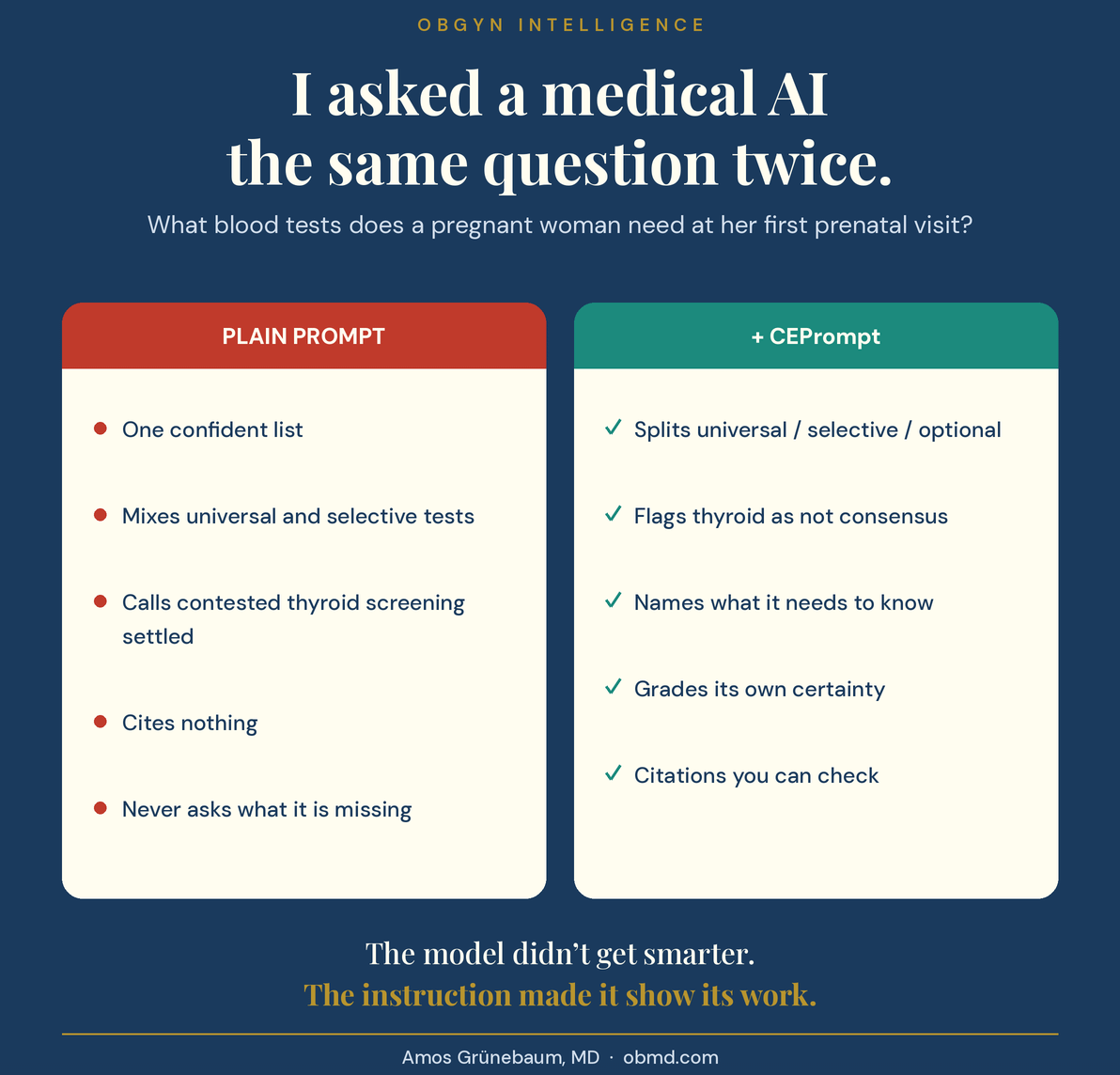
Not wrong, exactly. A reasonable list. But notice what it does not do. It never separates the tests every pregnant woman gets from the ones that depend on her age, weight, or history. It presents a thyroid test as routine — when the main US guideline actually recommends thyroid testing only for women with specific risk factors. It cites nothing. And it never once tells you what it would need to know about the patient to answer well. It just talks.
Now the same question, with one instruction added to the end.
That instruction is the Clinical Evidence Prompt or the CEPrompt™.
PROMPT: “(Tell me what blood tests a pregnant woman should do at her first prenatal visit [PLUS THE INSTRUCTION, the CEPrompt™.”
Here is the full answer it produced — nothing trimmed.
“This is the US/ACOG framework at a routine first visit, assuming no results already documented this pregnancy.
Universal — standard of care for all (high certainty): blood type, Rh(D) and antibody screen; CBC; rubella IgG; hepatitis B (HBsAg minimum, triple panel if not previously documented); hepatitis C (every pregnancy); HIV (opt-out); syphilis (repeat in third trimester and at delivery). Urinalysis and urine culture are also routine but not blood-based.
Selective — depends on the individual patient (moderate certainty): chlamydia/gonorrhea (universal if under 25, otherwise risk-based); varicella IgG if no immunity history; hemoglobinopathy evaluation guided by CBC/MCV and ancestry; early diabetes screening if overweight/obese with risk factors or prior GDM; lead and TB testing if at risk.
Offered, not assigned: genetic carrier screening and aneuploidy screening (cell-free DNA or serum) — both offered to all regardless of age.
Evidence vs. position: The universal panel reflects guideline consensus. Thyroid (TSH) is the exception — ACOG (PB 223) recommends selective, risk-based testing, not universal. Presenting routine TSH as standard is an inference, not consensus; universal offering is a defensible minority position, not the guideline.
Missing information that changes the selective list: maternal age, BMI, ancestry, prior obstetric/GDM history, immunization and prior-testing records, STI risk, gestational age at presentation.
Certainty: high for the universal panel; patient-dependent for selective tests; the thyroid point is genuinely contested.
Citations: Viral Hepatitis in Pregnancy. Clinical Practice Guideline No. 6. ACOG. Obstet Gynecol 2023;142:745–59. SMFM Consult Series #69: Hepatitis B in pregnancy. Am J Obstet Gynecol 2024;230:B2–B11. Owens DK, et al. USPSTF hepatitis C screening. JAMA 2020;323:970–5. doi:10.1001/jama.2020.1123.”
Read that again, because every line of it is doing a job the first answer skipped. It splits the tests into three groups instead of one: the ones every pregnant woman gets, the ones that depend on her age, weight, ancestry, or history, and the ones that are offered for her to accept or decline. It draws a clear line between guideline consensus and the author’s own position — and it catches the thyroid trap, telling you plainly that routine TSH for everyone is not what the main US guideline recommends, even though the first answer presented it as routine. It tells you what it would need to know about the actual patient before the selective list can be finalized. It labels how certain it is, group by group. And it ends with real citations you can open and check, not a vague wave at “the guidelines.”
That is the difference between a list and a consultation. The first answer hands you tests. The second one reasons with you — it shows what is settled, what depends on the patient, what is contested, what is missing, and where it got each claim. A clinician can act on the second answer. A patient can ask better questions because of it. Nobody should act on the first.
Same machine. The model did not get smarter between the two answers. The second answer is better because the prompt told it to show its work — to separate what the evidence supports from what it is assuming, to say how sure it is, to name what it is missing, and to admit when something is genuinely debated.
That instruction is the whole trick.
That instruction is the Clinical Evidence Prompt or the CEPrompt™.
It is one sentence.
You paste it at the end of any clinical question, and it changes the kind of answer you get back. Not the topic. The honesty.
The exact wording of the CEPrompt™ — the sentence that turns the first answer into the second — is below, with the six things it does and how to attach it to any question you ask. Paid subscribers read on.
