

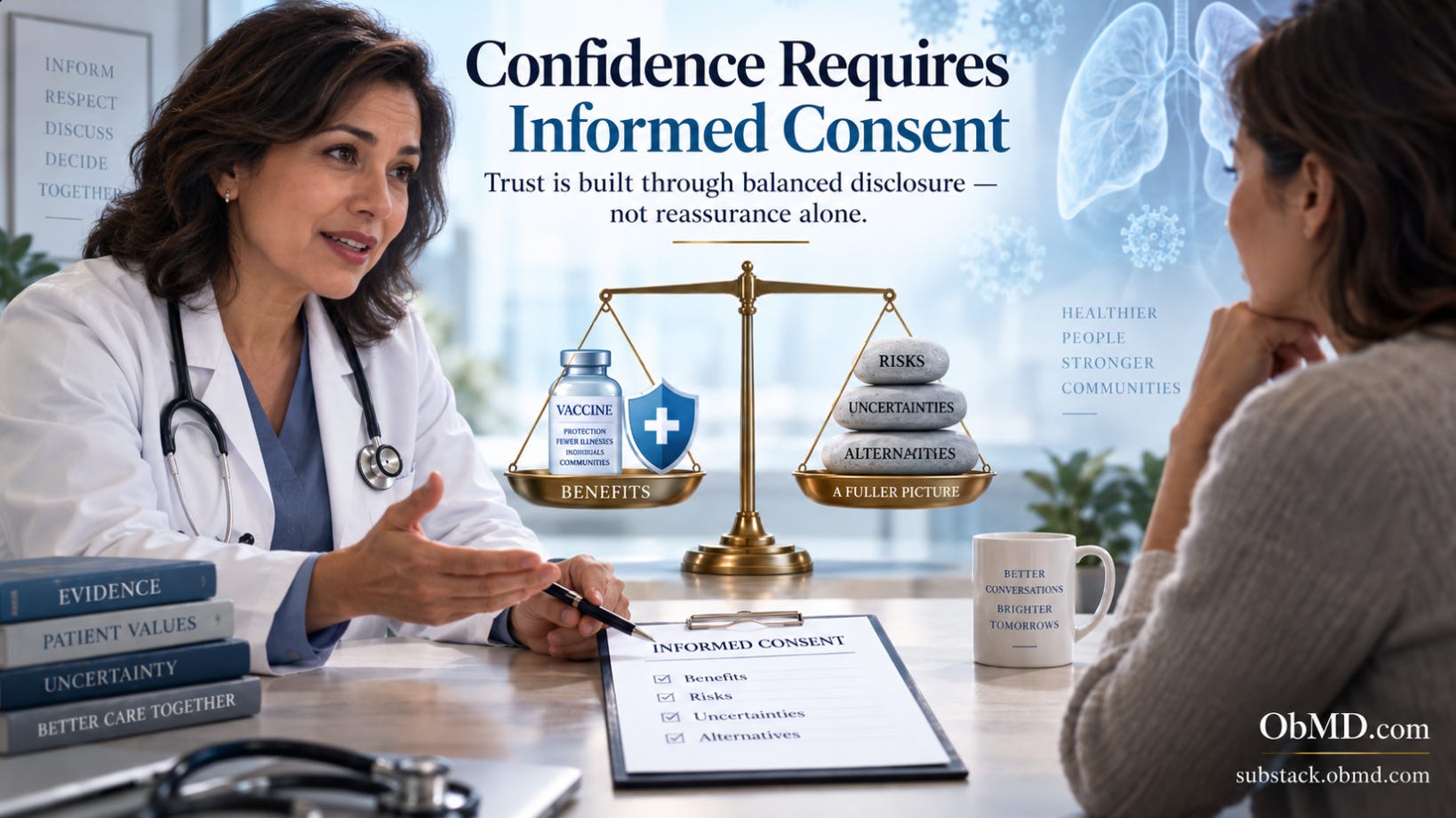
In their recent JAMA Perspective, Fryhofer and colleagues describe the AMA–Vaccine Integrity Project collaboration as an effort to provide rigorous, transparent, evidence-based guidance for the 2026–2027 respiratory virus season and to help restore public confidence in vaccination.
That goal is important.
But confidence cannot be restored by emphasizing benefits while giving only limited attention to harms, uncertainties, alternatives, and the information patients need for meaningful informed consent. Trust is built through balanced disclosure, not reassurance alone.
In that respect, this Perspective falls well short of the standard it seeks to promote.
Reference: Fryhofer SA, Garcia AM, Osterholm MT, Walensky RP. Respiratory season virus vaccines: restoring confidence and trust. JAMA. Published online September 2, 2026. doi:10.1001/jama.2026.18338.
There appear to be several major methodological and clinical-communication problems, especially if this Perspective is meant to support clinician counseling and “informed decision-making.”
Most importantly, it does not provide anything approaching an informed-consent presentation of benefits, harms, alternatives, and uncertainties.
Major errors / deficiencies
It repeatedly converts a heterogeneous evidence base into a much stronger global conclusion than the underlying reviews justify.
The Perspective states that vaccination “remains the most effective intervention” for reducing severe disease, hospitalization, and death from COVID-19, influenza, and RSV. That is an exceptionally broad comparative claim across pathogens, ages, pregnancy, risk groups, vaccine products, and outcomes. The cited reviews did not perform a comparative analysis establishing vaccination as “the most effective intervention” across all these settings.The summary largely hides the remarkably high risk of bias in the underlying evidence.
The Perspective describes a “structured and transparent methodology” and says studies were assessed for methodological quality. But it does not tell readers that, for example, in the COVID-19 review, 50 of 84 comparator observational studies were rated critical risk of bias and another 20 serious risk, while many RCT-derived analyses were also high or critical risk. JAMA Network For RSV, 19 of 33 comparator observational studies were critical risk and 9 serious risk, while all 16 single-group studies were critical risk. JAMA Network This is not a minor omission. It materially changes how confidently the summarized effectiveness and safety estimates should be interpreted.The Perspective calls the evidence review “comprehensive,” although the underlying 2026 reviews explicitly say they are not comprehensive.
The article describes a “comprehensive review of evidence” and emphasizes rigorous evaluation. Yet the influenza systematic review explicitly states that its results “are not comprehensive of all published data for any given season or vaccine product due to the narrow search window.” JAMA Network These were principally update reviews of newly published evidence from August 2025 through June 2026, not de novo systematic assessments of the entire evidence base.The description that protocols were posted “prior to initiation” appears misleading.
The Perspective says that the process included “posting of the PROSPERO protocols prior to initiation,” while the literature search covers August 1, 2025 The RSV protocol, for example, was registered on April 14, 2026, many months into the period being reviewed. JAMA Network “Prospectively registered” may be technically defensible if screening/extraction had not begun, but “prior to initiation” requires documentation of what precisely had not yet been initiated. As written, the Perspective implies a stronger form of prospective protocol registration than is demonstrated.Safety language is substantially stronger than the evidentiary limitations warrant.
The article states that safety findings were consistent with prior assessments and that serious adverse events were “rare and far outweighed by vaccine benefits.” But the cited updated reviews were not formal quantitative benefit-harm analyses capable of establishing that proposition for every vaccine, age group, risk category, pregnancy status, and alternative intervention. Moreover, many safety studies had critical risk of bias or lacked adequate power for rare events. The influenza review itself explicitly acknowledges lack of adequate power to detect rare events as a limitation. JAMA Network“No new safety signals” is presented in a way easily confused with evidence of absence.
For COVID-19, the Perspective says no new safety signals were reported. For RSV it calls safety “reassuring overall.” Those statements need the corresponding epistemic limitation: failure to detect a signal in the included studies is not equivalent to demonstrating absence of clinically important rare harms, particularly when many included safety datasets have substantial bias or limited power.The RSV section conflates “vaccines” with immunization more broadly.
The methodological description says the three reviews focused on US-licensed “vaccines” for COVID-19, influenza, and RSV. But the RSV review explicitly includes nirsevimab and clesrovimab, monoclonal antibodies rather than vaccines. JAMA Network The Perspective later acknowledges nirsevimab, making the terminology internally inconsistent. For counseling parents, this distinction matters because the interventions, recipients, timing, adverse effects, and decision pathways are different.It reports effectiveness ranges without sufficient absolute-risk context.
Examples include COVID hospitalization VE of 19.5% to 55%, influenza hospitalization/mortality reductions, maternal RSV effectiveness of 51% to 70%, and nirsevimab effectiveness of 63.6% to 93%. These are relative effects. The Perspective gives essentially no baseline risks, absolute risk reductions, numbers needed to vaccinate/immunize, or population-specific expected benefits. That is a major deficiency if the stated purpose is informed decision-making.It inadequately communicates uncertainty and heterogeneity.
The underlying studies span different seasons, products, variants/strains, populations, study designs, comparators, follow-up intervals, and geographic settings. Yet the concluding synthesis compresses this into the generalized assertion that the evidence “continues to support both their safety and efficacy in the populations for which they are currently recommended.” That conclusion substantially obscures differences in strength and certainty of evidence among specific products and populations.The article’s stated goal of restoring “confidence and trust” risks contaminating its evidentiary framing.
The project describes itself as responding to misleading vaccine information and supporting coordinated vaccine policy and communication. The collaboration also seeks unified recommendations and messaging that will “rebuild confidence in vaccines.” Those are legitimate public-health objectives, but they are not identical to neutral evidence appraisal. When an evidence review is explicitly connected to a predetermined communications objective, methodological transparency requires particular care not to suppress uncertainty or unfavorable evidence.
Absence of Informed Consent
The article repeatedly invokes “informed decision-making”, yet it does not provide the information required for a genuinely informed choice. It emphasizes vaccine effectiveness and repeatedly reassures readers about safety, but it does not present a structured, balanced discussion of material benefits, known risks, uncertainties, alternatives, and the option of declining vaccination.
This is particularly problematic because the article itself acknowledges that patients want information that includes “both the benefits and potential risks” of vaccinations. Yet the risk discussion is largely reduced to statements such as “no new safety signals,” “serious adverse events remaining rare,” and “reassuring” safety findings. These formulations do not substitute for disclosure of specific adverse effects, their frequency where known, limitations of safety detection, or uncertainty regarding rare harms.
For informed consent, patients should be given information relevant to their own circumstances, including absolute as well as relative benefit, material adverse effects, important uncertainties, reasonable alternatives, and the consequences of accepting or declining the intervention.
In RSV prevention, for example, this should include the distinction between maternal vaccination and infant monoclonal-antibody prophylaxis when both are clinically relevant options.
The article does not provide such a framework.
Thus, although the Perspective promotes “informed decision-making,” it primarily presents a rationale for immunization rather than the balanced benefit-risk-alternative disclosure required for meaningful informed consent.