

The mother reportedly developed measles late in pregnancy after other children in the family became infected. She became severely ill and went into labor approximately one month early. The newborn was not breathing at birth and could not be resuscitated. Testing after death detected measles virus.
The immediate cause of death, however, was determined to be hemorrhage from a lacerated spleen. Measles was listed on the death certificate as another significant condition. Whether measles caused or contributed to the splenic injury has not been established.
So we should not simply say, “This baby died from measles.”
But something extraordinarily important was demonstrated:
A pregnant woman developed measles, and her baby apparently became infected before birth.
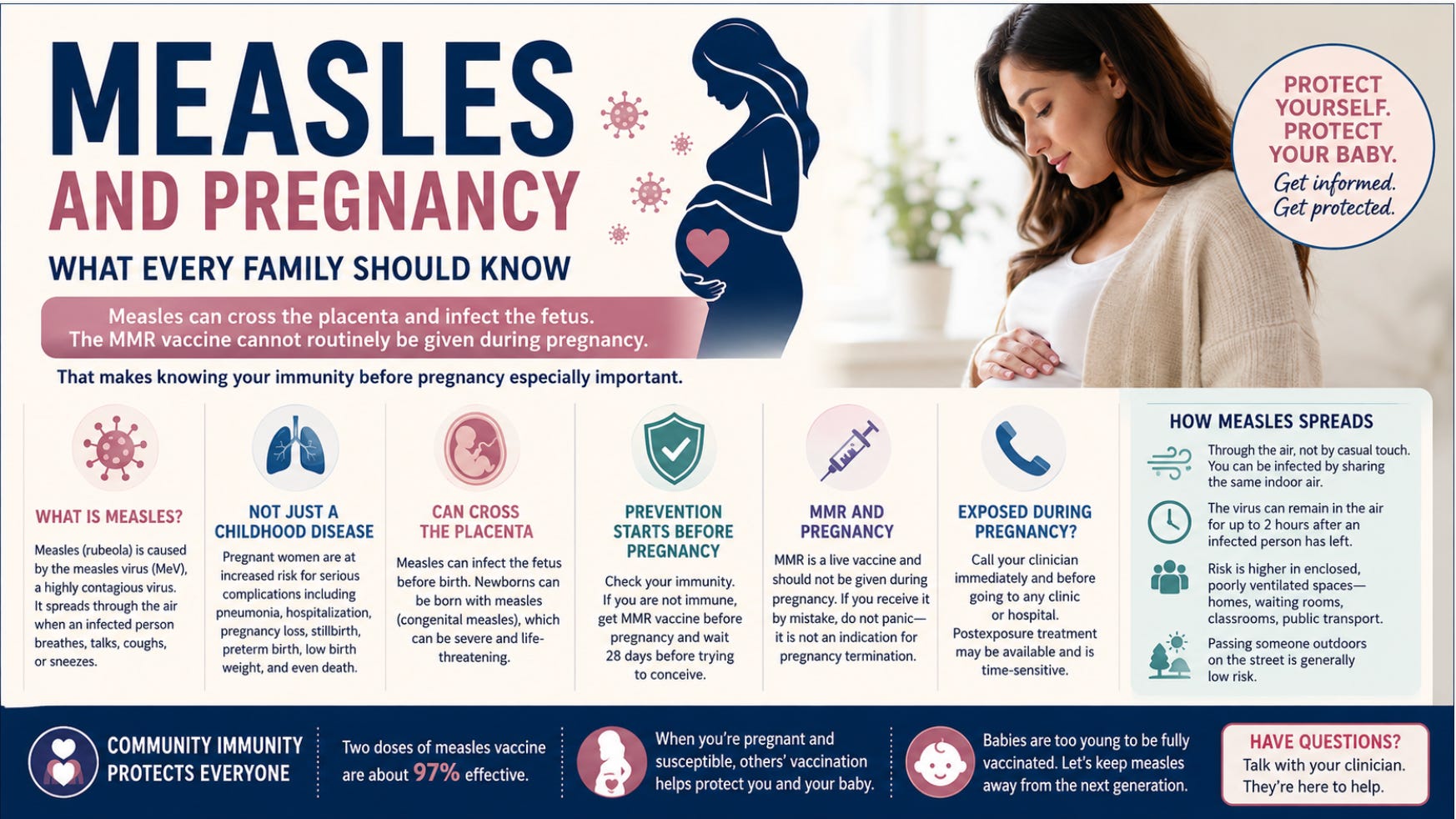
Measles can cross the placenta.
And that is something not only obstetricians, but everyone who is pregnant, considering pregnancy, or caring for pregnant women should understand.
Measles is not just a childhood disease
Measles, also known as rubeola, is caused by the measles virus (MeV), a highly contagious RNA virus in the genus Morbillivirus. It is one of the most contagious human infections.
Measles (Rubeloa) is not rubella. The similar names, rubeola and rubella, can cause confusion, but they are caused by different viruses and have different effects in pregnancy.
Rubella, sometimes called German measles, is caused by the rubella virus and can cause congenital rubella syndrome, including characteristic fetal malformations.
Measles (rubeola) is caused by measles virus and is not associated with a comparable congenital-malformation syndrome, although maternal infection can cause serious maternal and pregnancy complications and can be transmitted to the fetus.
Among susceptible people exposed in close-contact settings, approximately 9 of 10 may become infected. Measles virus spreads through the air in respiratory particles and can remain infectious in an enclosed space for up to approximately two hours after an infected person has left.
Pregnant women who get infected with measles are among those at increased risk for serious complications. Maternal measles has been associated with pneumonia, hospitalization, pregnancy loss, stillbirth, low birth weight, and preterm delivery. Maternal deaths have also been reported.
The quality of the pregnancy evidence deserves some caution. Measles has fortunately become uncommon in highly vaccinated populations, so much of our evidence comes from older observational studies, outbreaks, and case reports rather than modern prospective trials.
A 2020 systematic review identified 29 studies describing 420 pregnancies complicated by measles. Pneumonia was reported in 17.9% and prematurity in 13.4%. These numbers should not be presented to an individual pregnant woman as her contemporary absolute risk because the cases spanned more than 70 years and very different health-care environments.
The conclusion is nevertheless clear:
Measles during pregnancy is not benign.
Can measles infect the fetus?
Yes.
The CDC specifically recognizes that measles can be transmitted from a pregnant woman to her fetus.
When infection occurs before birth, the newborn may develop congenital measles. Traditionally, this has been recognized when a characteristic febrile rash illness develops during the first 10 days of life.
Congenital measles can be severe. Reported complications include pneumonia, encephalitis, and death.
There is another important concern. Infants infected with measles very early in life may have an increased risk of developing subacute sclerosing panencephalitis, or SSPE, a rare but devastating progressive neurologic disease that can appear years after the original infection.
The Pennsylvania case therefore illustrates an important biological fact even though the precise contribution of measles to the newborn’s death remains uncertain:
Maternal infection can become fetal infection.
Does measles cause birth defects?
Here we need to distinguish measles (Rubeola) from rubella.
They are not the same disease.
Rubella infection, particularly early in pregnancy, can cause congenital rubella syndrome, with abnormalities including congenital heart disease, hearing impairment, and eye disease.
Measles has not been shown to produce an analogous, reproducible congenital-malformation syndrome.
The major documented pregnancy concerns are maternal illness, pregnancy loss, stillbirth, impaired fetal growth, premature delivery, and fetal or neonatal infection.
That distinction matters because “MMR” combines vaccines against three different viruses: measles, mumps, and rubella.
If measles is dangerous, why can’t a pregnant woman simply get the MMR vaccine?
Because MMR is a live attenuated vaccine.
It contains weakened forms of the viruses capable of stimulating immunity without producing the diseases caused by their wild-type counterparts.
Because of a theoretical risk from live vaccine viruses during pregnancy, MMR should not be administered during pregnancy.
CDC and ACOG recommend avoiding pregnancy for 28 days after MMR vaccination.
But this creates one of the most misunderstood facts about vaccination and pregnancy:
“Contraindicated during pregnancy” does not mean that MMR has been demonstrated to cause fetal abnormalities.
The recommendation is precautionary.
Indeed, when MMR or rubella-containing vaccines have inadvertently been administered during pregnancy, congenital rubella syndrome attributable to the vaccine has not been demonstrated in the accumulated surveillance experience.
Therefore, inadvertent MMR vaccination during pregnancy is not an indication for pregnancy termination.
Wild-type infection and vaccination are not biologically or clinically equivalent.
This is why immunity should be addressed BEFORE pregnancy
This may be the most useful message in this entire discussion.
Know whether you are protected against measles before becoming pregnant.
For most people, documentation of appropriate MMR vaccination provides presumptive evidence of immunity. Laboratory evidence of immunity or laboratory-confirmed previous disease can also establish immunity.
If a nonpregnant person lacks evidence of immunity, MMR vaccination can be given before pregnancy.
Then wait at least 28 days before becoming pregnant.
Once pregnancy has begun, that opportunity changes because MMR vaccination must generally wait until after delivery.
What if you are already pregnant and discover you are not immune?
Do not panic.
Do not get MMR during pregnancy.
Avoid exposure to people who may have measles or another unexplained febrile rash illness.
Measles is transmitted primarily through the air, not by ordinary skin contact. An infected person releases virus-containing respiratory particles when breathing, talking, coughing, or sneezing.
You can become infected by sharing the same indoor air, even without touching or speaking directly to that person.
Measles virus can remain infectious in the air of an enclosed space for up to approximately two hours after the infected person has left.
Transmission from contaminated surfaces is possible but is not considered the principal route.
Casually passing someone outdoors on the street is generally much lower risk because respiratory particles are rapidly diluted in outdoor air. Risk is substantially greater with prolonged or close contact and in enclosed, poorly ventilated spaces, such as a home, waiting room, classroom, public transportation, or other indoor gathering.
CAUTION: A person with measles can transmit the virus from approximately four days before through four days after the rash appears, so someone may be contagious before anyone realizes that the illness is measles.
If you are pregnant and lack evidence of measles immunity (you should REALLY know your immunity status) , do not knowingly enter a room or home occupied by someone with suspected or confirmed measles.
During an outbreak, pay attention to public-health exposure notices. If you learn that you were in the same indoor location as a person with measles during the infectious period, contact your obstetric clinician or public-health department immediately and before going to a medical facility. Do not wait to develop fever or a rash. Postexposure immune globulin may be indicated and is time-sensitive.
After delivery, MMR can be given, including while breastfeeding. Ideally, vaccination should occur before leaving the hospital so the opportunity is not lost.
What if a pregnant woman is exposed to measles?
This is time-sensitive.
Do not wait for the rash.
Contact your obstetric clinician or other health-care professional immediately and tell them about the exposure before arriving at an office, emergency department, or labor unit.
That last point protects other patients because measles is airborne and extraordinarily contagious.
A pregnant patient exposed to measles who lacks evidence of immunity should not receive MMR as postexposure prophylaxis.
ACOG currently recommends intravenous immunoglobulin, 400 mg/kg, within six days of exposure for susceptible pregnant patients.
Local or state public-health authorities should also be involved in suspected cases and significant exposures.
What about the baby?
A newborn whose mother develops measles around the time of delivery may have been exposed before birth, after birth, or both.
That newborn requires prompt pediatric and infectious-disease assessment.
ACOG recommends IV immunoglobulin postexposure prophylaxis for infants born to women with suspected or confirmed measles.
And an important misconception should be avoided: maternal measles does not automatically prohibit breast milk. ACOG states that there is no contraindication to breastfeeding solely because the mother has measles, although careful infection-control measures are necessary to prevent respiratory transmission.
One more important misconception: vitamin A
Vitamin A has received considerable attention during recent measles outbreaks.
Vitamin A is not a substitute for vaccination.
It does not prevent someone from acquiring measles.
Vitamin A may be used under medical supervision as supportive treatment in children with measles, particularly when deficiency is possible. But high doses of preformed vitamin A can themselves be harmful during pregnancy.
Pregnant women should therefore not begin high-dose vitamin A supplementation because they have been exposed to measles unless specifically directed by an appropriate clinician.
The lesson extends beyond pregnancy
There is a larger reason everyone should understand this.
A newborn cannot choose to be vaccinated against measles.
A fetus obviously cannot be vaccinated.
And a susceptible woman who is already pregnant cannot simply receive MMR after exposure because the vaccine is contraindicated during pregnancy.
Their protection therefore depends partly on something that happens before pregnancy and partly on the immunity of the people around them.
Two doses of measles-containing vaccine are approximately 97% effective against measles.
That makes measles vaccination more than an individual decision when pregnancy and newborns are involved. High population immunity reduces the probability that measles reaches people who cannot yet receive the vaccine or cannot receive it at that particular time.
The five things worth remembering
1. Measles during pregnancy can be serious for both mother and pregnancy.
2. Measles can cross the placenta and infect the fetus. Congenital measles is real.
3. MMR prevents measles but should not be administered during pregnancy.
4. If you are planning pregnancy, this is the time to make sure your measles immunity is adequate.
5. If you are pregnant and exposed to measles, call your clinician immediately. Do not wait for symptoms. Effective postexposure intervention is time-sensitive.
The Pennsylvania newborn’s death is still being investigated, and we should resist claiming more about causation than the evidence establishes.
But we do not need uncertainty about the cause of that baby’s death to understand the larger lesson.
For decades, widespread vaccination made congenital measles something most obstetricians, pediatricians, and parents would never encounter.
As measles returns, some lessons that medicine had almost been able to forget have become important again.
Measles does not necessarily stop at the placenta. Prevention should begin before pregnancy.
Selected references
Congera P, Maraolo AE, Parente S, et al. Measles in pregnant women: a systematic review of clinical outcomes and a meta-analysis of antibodies seroprevalence. J Infect. 2020;80(2):152-160.
Ogbuanu IU, Zeko S, Chu SY, et al. Maternal, fetal, and neonatal outcomes associated with measles during pregnancy: Namibia, 2009-2010. Clin Infect Dis. 2014;58(8):1086-1092.
Atmar RL, Englund JA, Hammill H. Complications of measles during pregnancy. Clin Infect Dis. 1992;14(1):217-226.
American College of Obstetricians and Gynecologists. Measles, Mumps, Rubella (MMR) Vaccination and Management of Obstetric-Gynecologic Patients During a Measles Outbreak. Practice Advisory. Updated May 2025.
Centers for Disease Control and Prevention. Clinical Overview of Measles. Updated 2026.