

Every Thursday afternoon, an email arrives in my inbox. It comes from MedPage Today, a news site written for doctors and nurses. Its label promises “Must-Read Original Stories.”
On September 17, the subject line read: “Video: Nurse Attacked; Doc’s High-Speed Arrest; Fake Ob/Gyn Pleads Guilty.”
I have read MedPage for years.
Lately it felt different.
More arrests.
More killings.
More doctors in handcuffs.
But a feeling is not data. So I counted.
What I measured
MedPage sends a newsletter called “Exclusives & Features” twice a week. The Thursday edition is a roundup of three legal stories. I went through every Thursday edition still in my inbox, from 2023 to this week. That came to 54 issues and 150 headline items. I sorted each item into one of five groups: a clinician accused or convicted of a crime, violence against a clinician, a malpractice suit or other civil case, a licensing action, and everything else.
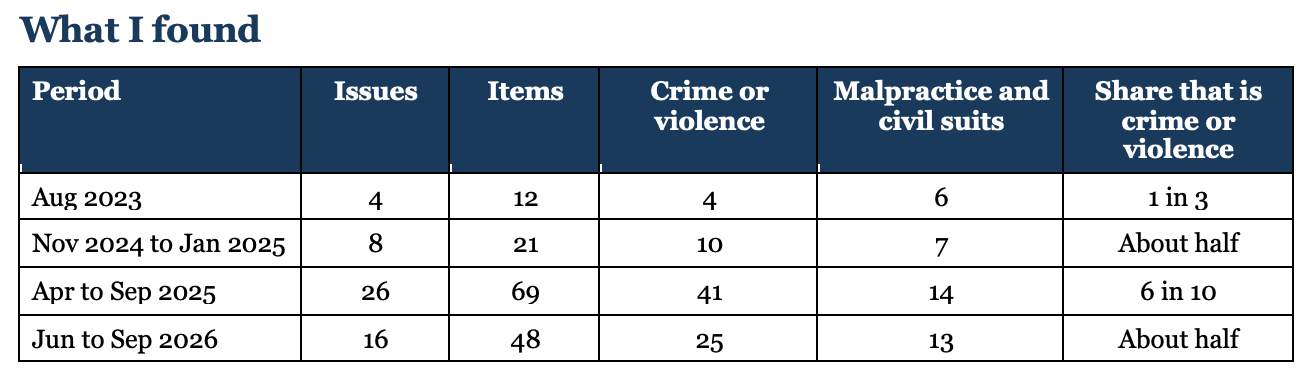
In August 2023, crime and violence made up 1 in 3 items. Half were malpractice suits and verdicts. By 2025, crime and violence had risen to 6 in 10. This year they sit at about half. Malpractice news, the part a practicing clinician can actually learn from, fell to about 1 in 4.
Two more things stood out. About half of the criminal items describe an accusation, an arrest or an investigation, not a conviction.
Some headlines end in a question mark, such as “Doc Hit Dementia Patient?” A question mark is not a verdict. It reads like one.
The Monday edition changed too.
From April to September 2025, none of its 23 lead stories was a medical oddity. Most were policy reporting.
From June to September 2026, 13 of 17 were oddities, with headlines like “Eyeball Tattoo Goes Sideways.”
One finding cuts the other way, and it belongs here. MedPage’s Weekly Review, the editors’ pick of the week’s best stories, featured these crime roundups a handful of times in 2024 and 2025. In 38 issues this year, it featured none. MedPage is not pushing crime onto its front page.
My data have limits. This is my inbox, not MedPage’s full archive, and some months are missing. The 2023 sample is small. I read headlines, not the articles, and I coded them alone. The direction is clear. The exact percentages are not precise.
The best case for the column
Accountability journalism matters. Impostors who pose as doctors, clinicians who harm patients, licensing boards that fail to act: the profession needs to know. Violence against nurses is a real workplace danger. Silence protects the wrong people.
I agree with every word.
That is exactly why this column fails.
Why it fails
A professional news service has a different job than a tabloid. Coverage of a colleague’s wrongdoing earns its place when it teaches. How did the impostor get hired? Why did the board miss the warning signs? What did the hospital change after the attack? A three-item list of arrests teaches none of that. “Doc Accused of Luggage Theft” does not make anyone a better doctor.
Journalists have their own code of ethics. It tells reporters to “avoid pandering to lurid curiosity, even if others do.” It asks them to weigh a suspect’s right to a fair trial and to think hard before naming someone who has not been charged. It asks them to update stories as facts change (1). Charges get dropped. Cases get dismissed. My sample includes both. A one-line accusation stays online long after the case ends.
In our work, beneficence means seeking the greatest good for the person who trusts us. A news service for clinicians owes its readers the same thing: stories that make them better at their jobs. Spectacle does the opposite. It spends clinicians’ limited attention on the worst colleague in the country, not on the lesson that might protect their own patients.
Conclusion
MedPage’s flagship original-reporting newsletter has drifted from accountability journalism toward spectacle.
It names clinicians before adjudication, emphasizes lurid detail, and offers no systemic lesson.
I do not know why the mix changed, and I will not guess. I do know what a professional news service owes its readers. Report a crime when it exposes a system failure, and explain the failure. Wait for charges before naming anyone. Follow up when charges are dropped. And give Thursday back to the malpractice verdicts that actually teach.
Check your own inbox this Thursday and count the arrests. Then share this with a colleague who still calls it must-read.
If careful counting is what you want from medical news, subscribe to ObGyn Intelligence.
References
1. Society of Professional Journalists. SPJ Code of Ethics [Internet]. Society of Professional Journalists; 2014 [cited 2026 Sep 25]. Available from: https://www.spj.org/spj-code-of-ethics/
Data source: author’s analysis of MedPage Today newsletter emails received August 2023 to September 2026 (Thursday “Exclusives & Features” roundups, Monday editions, and Weekly Review issues). Headline items coded by a single reviewer.