

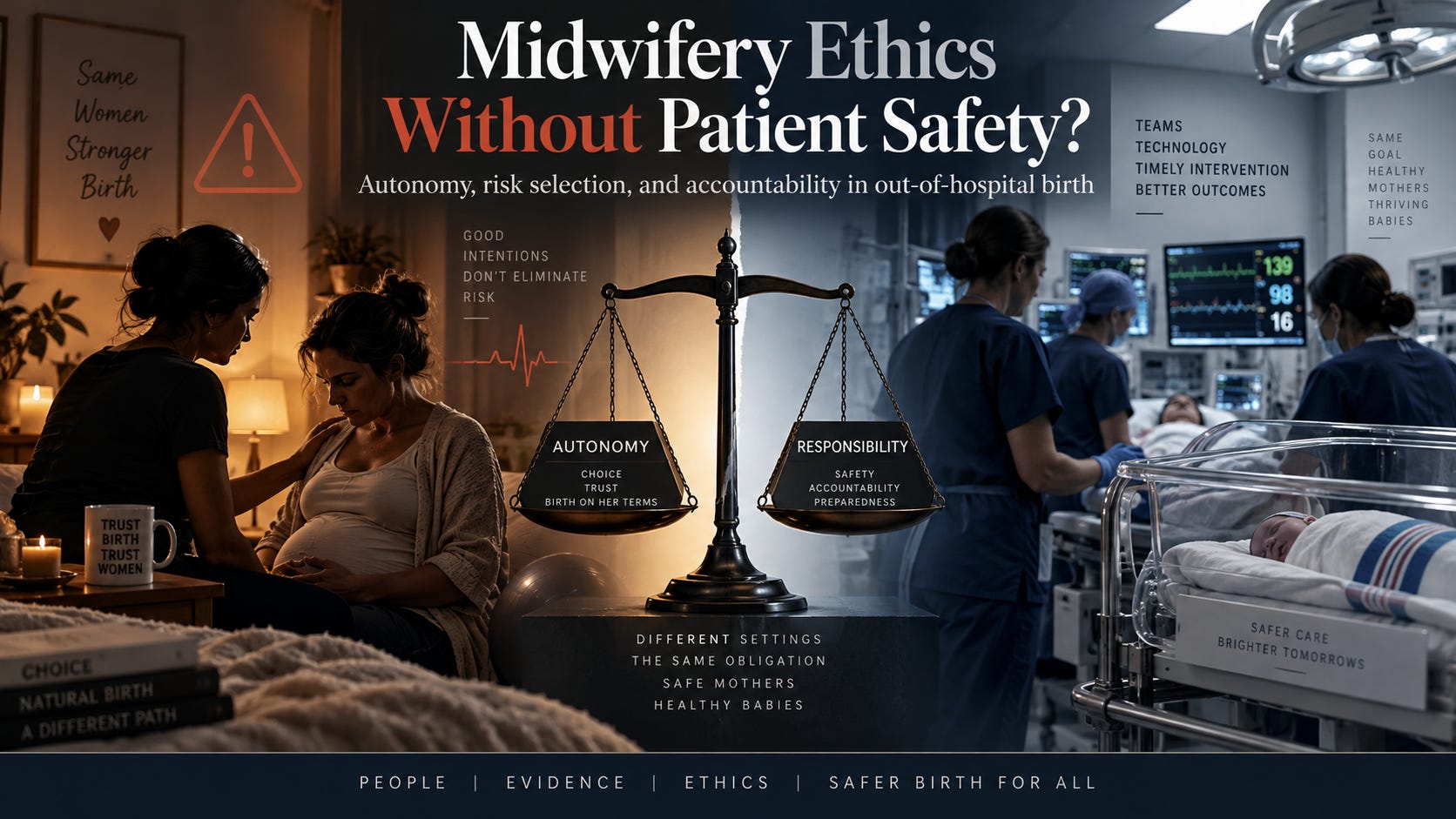
Patient autonomy is essential. But so are risk-based patient selection, professional competence, timely referral, and accountability for preventable maternal and neonatal harm.
A newly published scoping review in the European Journal of Midwifery, titled “Midwifery ethics in care, practice, and education,” raises an important question: Can a professional ethical framework adequately protect mothers and newborns if it gives extensive attention to autonomy, relationships, and reproductive justice, but insufficient attention to the clinical responsibilities that prevent avoidable harm?
Buchanan and colleagues reviewed 50 publications to identify the ethical concepts that characterize contemporary midwifery practice. Their findings were organized into four domains: relational ethics, ethical practice, ethical use of knowledge, and ethical leadership. The stated purpose was to inform the International Confederation of Midwives (ICM) Code of Ethics.
The review addresses important subjects, including trust, dignity, informed choice, respectful care, professional autonomy, and the prevention of unnecessary interventions. These are legitimate components of ethical maternity care.
However, two major concerns warrant attention. The first is the inadequate treatment of risk-based patient selection and the professional responsibility to recognize when a planned birth setting is inappropriate. The second is the failure to distinguish among different categories of midwives and healthcare systems, particularly the fragmented arrangements governing out-of-hospital birth in the United States.
These are not minor technical omissions. They concern fundamental obligations of professional ethics.
Patient autonomy does not eliminate professional responsibility
The review places substantial emphasis on the relationship between the midwife and the woman, informed choice, and the ability of women to exercise control over their maternity care.
Yet professional ethics requires more than respect for preferences. It also requires practitioners to identify foreseeable risks, communicate them accurately, recommend appropriate care, recognize the limits of their competence, and avoid providing services under conditions that cannot adequately protect patients.
The central question is straightforward: What should a midwife do when a woman requests a planned home birth despite clinical circumstances that make that setting inappropriate?
Respect for autonomy requires that the woman receive accurate information and retain the authority to accept or refuse recommended care. It does not follow that the midwife has an ethical obligation to provide or endorse care that falls outside accepted safety criteria or professional capabilities.
These are separate questions: what the patient is entitled to decide and what the professional is ethically justified in providing.
The distinction is fundamental to obstetric and midwifery ethics.
A clinician may respect a patient’s decision while declining to participate in a planned clinical arrangement that the clinician cannot safely support. That response must include respectful counseling, appropriate referrals, and efforts to preserve continuity of care. It must never become abandonment or coercion.
Where are the obligations to identify and exclude high-risk patients?
The most striking limitation of the review is its failure to meaningfully develop the ethics of risk-based eligibility for different birth settings.
ACOG’s Committee Opinion No. 697, Planned Home Birth, explicitly identifies fetal malpresentation, multiple gestation, and previous cesarean delivery as absolute contraindications to planned home birth. ACOG also emphasizes appropriate candidate selection, qualified attendants, medical consultation, and safe, timely hospital transfer.
The American Academy of Pediatrics similarly states that hospitals and accredited birth centers are the safest birth settings in the United States. Its 2020 policy statement, reaffirmed in September 2025, does not recommend planned home birth and identifies specific clinical and systems requirements intended to reduce neonatal risk.
These recommendations are not simply administrative preferences. They reflect professional responsibilities intended to prevent avoidable harm.
A comprehensive ethical discussion should therefore examine at least four questions.
First, does the midwife have an obligation to assess whether the woman meets accepted criteria for the intended birth setting?
Second, is there an obligation to recommend a different birth setting when clinical risk exceeds what can be managed safely?
Third, must the midwife decline to attend a planned birth when it falls outside professional scope or accepted clinical safety standards?
Fourth, what are the ethical responsibilities for arranging consultation, transfer, and continuing care when complications develop?
Buchanan and colleagues recognize nonmaleficence, professional competence, accountability, and evidence-based practice. However, these principles remain largely abstract. Their practical consequences for risk selection, referral, and birth-setting decisions receive little attention.
That is a significant limitation for a review intended to inform professional ethics.
The United States is not the Netherlands
International discussions of midwifery frequently treat midwife-led care as though it represents a reasonably consistent model across countries.
It does not.
Birth outcomes depend not only on the professional attending the delivery, but also on training, patient selection, regulation, access to emergency obstetric services, consultation arrangements, and the integration of midwives into the healthcare system.
A system in which midwives operate within coordinated maternity services, established referral pathways, and accessible emergency care cannot automatically be compared with a system in which out-of-hospital care may operate through separate professional, institutional, and regulatory arrangements.
This distinction is particularly consequential in the United States.
International evidence from integrated maternity systems should not be generalized to U.S. planned home births without examining these differences. Even favorable outcomes among carefully selected low-risk women in one system do not establish safety for higher-risk patients or differently organized services elsewhere.
An ethical framework that emphasizes the virtues of midwife-led care without adequately addressing the conditions necessary for safe delivery risks confusing a professional philosophy with demonstrated clinical safety.
The missing distinction between CNMs and CPMs
The United States has multiple midwifery credentials, and they must not be treated as interchangeable.
Certified Nurse-Midwives (CNMs) are graduate-educated clinicians who are commonly integrated into hospitals and other organized healthcare settings. Certified Midwives (CMs) also complete graduate-level midwifery education, although their recognition varies by state.
Certified Professional Midwives (CPMs), in contrast, receive certification through the North American Registry of Midwives, with educational pathways that may include structured apprenticeship-based preparation rather than graduation from a graduate-level midwifery program. Their practice is concentrated in homes and freestanding birth centers.
CPM certification does not itself confer a license to practice. State laws governing their authority, scope, and regulation vary. Nor does certification automatically establish hospital privileges, formal physician collaboration, or an integrated emergency transfer system.
This does not mean that every CPM practices without consultation or that all CPM-attended births lack safe transfer arrangements. It means these protections cannot simply be assumed.
The distinction matters ethically because professional accountability requires more than possession of a credential. It requires appropriate preparation, adherence to defined scope, effective clinical oversight and regulation, and the ability to obtain higher-level care when necessary.
Buchanan and colleagues include studies from the United States but do not meaningfully examine these credentialing and systems differences.
A global ethical framework cannot ignore such variation while making broad claims about midwifery practice.
Transfer is not a substitute for appropriate patient selection
Timely transfer is essential to safe out-of-hospital care, but it cannot eliminate the risks associated with poor candidate selection.
Some obstetric emergencies develop rapidly. An emergency that can be managed promptly in a hospital may have a very different outcome when definitive treatment requires transportation, communication, acceptance by another institution, and preparation of a receiving clinical team.
This is why patient selection must occur before labor and why plans must be reassessed as maternal or fetal conditions change.
The ethical obligation is not merely to initiate transfer after a complication has occurred. It is also to avoid exposing mothers and newborns to foreseeable risks that exceed the capabilities of the chosen setting.
ACOG’s December 2025 position statement on transfer protocols for out-of-hospital birth reinforces the importance of communication and coordinated transfer arrangements.
Transfer protocols are necessary. They do not make an otherwise inappropriate planned birth setting appropriate.
The fetus and newborn are also patients
Another concern is the limited development of professional responsibility for fetal and neonatal outcomes within the review’s emphasis on the midwife-woman relationship.
Respect for maternal autonomy is nonnegotiable. However, an ethical framework for maternity care also needs to recognize professional obligations concerning the welfare of the fetus and the newborn.
These obligations do not authorize coercion or remove a pregnant woman’s decision-making authority. They do require clinicians to communicate fetal and neonatal risks accurately, make evidence-based recommendations, and avoid professional participation in arrangements that cannot be justified clinically.
The newborn’s interests are especially important because the newborn cannot participate in decisions about birth location, attendant qualifications, or emergency preparedness.
An ethical framework that addresses maternal experience extensively but does not equally develop the responsibilities associated with preventable fetal and neonatal morbidity and mortality is incomplete.
What should an international code of ethics require?
The ICM already recognizes that midwifery practice includes detecting complications, accessing appropriate medical care, and taking emergency measures. Its professional framework also addresses competence and regulatory responsibilities.
The concern, therefore, is not that international midwifery standards contain no safety obligations. It is that the scoping review does not adequately examine how these obligations should be defined and applied in ethically difficult circumstances.
A professional ethical framework should make clear that midwives have duties to:
Use evidence-based criteria to determine whether a patient is suitable for the proposed setting and model of care.
Recognize clinical conditions that require physician consultation, referral, or hospital-based management.
Practice within verified competencies, legal scope, and available institutional resources.
Provide accurate comparative information about maternal and neonatal risks, including the limitations of available evidence.
Establish appropriate consultation and emergency transfer arrangements before out-of-hospital delivery.
Decline to provide planned care outside professionally defensible safety parameters while respecting patient autonomy and avoiding abandonment.
Participate in transparent review of adverse outcomes, including failures of selection, recognition, communication, and transfer.
These requirements should apply to the profession regardless of whether midwives practice in hospitals, birth centers, or homes, with operational standards adapted to the setting.
Ethical ideals must be tested against clinical consequences
Buchanan and colleagues performed a scoping review of ethical concepts, not a systematic review of birth outcomes or a clinical guideline appraisal. That distinction matters. They should not be criticized for failing to conduct a study they did not propose.
But their stated aim was to help establish the ethical foundations of an international profession. In that context, the limited attention to risk selection, clinical thresholds, and out-of-hospital safety represents a consequential gap.
The review also did not critically appraise the quality of its included literature. The prominence of particular ethical concepts in primarily qualitative and theoretical publications cannot, by itself, establish that those concepts constitute a complete framework of professional responsibility.
Relational ethics, dignity, and reproductive justice are important. They are not alternatives to clinical competence, appropriate patient selection, and the prevention of avoidable harm.
A profession’s ethical obligations must be assessed not only by the values it expresses, but also by the safeguards it requires and the consequences of its clinical decisions.
Respecting a woman’s right to choose does not mean that every choice must be professionally endorsed or facilitated.
An ethical framework that protects autonomy but inadequately defines the clinician’s responsibilities for risk assessment, patient selection, timely referral, and maternal and neonatal safety is not a complete framework for professional ethics.
Patient safety must be central to midwifery ethics, not merely an implied consequence of respectful care.
References
Buchanan K, Newnham E, Megregian M, et al. Midwifery ethics in care, practice, and education: a scoping review. Eur J Midwifery. 2026;10:45. doi:10.18332/ejm/231691.
American College of Obstetricians and Gynecologists. Committee Opinion No. 697: planned home birth. Obstet Gynecol. 2017;129(4). doi:10.1097/AOG.0000000000002024.
Watterberg KL; Committee on Fetus and Newborn. Providing care for infants born at home. Pediatrics. 2020;145(5). doi:10.1542/peds.2020-0626. Reaffirmed September 2025.
American College of Obstetricians and Gynecologists. Transfer protocols for out-of-hospital birth. Position statement. December 10, 2025.
International Confederation of Midwives. International definition and scope of practice of the midwife. Revised 2024.
International Confederation of Midwives. International Code of Ethics for Midwives. Approved June 2026.
American College of Nurse-Midwives. National midwifery credentials in the United States of America: CNM, CM, CPM comparison chart. 2023.
North American Registry of Midwives. Certification and legal authority to practice. Accessed October 2026.