

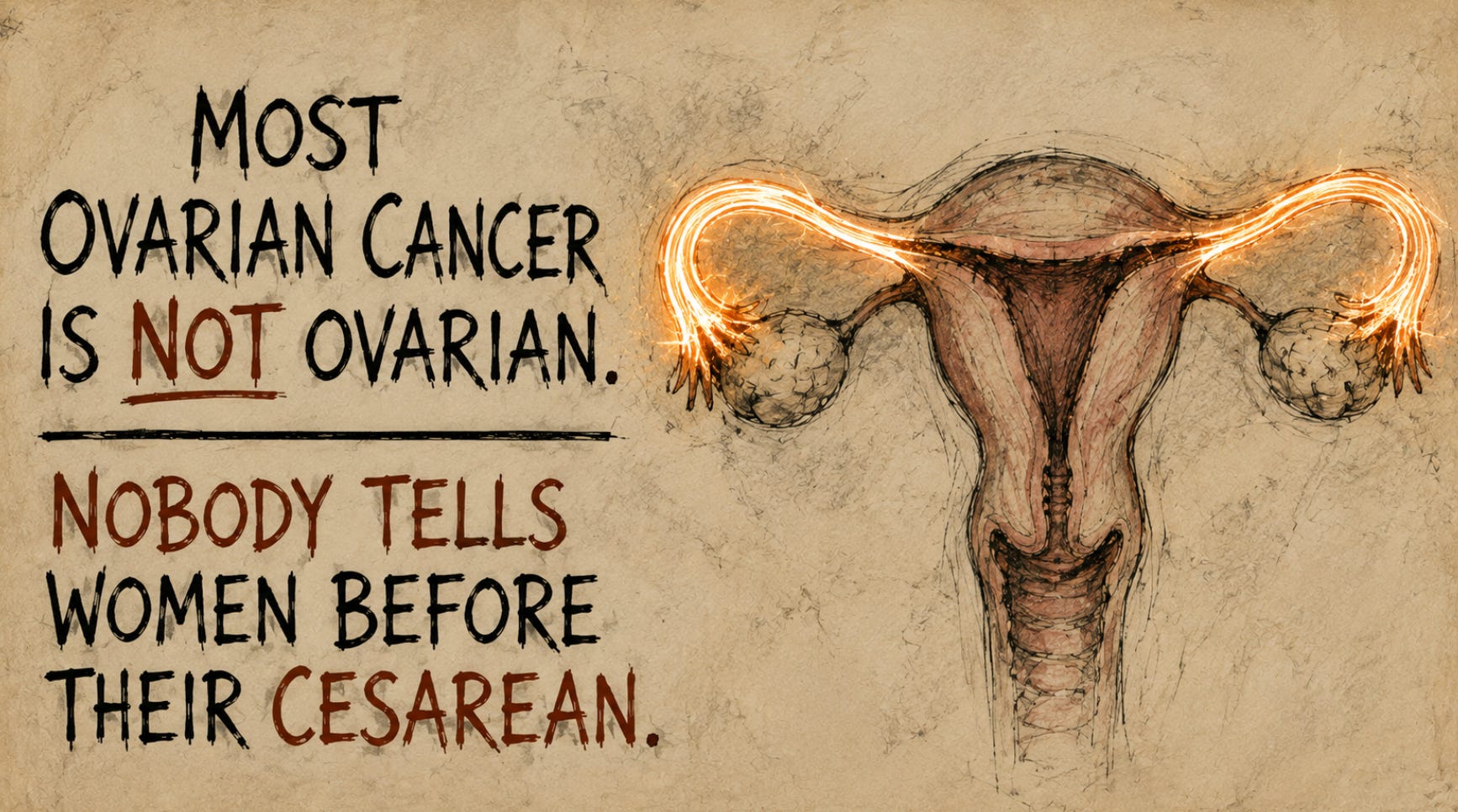
In 2024, American surgeons performed 1,173,391 cesareans. In every one of them, the fallopian tubes, where most lethal ovarian cancer begins, were in plain view. New population data show that removing them cuts the risk of serous ovarian cancer by about 78 percent. No obstetric guideline requires that any woman be told this before her cesarean. Link in the first comment.
The evidence changed. The consent conversation did not.
In 2024, 1,173,391 American women gave birth by cesarean. That is 32.4 percent of all births, and the rate rose again in 2025 to 32.5 percent.
In every one of those operations, the surgeon opened the abdomen and looked directly at both fallopian tubes. In most of those operations, the woman on the table had never been told what those tubes have to do with ovarian cancer.
She had never been told because nobody is required to tell her.
Start with the name, because the name is wrong
Ovarian cancer is not one disease. About 90 percent of cases are epithelial, and the most common and most lethal type is high-grade serous carcinoma, which makes up roughly 70 percent of ovarian carcinomas. High-grade serous carcinoma does not usually begin in the ovary. It begins in the fimbria, the fringed open end of the fallopian tube that rests against the ovary.
The idea came from a Dutch doctoral student, Jurgen Piek, who around 2000 began examining ovaries removed preventively from women carrying BRCA mutations. He expected early cancer in the ovaries. He did not find it there. He found precancerous cells in the tubes. In 2001 he proposed that ovarian cancer starts in the fallopian tube. He was told at conferences that he was a lunatic. Twenty-five years later he is the first author of the European Society of Gynaecological Oncology consensus statements on removing the tubes to prevent the disease.
The lesion has a name: serous tubal intraepithelial carcinoma. It carries the same TP53 mutation as the high-grade serous cancers that follow it. The gene expression of high-grade serous carcinoma resembles fallopian tube tissue, not the surface of the ovary. Cells shed from the open end of the tube, settle on the ovary and the lining of the abdomen, and grow there.
That single fact explains something that has frustrated this field for forty years. Screening does not work. Ultrasound, CA-125, and combinations of both have been tested in two large randomized trials, and neither reduced death from ovarian cancer. Screening looks at the ovary. Early in the process, the disease is not in the ovary.
The stakes, in numbers
In the United States in 2026, an estimated 21,010 women will be diagnosed with ovarian cancer and 12,450 will die of it. A woman’s lifetime chance of being diagnosed is about 1 in 91, roughly 1.1 percent. Her lifetime chance of dying from it is about 1 in 143. Five-year relative survival is about 52 percent, and half of women are 63 or older at diagnosis. Most women who develop it have no known risk factor and no family history, which is why strategies aimed only at BRCA carriers will never move the population number.
Now the part that has changed. Removing both fallopian tubes during an operation a woman is already having is called opportunistic salpingectomy. British Columbia became the first jurisdiction in the world to recommend it, in 2010. In February 2026, the population data from that experiment were published. Among 40,527 people who had opportunistic bilateral salpingectomy compared with 45,296 who had hysterectomy alone or tubal ligation, the hazard ratio for serous ovarian carcinoma was 0.22, with a 95 percent confidence interval of 0.05 to 0.95. That is a reduction of roughly 78 percent in the deadliest form of the disease.
Why that 78 percent is believable
Observational studies of preventive surgery are usually contaminated by the healthy user problem. Women who get an extra procedure tend to be younger, better insured, and better cared for, so they look healthier for reasons that have nothing to do with the procedure.
The investigators anticipated that. They ran the identical analysis with breast cancer as the outcome. If the salpingectomy group were simply healthier, breast cancer should also have dropped. The hazard ratio for breast cancer was 0.99, with a 95 percent confidence interval of 0.84 to 1.17. Flat. The protection is specific to the organ that was removed.
They then did something more direct. International pathologists submitted every ovarian carcinoma they could find in a patient who no longer had fallopian tubes. Among 26 such cancers, only 6, or 23.1 percent, were high-grade serous, compared with 68.1 percent in a historical series of 942 ovarian carcinomas in women with intact tubes. When you remove the tubes, the cancers that still occur are mostly the other kinds.
This sits on top of earlier work pointing the same direction. A Swedish national cohort found a 65 percent lower risk of ovarian cancer after bilateral salpingectomy, compared with 28 percent after sterilization alone. The first British Columbia outcomes analysis in 2022 found zero high-grade serous carcinomas where several were expected.
The honest limits: this is observational, not randomized. The number of cancers is small, 21 serous carcinomas in the comparison group and five or fewer in the salpingectomy group. Median follow-up in the salpingectomy group was 4.72 years against 8.45 years in the comparison group, and most of these surgeries were performed decades before peak risk age. A randomized trial with cancer as the endpoint would take thirty years and will not be done. This is the evidence that exists, and it points one way.
Who has said what, and who has not
The Society of Gynecologic Oncology issued a practice statement in 2013 supporting salpingectomy in place of tubal ligation and at the time of hysterectomy for women at population risk who have completed childbearing.
The European Society of Gynaecological Oncology published 18 consensus statements in JAMA in 2026, with grades of recommendation from B to D and levels of evidence from II to V. Their conclusion: opportunistic salpingectomy lowers the risk of tubo-ovarian carcinoma, shows no adverse short-term effect on ovarian function, is safe across surgical approaches, adds little operative time, and belongs in preoperative counseling for eligible women, including women having selected nongynecologic abdominal and pelvic operations.
The American College of Surgeons went further in a direction obstetrics has not. At its 2025 Clinical Congress, surgeons were urged to offer tube removal, after informed consent, to post-reproductive women having elective abdominal surgery such as hernia repair or gallbladder removal. Their estimate: performing it in 60 percent of eligible operations could prevent close to 6,000 ovarian cancer deaths every year in the United States.
The American Cancer Society announced a collaboration with Break Through Cancer in September 2025 to build a national awareness campaign, and helped establish a new ICD-10 encounter code for opportunistic salpingectomy so the procedure can be tracked and reimbursed.
Then there is ACOG.
In August 2026, ACOG finally updated its 2019 Committee Opinion on opportunistic salpingectomy. The new Clinical Practice Update announces that its purpose is to “strengthen the recommendation” for complete bilateral salpingectomy at the time of obstetric or gynecologic surgery, citing evidence that the procedure can substantially reduce epithelial ovarian cancer incidence.
That sounds clear. The actual recommendations are not.
ACOG is unequivocal when the surgery is gynecologic. Obstetrician-gynecologists “should routinely perform” bilateral salpingectomy at hysterectomy. Salpingectomy “should be recommended” to patients undergoing other gynecologic operations that enter the peritoneal cavity if they do not desire future fertility. ACOG even tells obstetrician-gynecologists to help other surgical specialists offer salpingectomy during nongynecologic surgery.
Then comes cesarean delivery.
ACOG reviews remarkably reassuring obstetric data. A meta-analysis of 11 studies involving 320,443 patients found no increase in surgical complications when salpingectomy was performed at cesarean delivery, with an average increase in operating time of only six minutes. A subsequent cohort of 18,184 patients likewise found no clinically significant difference in perioperative complications and an approximately eight-minute increase in operative time.
Yet ACOG still does not say:
Patients undergoing planned cesarean delivery who do not desire future pregnancy should routinely be counseled about opportunistic salpingectomy for ovarian cancer prevention.
Instead, ACOG says complete bilateral salpingectomy is the “preferred tubal procedure for patients desiring permanent contraception after shared decision making.”
That qualification matters.
The obligation still appears to arise only after the patient has entered the permanent-contraception pathway. A patient who has completed childbearing but has never asked for sterilization is not clearly included. A patient who does not know that removing the fallopian tubes may substantially reduce her future ovarian cancer risk cannot reasonably be expected to request an option she has never been told exists.
ACOG itself comes remarkably close to recognizing this problem. It states that contraceptive counseling should highlight the cancer-risk reduction associated with salpingectomy because patients who do not desire future pregnancy “may not be aware of this relevant benefit.”
Exactly.
If patients may not know the benefit, the professional obligation cannot logically depend on patients first asking for permanent contraception.
The inconsistency becomes even harder to defend when ACOG turns to nongynecologic surgery. It says salpingectomy should be made available to patients undergoing intraperitoneal operations who do not desire future fertility and directs obstetrician-gynecologists to support other surgeons in offering it. A woman having abdominal surgery for a nonobstetric reason may therefore be affirmatively offered ovarian-cancer prevention, while a woman whose obstetrician is already performing a cesarean may not receive the same discussion unless she has first identified herself as wanting permanent contraception.
That is difficult to reconcile with informed consent.
The issue is not whether every woman undergoing cesarean delivery should have a salpingectomy. Of course not. Salpingectomy permanently eliminates natural fertility, and ACOG appropriately requires counseling, time for consideration, and individualized decision-making.
The issue is whether an appropriate patient should know that the option exists.
ACOG has now strengthened its evidence review, strengthened its recommendations for gynecologic surgery, and even encouraged other surgical specialties to offer salpingectomy. What it still has not done is write the one sentence obstetricians and patients actually need:
Patients undergoing planned cesarean delivery who do not desire future pregnancy should be counseled about the benefits, risks, and permanent contraceptive consequences of bilateral salpingectomy and offered the procedure when clinically appropriate.
In professional ethics, there is an important distinction among what physicians should not offer, what they should offer, and what they should recommend.
After seven years and a new Clinical Practice Update, ACOG still has not clearly told obstetricians which of those applies to opportunistic salpingectomy at cesarean delivery.
What the cesarean data actually show
Feasibility first. A 2020 systematic review and meta-analysis identified 11 studies covering 320,443 women who had either total salpingectomy or standard sterilization at cesarean.
Across the three randomized trials, 163 women, total operative time was not significantly increased: 8.1 minutes, with a 95 percent confidence interval of minus 4.4 to 20.7. Across seven cohort studies, 7,303 women, the difference was 6.3 minutes, with a 95 percent confidence interval of 3.5 to 9.1. There was no increased risk of wound infection, transfusion, readmission, reoperation, internal organ damage, blood loss, change in hemoglobin, or length of stay.
The two randomized trials published in 2018 differ in a way that matters, and the difference is instrumentation, not biology.
At the University of Virginia, 44 women were randomized and salpingectomy was performed with a vessel sealing device. Sterilization procedure time was 5.6 minutes against 6.1 minutes for tubal ligation, a mean difference of 30 seconds, and salpingectomy was completed in 95 percent. At the University of Alabama at Birmingham, 80 women were randomized and salpingectomy was performed with clamps and suture. Total operative time was 15 minutes longer and bilateral salpingectomy was completed in 68 percent against 95 percent for tubal ligation. No adverse outcome related to the sterilization procedure occurred in either trial. The lesson is that technique and available instruments determine the added time, not the concept.
Ovarian function. A randomized trial compared antimullerian hormone before cesarean and again at six to eight weeks after, in women randomized to salpingectomy or tubal ligation. The change did not differ between groups, an average rise of 0.58 against 0.39 nanograms per milliliter. A British Columbia cohort found no evidence that salpingectomy brings menopause earlier. The ESGO review reached the same conclusion for the short term, and stated openly that long-term follow-up is not yet available.
Cost. A 2019 decision analysis modeled 110,000 women having cesarean and desiring permanent contraception. Salpingectomy produced an incremental cost-effectiveness ratio of 23,189 dollars per quality-adjusted life year against tubal ligation. Here is the honest part that rarely gets quoted: in probabilistic sensitivity analysis, tubal ligation had a 49 percent chance of being preferred, and the model flipped to favoring tubal ligation if the true cancer risk reduction from salpingectomy fell below 52 percent. That was the open question in 2018. The 2026 population data put the reduction near 78 percent, above that threshold. The uncertainty that made the economics a coin flip has now been narrowed by data.
Uptake. National inpatient data covering 3,813,823 cesareans between October 2015 and December 2018 show salpingectomy at cesarean rising from 4.6 percent to 13.2 percent while tubal ligation fell from 11.3 percent to 2.4 percent. Among women who receive permanent contraception at cesarean, salpingectomy has become the default. That is genuine progress and obstetrics deserves credit for it.
But add those two numbers together. Roughly 16 percent of women having a cesarean receive any permanent contraception. The other 84 percent are not in the counseling conversation at all, and a substantial share of them have completed childbearing and do not know that the option exists.
What honest counseling contains
This is not an argument for sterilizing more women. It is an argument for telling every woman the truth in advance and then respecting whatever she decides.
The conversation belongs in the prenatal office, in the second trimester, with time to think and time to change her mind. It does not belong in labor, it does not belong on the way to the operating room, and it should never be offered by a surgeon whose hands are already inside the abdomen. Preventive ethics means having the difficult conversation before the moment of pressure rather than during it. A woman being wheeled into an operating room cannot give meaningful consent to a permanent decision about her fertility.
What she should hear is specific. Most lethal ovarian cancer begins in the fallopian tubes. Removing both tubes lowers the risk of the deadliest subtype by roughly 78 percent, and it does not remove the risk entirely, because endometrioid, clear cell and mucinous carcinomas, along with germ cell and sex cord stromal tumors, still arise from the ovary itself. The procedure is permanent and it ends the possibility of surgical tubal reversal, although in vitro fertilization remains available. Ovarian function does not appear to change, measured by antimullerian hormone six to eight weeks afterward. It adds somewhere between five and fifteen minutes to the operation depending on technique. As contraception, the closest comparison is postpartum partial salpingectomy, which carries a ten-year pregnancy probability of 7.5 per 1,000 procedures; complete removal of the tubes should perform at least as well, but that has not been measured directly.
Regret belongs in that conversation too, with its number. In the largest prospective cohort of sterilized women in the United States, the cumulative probability of expressing regret within 14 years was 20.3 percent among women aged 30 or younger at the time of sterilization after cesarean, with a 95 percent confidence interval of 14.5 to 26.0, compared with 5.9 percent among women older than 30. A woman deciding this at 26 is in a different position from a woman deciding it at 38, and she deserves to be told so.
The history belongs in the conversation as well. Forced sterilization of Black women, disabled women, and poor women is American history, and it is not distant history. The federal Medicaid sterilization consent form exists because of it. It requires a signature at least 30 days before the procedure and expires after 180 days. That protection has now become an obstacle: the consent form is estimated to account for 24 to 44 percent of unfulfilled sterilization requests among Medicaid enrollees, and roughly 30 to 50 percent of women who ask for permanent contraception after birth do not receive it before discharge. Counseling in the second trimester is precisely what allows the 30-day clock to run in time. Talking earlier serves both goals at once: it protects against coercion and it protects against the woman who asked, was told yes, and went home without it.
Conclusion
The evidence stopped being ambiguous. Most lethal ovarian cancer starts in the fallopian tubes. Removing them during an operation a woman is already having lowers her risk of the deadliest subtype by roughly 78 percent. At cesarean it adds minutes, not risk, and it does not appear to touch ovarian function. European gynecologic oncologists have said so, the American Cancer Society has said so, and general surgeons have said so about gallbladders and hernias.
Obstetrics is holding the largest opportunity in American surgery and treating it as a footnote in a gynecology committee opinion. ACOG’s conditional sentence should be rewritten. Every woman planning a cesarean who has completed childbearing should hear this during prenatal care, with the absolute numbers, with the permanence stated plainly, with the regret data included, and with complete freedom to decline. Whether she says yes is her decision. Whether she is told is ours.
If she is never told, we did not respect her autonomy.
We just stayed quiet and called it respect.
ObGyn Intelligence is where the evidence gets read carefully and said plainly. If this changed how you will counsel your next cesarean patient, or how you will talk to your own doctor, subscribe and share it with someone who schedules cesareans for a living.
References
1. National Center for Health Statistics. FastStats: births, method of delivery. Data from Births: Final Data for 2024, table 9. Atlanta (GA): Centers for Disease Control and Prevention. Available from: https://www.cdc.gov/nchs/fastats/delivery.htm
2. National Center for Health Statistics. Births: provisional data for 2025. Vital Statistics Rapid Release. Hyattsville (MD): NCHS. Available from: https://www.cdc.gov/nchs/data/vsrr/vsrr043.pdf
3. American Cancer Society. Key statistics for ovarian cancer. In: Cancer Facts and Figures 2026. Atlanta (GA): American Cancer Society; 2026.
4. Sowamber R, Mei AJ, Kaur P, McLeod J, McKay E, Lukey A, et al. Serous ovarian cancer following opportunistic bilateral salpingectomy. JAMA Netw Open. 2026;9(2):e2557267. doi:10.1001/jamanetworkopen.2025.57267
5. Hanley GE, Pearce CL, Talhouk A, Kwon JS, Finlayson SJ, McAlpine JN, et al. Outcomes from opportunistic salpingectomy for ovarian cancer prevention. JAMA Netw Open. 2022;5(2):e2147343. doi:10.1001/jamanetworkopen.2021.47343
6. Falconer H, Yin L, Gronberg H, Altman D. Ovarian cancer risk after salpingectomy: a nationwide population-based study. J Natl Cancer Inst. 2015;107(2):dju410. doi:10.1093/jnci/dju410
7. Piek JM, Schauwaert J, Ellis LB, Zapardiel I, Planchamp F, Koblos K, et al. Opportunistic salpingectomy for prevention of tubo-ovarian carcinoma: the European Society of Gynaecological Oncology consensus statements. JAMA. 2026;335(10):894-902. doi:10.1001/jama.2025.24510
8. Opportunistic salpingectomy as a strategy for epithelial ovarian cancer prevention. ACOG Committee Opinion No. 774. American College of Obstetricians and Gynecologists. Obstet Gynecol. 2019;133:e279-84. Reaffirmed 2020.
9. American College of Surgeons. One surgery could prevent most ovarian cancers, surgeons say. Press release. Chicago (IL): ACS; November 17, 2025.
10. American Cancer Society, Break Through Cancer. American Cancer Society and Break Through Cancer unite to outsmart ovarian cancer. Press release. Atlanta (GA); September 25, 2025.
11. Mandelbaum RS, Matsuzaki S, Sangara RN, Klar M, Matsushima K, Roman LD, et al. Paradigm shift from tubal ligation to opportunistic salpingectomy at cesarean delivery in the United States. Am J Obstet Gynecol. 2021;225(4):399.e1-399.e32. doi:10.1016/j.ajog.2021.06.074
12. Roeckner JT, Sawangkum P, Sanchez-Ramos L, Duncan JR. Salpingectomy at the time of cesarean delivery: a systematic review and meta-analysis. Obstet Gynecol. 2020;135(3):550-7. doi:10.1097/AOG.0000000000003673
13. Garcia C, Moskowitz OM, Chisholm CA, Duska LR, Warren AL, Lyons GR, et al. Salpingectomy compared with tubal ligation at cesarean delivery: a randomized controlled trial. Obstet Gynecol. 2018;132(1):29-34. doi:10.1097/AOG.0000000000002674
14. Subramaniam A, Blanchard CT, Erickson BK, Szychowski J, Leath CA, Biggio JR, et al. Feasibility of complete salpingectomy compared with standard postpartum tubal ligation at cesarean delivery: a randomized controlled trial. Obstet Gynecol. 2018;132(1):20-7. doi:10.1097/AOG.0000000000002646
15. Ganer Herman H, Gluck O, Keidar R, Kerner R, Kovo M, Levran D, et al. Ovarian reserve following cesarean section with salpingectomy vs tubal ligation: a randomized trial. Am J Obstet Gynecol. 2017;217(4):472.e1-472.e6. doi:10.1016/j.ajog.2017.04.028
16. Hanley GE, Kwon JS, McAlpine JN, Huntsman DG, Finlayson SJ, Miller D. Examining indicators of early menopause following opportunistic salpingectomy: a cohort study from British Columbia, Canada. Am J Obstet Gynecol. 2020;223(2):221.e1-221.e11. doi:10.1016/j.ajog.2020.02.005
17. Venkatesh KK, Clark LH, Stamilio DM. Cost-effectiveness of opportunistic salpingectomy vs tubal ligation at the time of cesarean delivery. Am J Obstet Gynecol. 2019;220(1):106.e1-106.e10. doi:10.1016/j.ajog.2018.08.032
18. Peterson HB, Xia Z, Hughes JM, Wilcox LS, Tylor LR, Trussell J. The risk of pregnancy after tubal sterilization: findings from the U.S. Collaborative Review of Sterilization. Am J Obstet Gynecol. 1996;174(4):1161-8.
19. Hillis SD, Marchbanks PA, Tylor LR, Peterson HB. Poststerilization regret: findings from the United States Collaborative Review of Sterilization. Obstet Gynecol. 1999;93(6):889-95.
20. Access to postpartum sterilization. ACOG Committee Opinion No. 827. American College of Obstetricians and Gynecologists. Obstet Gynecol. 2021;137:e169-76.
21. Kolata G. Most ‘ovarian cancer’ isn’t. And that fact can save lives. The New York Times. July 28, 2026.