

By 2026, 81% of physicians were using artificial intelligence in practice. Fewer than 15% had any training in how to use it safely. So I built a short course to close that gap — and built it using the exact method it teaches. Paid subscribers get the access password.

By 2026, about one in three American adults had asked an AI chatbot for health advice. Among physicians, 81% report using artificial intelligence in their work. And fewer than 15% have had any formal training in how to use it safely. Read those three numbers again. We have adopted a clinical tool faster than almost any technology before it, and we skipped the part where someone teaches us how to use it.
A large language model — ChatGPT, Claude, Gemini — is not a database of checked facts.
It is a very good pattern engine that predicts the next likely words.
Most of the time that is helpful. Sometimes it invents a citation that does not exist, or a dose that is wrong, and it does so with total confidence. The danger is not that the tool is bad. The danger is that it is convincing, and that we are using it without knowing where it breaks.
It can make mistakes. It hallucinates. But with proper training you can get the most out of it.
So we built the course.
It is called AI Health Course. Passwords are required to get in. The course is in private preview. Paid subscribers get the access password below after the paywall.
Please message me on LinkedIn for any questions.

It is short — about three to four hours, in sittings of fifteen to thirty minutes — and it is written both for patients and clinicians, not engineers. It covers how to give the model the right context, how to spot an answer that is unsafe, how to verify what matters, how to keep patient information private, and how to stay responsible for the decision. Every idea is taught in plain language, then practiced on a real, de-identified example.
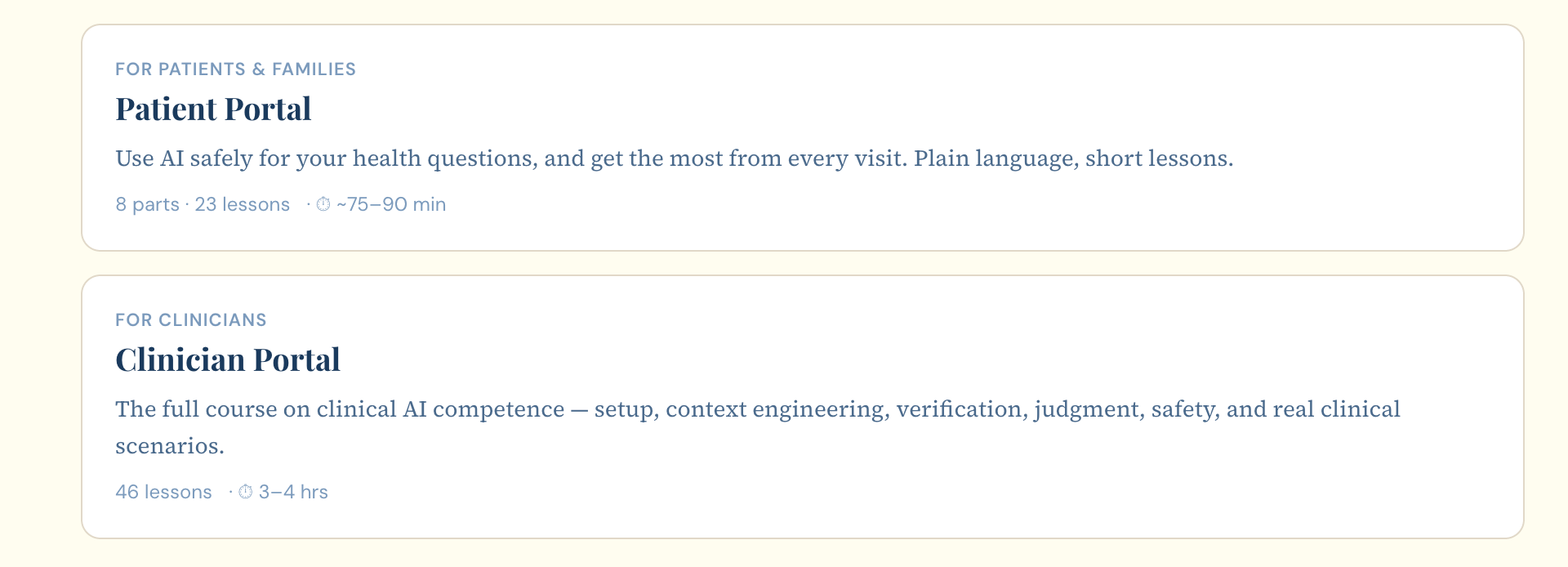
Here is the part I like. I built the course itself by “vibe coding.” That means I described what I wanted in plain English, Claude wrote the working code, and I tested and corrected it until it was right, no web developer in the room. But nothing was taken on the model’s word. Every clinical number, every citation, and every privacy rule was checked against the original source before it went in. The tool drafts; the clinician stays accountable. That is the whole message of the course, and it is also how the course was made.
The course is in private preview.
Paid subscribers get the access passwords below.
