

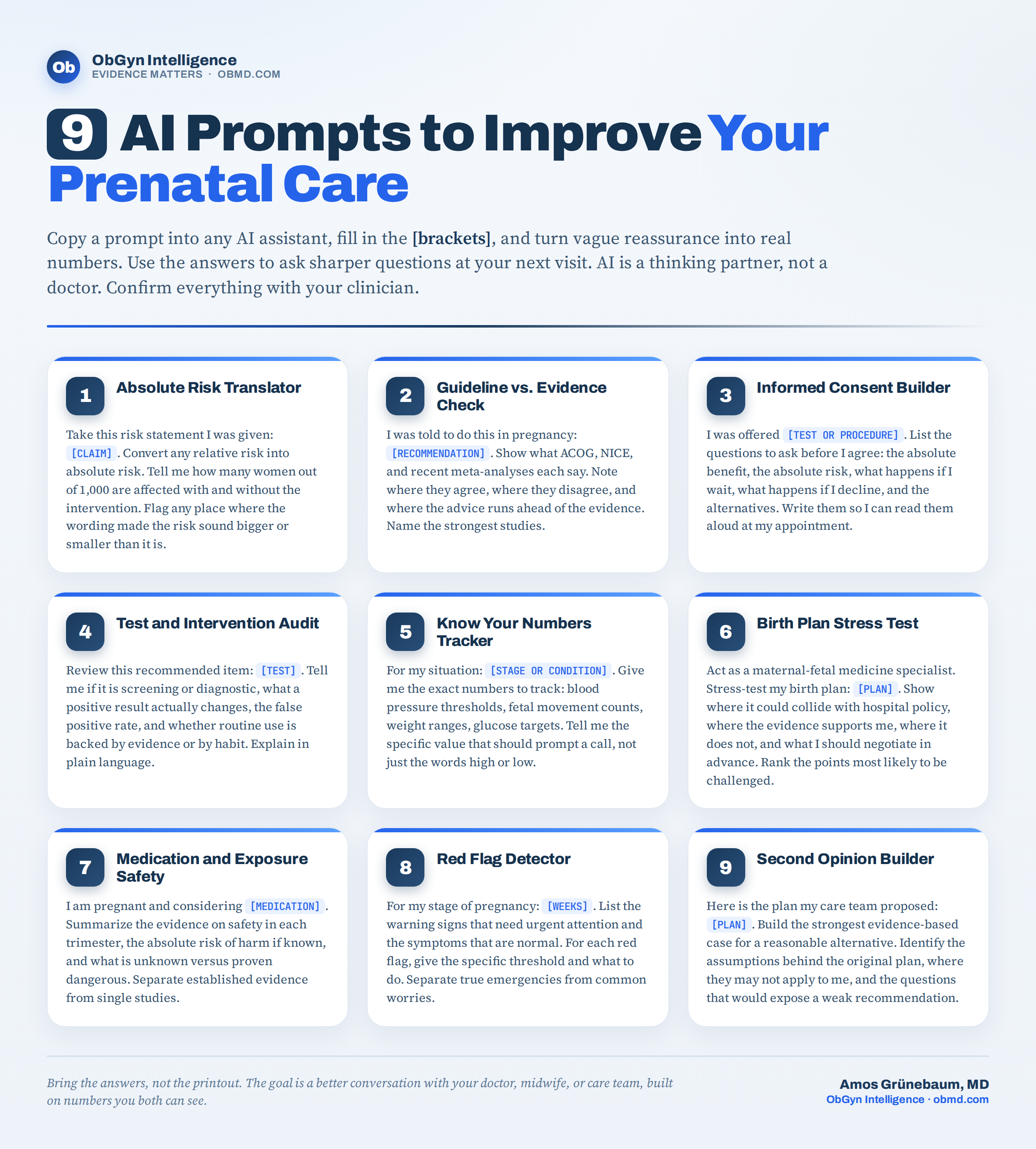
Better Prompts Lead to Better Medical Answers
Large language models can be powerful pregnancy education tools, but the quality of the answer depends heavily on the quality of the prompt. A vague prompt such as “Should I have an induction?” usually produces a generic response that may not apply to your pregnancy. A specific prompt that includes your situation, asks for evidence, requests absolute rather than relative risk, and separates established evidence from expert opinion is much more likely to produce a useful answer.
An effective prompt tells the AI exactly what role to take, what information to analyze, what evidence to use, and how to present the answer. It should ask for current clinical guidelines, the strongest available studies, and clear explanations in plain language. It should also ask the AI to identify uncertainty, explain where evidence is limited, and distinguish facts from interpretation. The goal is not to replace your obstetrician or midwife, but to help you ask better questions and participate more effectively in shared decision-making.
