

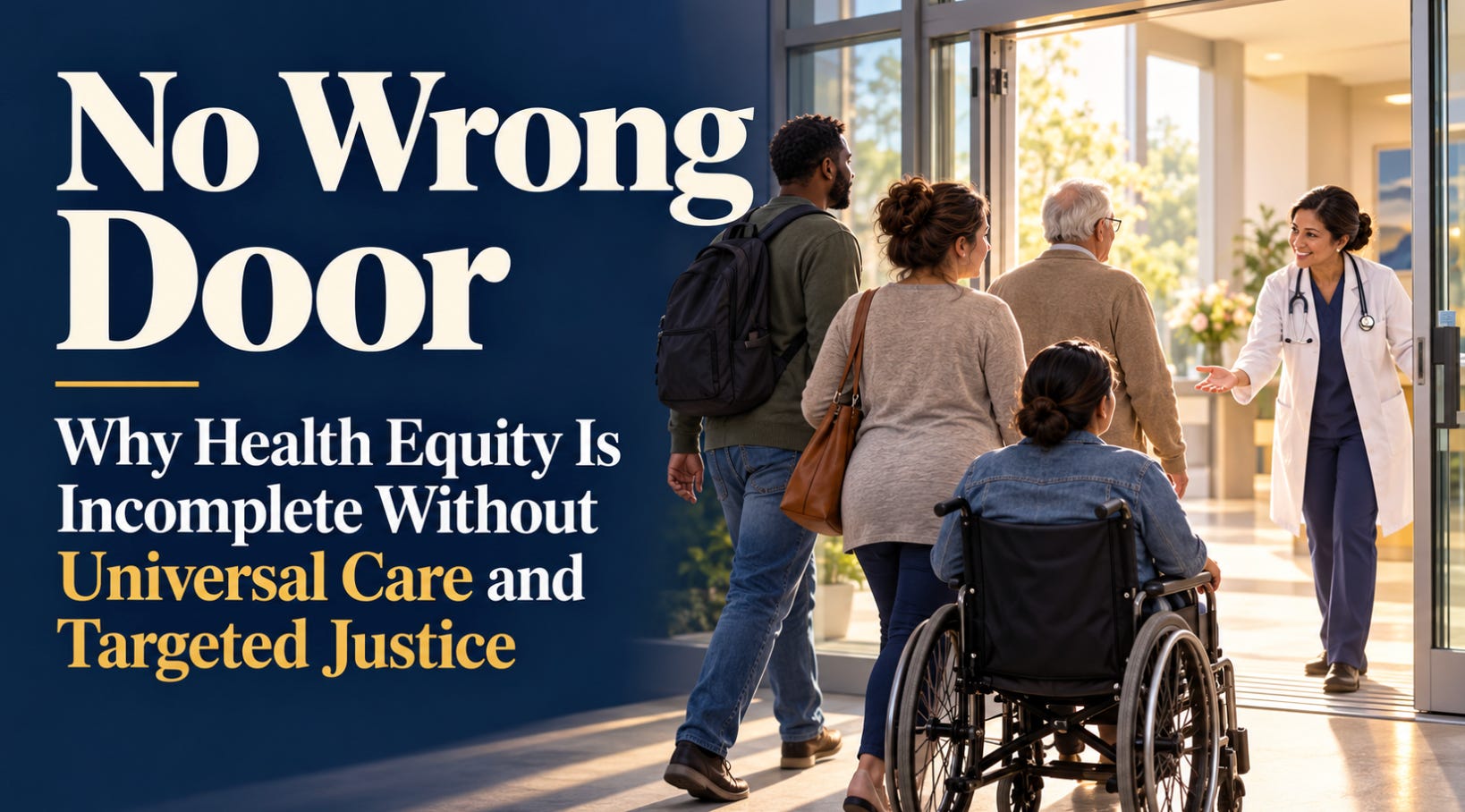
An eight-part essay series
A compassionate, evidence-disciplined argument for universal access, support according to need, and institutional responsibility.
The series
1. Everyone Belongs Before Anyone Becomes Ill
2. An Insurance Card Is Not an Appointment
3. Different Barriers, Equal Concern
4. The Door Is Open. Is the Patient Heard?
5. Reproductive Care Should Not Depend on the Insurance Card
6. Pregnancy Tests the Promise of Care
7. Universal Care, Support According to Need
8. No Wrong Door: A Responsibility to Connect
Each essay can be published independently. Patient scenarios are illustrative. Empirical findings are cited locally; proposed reforms express the author’s ethical position.
NO WRONG DOOR · PART 1 OF 8
Everyone Belongs Before Anyone Becomes Ill
Imagine a woman sitting at her kitchen table with a referral beside her. She is worried about her symptoms, but her first task is to work out whether she can afford the next appointment. Across town, another patient has adequate insurance but cannot find an accessible examination room. A third has reached a clinic and cannot understand the discussion about treatment. These are illustrative situations, not accounts of identified patients. Each asks us to consider what it means to offer care that a person can actually use.
Health equity begins with equal moral concern. It asks whether people have a fair opportunity for health and whether avoidable barriers deny that opportunity. The World Health Organization’s definition includes unfair, avoidable or remediable differences across social, economic, geographic and other groups.[1] Its scope includes racial inequity, poverty, disability and other forms of disadvantage. Recognizing that breadth should deepen our attention to specific harms.
The argument of this series is that a just health system needs both universal care and targeted justice. By universal care, I mean a dependable claim to necessary, evidence-based services, supported by adequate capacity and financial protection. By targeted justice, I mean additional measures directed at identifiable barriers and unjust disadvantages, including discrimination and persistent underinvestment. These are ethical commitments and proposals for system design. They are not promises that one policy can eliminate every difference in health.
A common promise, made practical
Universal care answers a question of membership: who belongs within the system? My answer is everyone. A person’s claim to necessary care should not rise or fall with a job change, an insurance category or the ability to negotiate a complicated application. Institutions still need eligibility rules and financing arrangements. Those arrangements should serve access rather than become tests of deservingness.
Targeted justice asks what must change so that the common promise reaches people facing different obstacles. A qualified interpreter, accessible equipment and support with travel serve different needs. The ethical purpose is shared: to make an appropriate course of care possible. Equal concern does not require an identical pathway for every patient.
This distinction also places limits on what we should claim. Health equity is broader than health care. Housing, education, working conditions and other circumstances matter to health. Universal medical care is a commitment within this wider project, not a substitute for it. Nor does equitable care guarantee identical outcomes. People can become gravely ill despite timely, competent treatment. A difference in outcomes calls for investigation; it does not identify its own cause.
Responsibility without blame
Compassion should extend to the people providing care. A receptionist cannot create an appointment that does not exist. A physician cannot sustain an understaffed service through goodwill alone. Insurers, health systems and public authorities must carry responsibilities that individual encounters cannot absorb.
That does not excuse inaction. It helps assign the right work to the right institution. Practices can improve communication and referral follow-up. Health systems can invest in access and capacity. Public policy can address coverage and financial protection. Each should be judged by what it has the power to change.
“No Wrong Door” names the responsibility that connects these levels. A service may need to redirect a patient. It should have a reliable process for helping that person reach appropriate care, within its role and resources. The first question should be what the person needs, followed by a clear account of how the system will respond.
The patient at the kitchen table should not have to establish that her fear deserves our attention. She already belongs within it.
Reference
[1] World Health Organization. Health equity [Internet]. Geneva: WHO; [cited 2026 Sep 8]. Available from: https://www.who.int/health-topics