
Nobody Warned Me: What 408 Mothers Wish They Had Known About Postpartum Recovery
Source: Reddit r/BabyBumps | June 2026

Summary
A first-time mother at 32 weeks asked a simple question: everyone warns you about labor, but what happens to your body and mind in the weeks after birth?
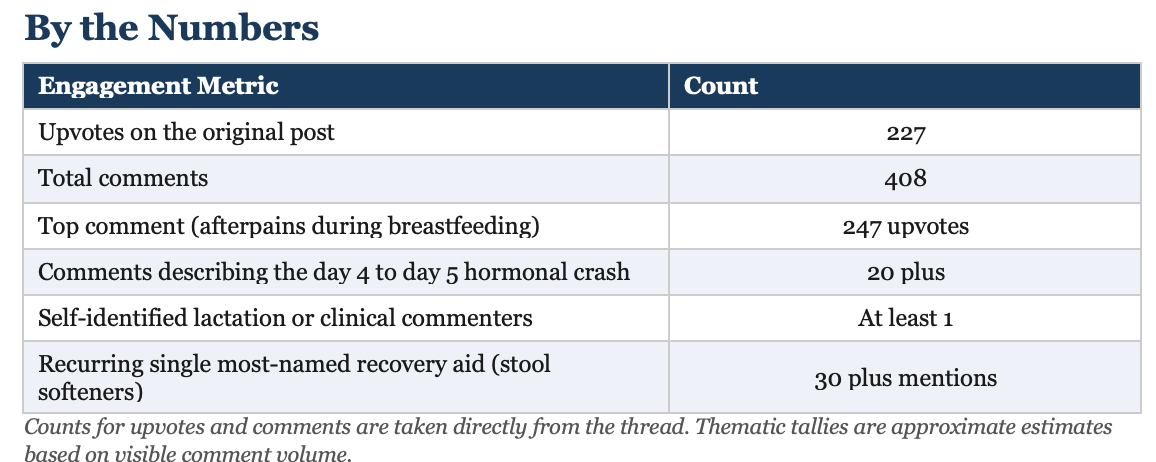
The thread drew 408 comments and 227 upvotes.
The answers were strikingly consistent.
The single most upvoted reply, with 247 votes, described painful uterine contractions during breastfeeding.
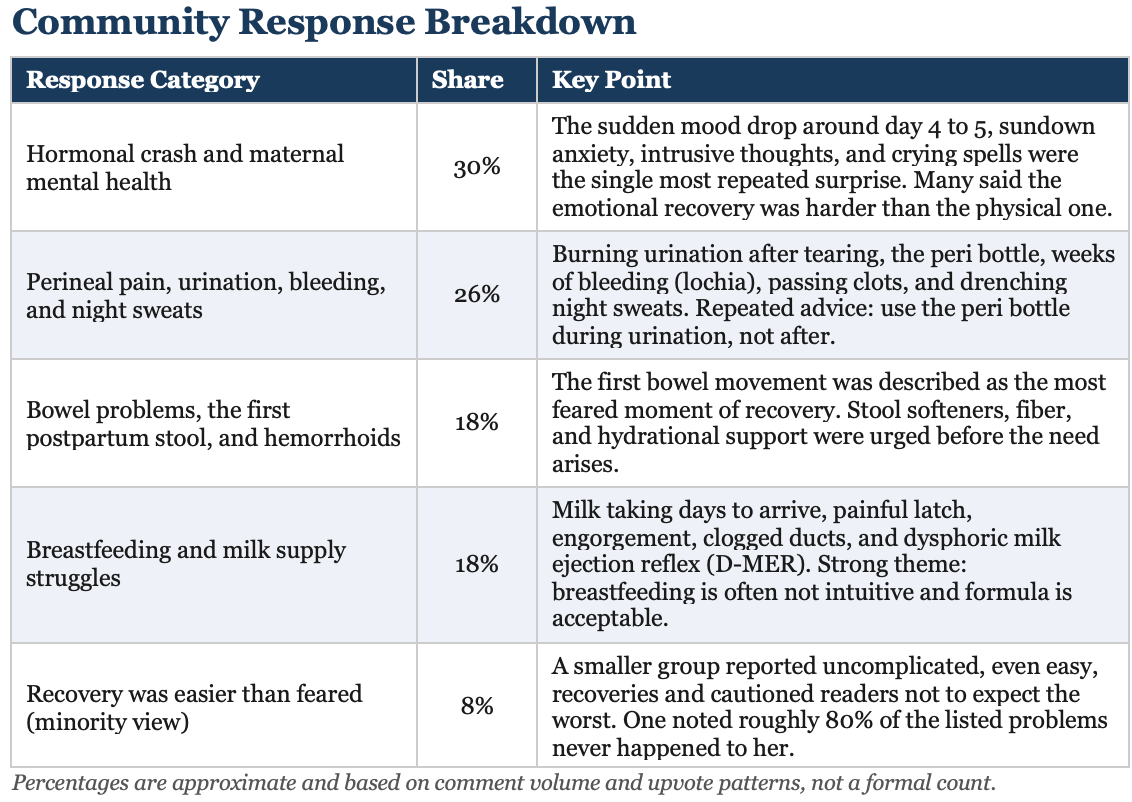
But the dominant theme was emotional, not physical.
Mother after mother described a sudden hormonal crash around the fourth or fifth day, with crying, anxiety, intrusive thoughts, and a nightly dread several women called the sundown scaries. Physical surprises followed: burning urination after vaginal tears, weeks of bleeding, drenching night sweats, the feared first bowel movement, hemorrhoids, and difficult breastfeeding. A smaller group pushed back, reporting easy recoveries and warning others not to expect the worst. The recurring sentiment across hundreds of comments was the same: I had no idea, and no one told me.
What Is Happening to the Body
Most of what these mothers described is normal postpartum physiology, the part of pregnancy care often called the fourth trimester. After delivery, estrogen and progesterone fall sharply within days. That drop drives the tearful, anxious baby blues, the night sweats, and the temperature swings. The uterus shrinks back toward its pre-pregnancy size, and these contractions, called afterpains, are felt most during breastfeeding because nursing releases oxytocin. They are stronger with each successive birth. Vaginal bleeding, called lochia, can last six weeks or longer and often returns after it seems to have stopped. Perineal tears, swelling, and stitches make urination and the first bowel movement painful, which is why stool softeners and a peri bottle help. None of this means something is wrong. The signs that do need a doctor are different: a headache or high blood pressure that can signal postpartum preeclampsia, heavy bleeding or fever, and low mood that lasts beyond two weeks.
What It Means: The Evidence
The thread is a near-perfect mirror of the published evidence, and that is the uncomfortable part. The baby blues are not rare. They affect somewhere between 15 and 85 percent of mothers, peak around the fifth day after delivery, and usually resolve on their own within two weeks1. The repeated day 4 and day 5 crash described by these women is textbook. When low mood lasts beyond two weeks, it is no longer the blues; up to about 1 in 7 mothers develops postpartum depression1, which is why the two-week mark matters and why several commenters who said it lasted longer needed care.
The emotional dominance of this thread is also predictable. When researchers asked mothers, obstetricians, and nurses to rank what recovery actually involves, psychosocial distress ranked as the single highest domain, above pain and physical function2.
Yet antenatal education still front-loads labor and treats recovery as an afterthought. That gap is dangerous, not just unpleasant.
ACOG reframed postpartum care as an ongoing process, the fourth trimester, and recommends contact within the first 3 weeks and a comprehensive visit by 12 weeks, precisely because more than half of pregnancy-related deaths occur after the birth, not during it3.
The single comment about postpartum preeclampsia, where blood pressure climbed dangerously after delivery, was not an outlier; it was a woman catching a leading cause of maternal death because a family member noticed her symptoms.
The teaching point is simple.
Nearly everything these mothers called a blindside is known, common, and time-limited. Naming it in advance, with specific numbers and a timeline, turns terror into something manageable. The original poster said it best after one reply: knowing it is a known thing on a timeline made it far less frightening. Anticipatory guidance is not reassurance. It is care.
References
1 Pearlstein T, Howard M, Salisbury A, Zlotnick C. Postpartum depression. Am J Obstet Gynecol. 2009;200(4):357-364. doi:10.1016/j.ajog.2008.11.033. PMID: 19318144.
2 Sultan P, Jensen SE, Taylor J, et al. Proposed domains for assessing postpartum recovery: a concept elicitation study. BJOG. 2022;129(1):9-20. doi:10.1111/1471-0528.16937. PMID: 34536324.
3 ACOG Committee Opinion No. 736: Optimizing Postpartum Care. Obstet Gynecol. 2018;131(5):e140-e150. doi:10.1097/AOG.0000000000002633. PMID: 29683911.
THE FOURTH TRIMESTER CHEAT SHEET
What to expect in the weeks after birth

THE TIMELINE
Days 1 to 3:  Heavy bleeding, afterpains (uterus cramping, worse while
              breastfeeding), shaking, trouble peeing, organs "settling."
Day 4 to 5:   The hormone crash. Crying, anxiety, mood swings, "sundown"
              dread at night. Very common. Eases by about 2 weeks.
Day 2 to 5:   Milk usually comes in. Breasts may get hard and sore for a
              day or two.
Weeks 1 to 6: Bleeding (lochia) continues, fading red to pink to pale.
              Night sweats. Soreness. It can stop and restart.
Months 3 to 4: Hair sheds a lot. Temporary. It grows back.

NORMAL AND EXPECTED (your body)
- Bleeding up to 6 weeks, with occasional small clots and a strong smell
- Afterpain cramps that get stronger with each baby
- Burning when you pee if you tore. Use a peri bottle WHILE you pee
- A hard, dreaded first bowel movement
- Drenching night sweats and hot or cold flashes
- Leaking urine when you sneeze, cough, or stand; a heavy feeling below
- Breastfeeding that is hard at first. Latch pain, clogged ducts, slow milk
- A wave of sadness or nausea right as milk lets down (a real reflex)

NORMAL AND EXPECTED (your mind)
- Tearfulness and feeling overwhelmed in the first 2 weeks
- Trouble sleeping even when the baby sleeps
- Checking the baby's breathing over and over

CALL YOUR DOCTOR OR MIDWIFE NOW IF:
- Bleeding soaks more than one full pad in an hour
- A clot is bigger than a golf ball
- Foul-smelling discharge WITH a fever
- Blood pressure 140/90 or higher (CALL). 160/110 or higher (EMERGENCY)
- Severe headache that pain relievers don't touch, vision spots/blurring,
  pain under the right ribs, sudden swelling, or shortness of breath
  (these can mean preeclampsia, which can start AFTER birth)
- Low mood, anxiety, or scary thoughts lasting past 2 weeks, or that
  feel out of control. Don't wait for the 6-week visit.

DANGER FACT TO REMEMBER
High blood pressure after birth can strike women who had a normal
pregnancy. More than half of pregnancy deaths happen after the birth.
If you had high blood pressure in pregnancy, get a BP check in week 1.

PREPARE NOW (while you are pregnant)
- Recovery kit: stool softener, peri bottle, ice packs/padsicles, witch
  hazel pads, numbing spray, high-waisted disposable underwear, big pads
- Start a stool softener in the first days, before you need it
- Ask now for a pelvic floor physical therapy referral
- Keep some formula on hand. A fed baby is the goal. Formula is fine.
- Tell your partner: handle food and chores week 1, and help you call
  if your mood isn't better by 2 weeks

TWO RULES
1. Almost everything on this list is normal and temporary.
2. The few things that aren't (heavy bleeding, high blood pressure,
   mood that won't lift) are worth a call. When in doubt, call.