

It appears in childbirth education, birth plans, social media, books, and even scientific publications. The story is familiar.
An epidural leads to oxytocin.
Oxytocin leads to fetal heart rate abnormalities.
Fetal heart rate abnormalities lead to cesarean delivery.
The conclusion seems obvious.
If the first intervention had never occurred, the cesarean would never have happened.
It is a compelling narrative.
It is also a causal claim.
And causal claims require evidence.
What if we have been asking the wrong question?
What if many so-called cascades of intervention are not caused by the intervention at all?
What if they are instead the consequence of a labor that was already becoming increasingly abnormal?
What if the interventions are simply the visible markers of clinicians recognizing new risks as labor unfolds?
That possibility changes how we interpret research.
It changes how we counsel pregnant patients.
And it changes how we think about one of the most frequently repeated concepts in maternity care.
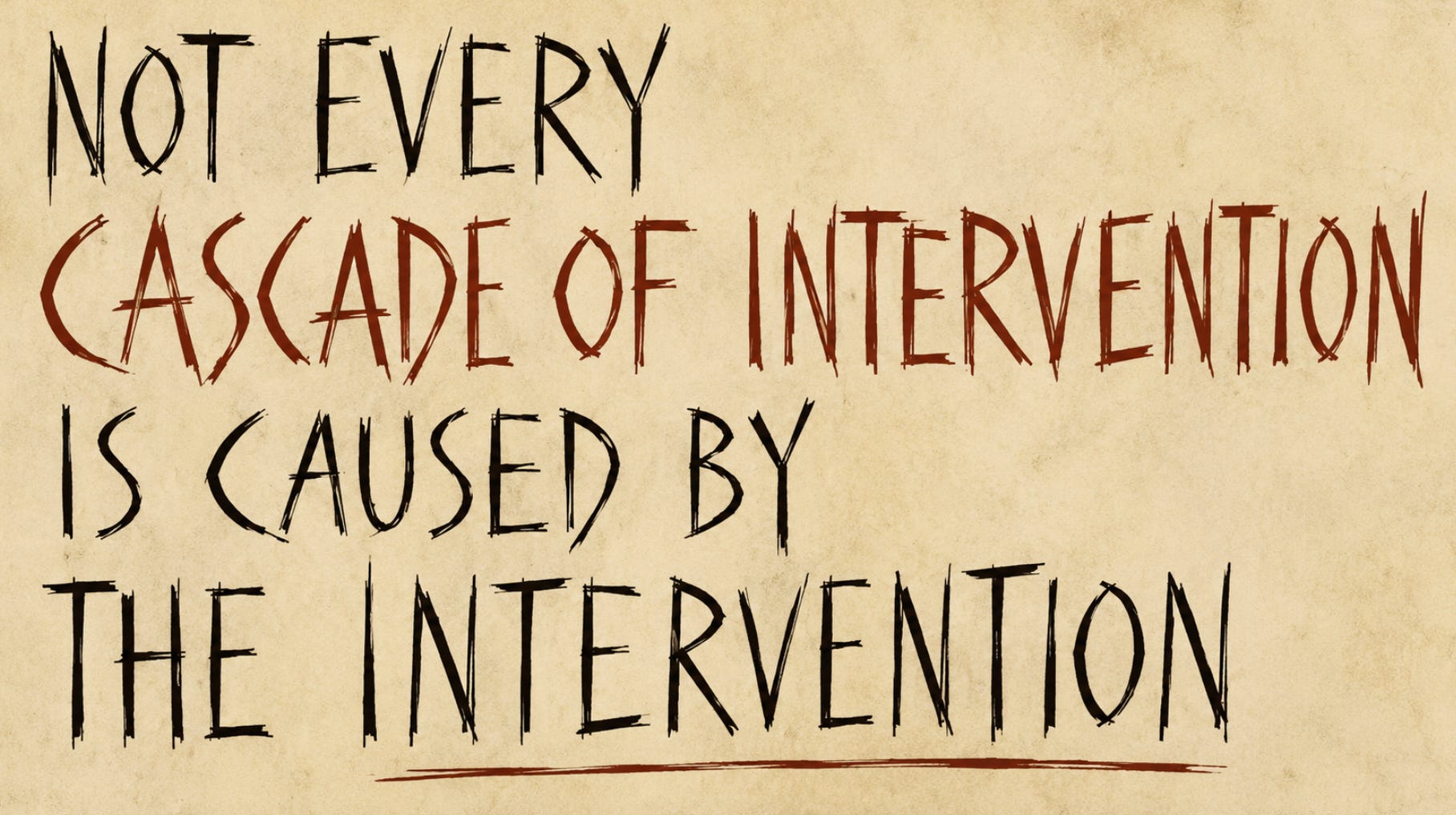
This article argues that many “cascades of intervention” are better understood as cascades of risk recognition.
Subscribe to read the full article
The remainder of this essay explores why sequence is so often mistaken for causation, how confounding by indication shapes obstetric decision making, why observational studies can reinforce misleading narratives, and why distinguishing intervention from risk recognition matters for evidence-based counseling and patient safety.
