

A patient education chart from two respected maternal health organizations raises serious questions about clinical completeness, informed consent, readability, and the ethical responsibility to help pregnant patients make meaningful medical decisions.
A pregnant woman develops a fever, cough, and nasal congestion. She wants to know which medications she can take without harming her baby.
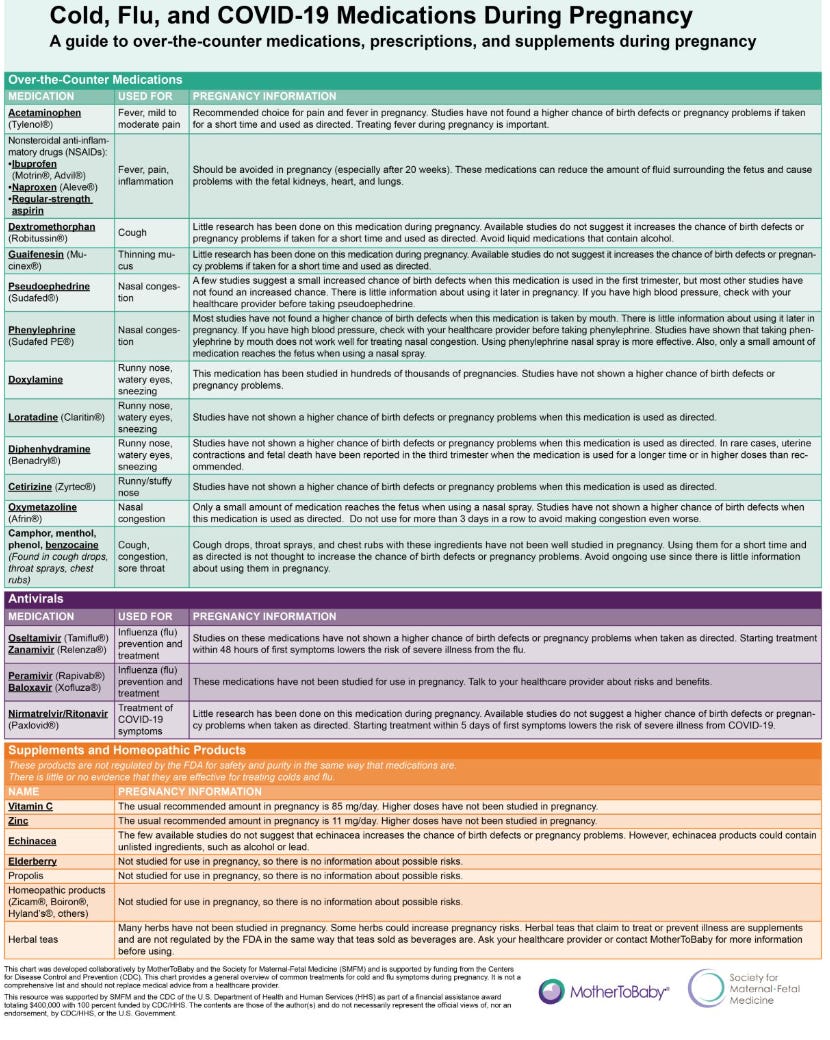
She finds a colorful chart titled Cold, Flu, and COVID-19 Medications During Pregnancy, developed by MotherToBaby and the Society for Maternal-Fetal Medicine (SMFM).
The chart lists common over-the-counter medications, antiviral drugs, supplements, and homeopathic products. It describes what the medications are used for and summarizes available information about their safety during pregnancy.
MotherToBaby is the public education service of the Organization of Teratology Information Specialists (OTIS), a nonprofit organization receiving substantial federal funding, including grants from the CDC and HRSA that continued under the Trump administration. Importantly, MotherToBaby explicitly identifies enabling informed decision-making through accurate, up-to-date information as part of its mission. That makes the central question even more important: Does this chart actually enable informed decisions, or does it merely distribute information without ensuring that patients can understand and act on it?
At first glance, it appears helpful. It bears the names and logos of two respected organizations.
But I examined the chart more critically.
The central question is not whether the chart contains useful information. It does. The question is whether it provides patients with the information they need, in language they can understand, to participate meaningfully in medical decisions.
I identified several concerns. Some involve clinical omissions. Others concern how risks and benefits are presented. Still others involve health literacy.
A preliminary readability assessment also suggested that the explanatory language is substantially more difficult than the commonly recommended sixth- to seventh-grade level for patient education.
But readability is only one part of a much larger problem.
After more than 50 years practicing obstetrics, I believe professional medical organizations must distinguish between distributing medical information and fulfilling their responsibility to support informed consent.
This chart provides an important case study.
1. The Central Ethical Problem: Information Is Not Enough For Informed Consent
A patient cannot make a genuinely informed treatment decision simply because someone has provided a list of medications and their possible adverse effects.
Informed consent requires much more.
Patients must understand the clinical problem, the recommended treatment, its expected benefits, material risks, reasonable alternatives, and the consequences of declining treatment.
They must also have an opportunity to ask questions and make a voluntary decision.
ACOG’s Committee Opinion No. 819, Informed Consent and Shared Decision Making in Obstetrics and Gynecology, recognizes that informed consent is an ethical process grounded in respect for patient autonomy.
Importantly, informed consent is not simply a document or a signature. It is a process of communication.
The SMFM and MotherToBaby chart primarily provides medication exposure information. It frequently addresses whether studies have identified increases in birth defects or other pregnancy problems.
That information matters.
But it does not consistently answer several essential clinical questions:
Does the medication work?
How much benefit can the patient expect?
Is it the preferred treatment?
Are there safer or more effective alternatives?
What happens if the patient does not take it?
How urgent is treatment?
What should the patient do next?
A one-page chart cannot replace a clinical informed consent discussion, and it would be unreasonable to demand that it do so.
However, a patient education document should facilitate that discussion rather than leave critical information unexplained.
A chart can be factually accurate and still be inadequate for supporting an informed decision.
That distinction is fundamental.
2. The Clinical Problem: Safety Without Sufficient Attention to Benefit
Much of the chart focuses on whether medication exposure during pregnancy has been associated with birth defects or other adverse outcomes.
This emphasis reflects MotherToBaby’s legitimate expertise in reproductive toxicology.
But pregnancy medication counseling cannot be reduced to teratogenicity.
Consider influenza.
Influenza during pregnancy can cause serious maternal illness. Prompt antiviral treatment is recommended. Oral oseltamivir is the preferred medication.
The chart correctly states that starting antiviral treatment within 48 hours reduces the risk of severe illness.
However, it does not adequately communicate that treatment should not be withheld solely because 48 hours have passed.
ACOG recommends initiating treatment as soon as possible and not delaying treatment while waiting for laboratory confirmation.
A pregnant patient reading the chart on her third day of illness could mistakenly believe that antiviral treatment would no longer be worthwhile.
This is not simply a missing detail.
When treatment timing affects clinical outcomes, incomplete communication may influence whether a patient seeks treatment at all.
The chart also lists oseltamivir and zanamivir together without clearly identifying oseltamivir as preferred.
It groups peramivir and baloxavir despite important differences in their clinical roles and recommendations during pregnancy.
The result is a medication list rather than a sufficiently informative treatment guide.
3. The COVID-19 Problem: What About Treatment Alternatives and Drug Interactions?
The chart includes nirmatrelvir/ritonavir, commonly known as Paxlovid.
It discusses available pregnancy safety evidence and states that treatment within five days of symptom onset lowers the risk of severe COVID-19 illness.
But it omits remdesivir, an important treatment alternative.
It also fails to emphasize major drug interactions associated with ritonavir and the importance of assessing renal function when selecting and dosing Paxlovid.
For a pregnant patient with COVID-19, the decision involves more than whether a medication has been associated with birth defects.
It involves determining whether antiviral treatment is indicated, which treatment is appropriate, and whether maternal medical conditions or other medications affect that choice.
Here is the broader ethical concern.
We sometimes place disproportionate emphasis on fetal medication exposure while failing to explain the risks of leaving maternal disease untreated.
Not treating an infection is itself a clinical decision with potential consequences for both the pregnant patient and the fetus.
An informed decision requires discussing both sides of that comparison.
A Major Omission: Where Is Vaccination?
The chart discusses medications for influenza and COVID-19 but does not address vaccination.
Influenza vaccination is a central component of preventing serious influenza illness during pregnancy. COVID-19 vaccination recommendations also deserve explicit, current discussion, including relevant differences among professional and public health recommendations.
Although vaccination is not a treatment for an existing infection, patients seeking guidance about influenza and COVID-19 during pregnancy should be directed to evidence-based prevention recommendations.
A document from SMFM and MotherToBaby could accomplish this with a brief statement and links to current vaccination guidance.
Treating infection matters. Preventing infection and severe disease matters too. Patient education should connect both.
An Especially Puzzling Omission: Both SMFM and MotherToBaby Recommend Vaccination
Both the Society for Maternal-Fetal Medicine (SMFM) and MotherToBaby have published recommendations supporting influenza and COVID-19 vaccination during pregnancy.
MotherToBaby explicitly states that influenza antiviral medications are not substitutes for vaccination, while SMFM has repeatedly emphasized the importance of maternal immunization in preventing serious illness. Yet their jointly published medication chart does not mention vaccination or direct patients to either organization’s vaccination resources. Although the chart focuses on medications, a simple statement about vaccination and a link to current recommendations would provide essential preventive context.
The problem is not that these organizations fail to recognize the importance of vaccination. It is that their jointly branded patient education material separates treatment from prevention, leaving patients without a complete picture of how best to protect themselves and their pregnancies.
4. The Difference Between a Safe Medication and an Effective Medication
The chart appropriately acknowledges that oral phenylephrine does not work well for nasal congestion.
That is important, particularly given the FDA’s 2024 proposal to remove oral phenylephrine from the relevant OTC monograph because evidence did not support its effectiveness.
But this illustrates why medication counseling must address both efficacy and safety.
A medication may have reassuring reproductive safety data yet provide little or no meaningful clinical benefit.
Conversely, an effective medication may have uncertainties that patients must weigh against the risks of untreated illness.
Those are different questions.
The same concern applies to supplements and homeopathic products.
The chart correctly states that evidence for their effectiveness against colds and influenza is limited or absent. Yet their presentation alongside established antiviral treatments can still make the clinical distinctions less apparent.
Patients need to know not only whether an intervention is dangerous, but whether it is likely to help.
An informed choice requires evidence about benefits, risks, and alternatives, not merely the absence of known fetal harm.
5. The Readability Problem: I Examined the Actual Language
Patient education materials are commonly recommended to be written at approximately the sixth-grade level, although specific institutional standards differ.
I conducted a preliminary readability assessment of the chart’s explanatory text.
The analysis covered approximately 781 words, excluding medication-name lists, headings, logos, and administrative disclosures.
The preliminary estimates were:
Flesch-Kincaid Grade Level: 9.3
This corresponds to approximately ninth-grade reading difficulty, above the commonly recommended sixth- to seventh-grade target.
SMOG Grade: 11.8
This suggests approximately twelfth-grade reading difficulty. The SMOG formula was developed specifically to estimate reading difficulty and has frequently been applied to health education materials.
Automated Readability Index: 9.6
This corresponds to approximately tenth-grade reading difficulty.
Flesch Reading Ease: 55.0
This falls within the range generally classified as fairly difficult reading.
These figures are preliminary calculations, not independently validated measurements. They require confirmation from a complete, audited transcription before they can be treated as reproducible research findings.
Nevertheless, all three grade-level estimates point toward substantially greater linguistic complexity than the commonly recommended target for patient education.
The differences between the scores are expected because the formulas use different measures of sentence length, word length, and syllable complexity.
But even these scores do not capture the entire problem.
The chart is presented in dense tables, with very small text and multiple sentences crowded into narrow columns.
It uses phrases such as:
“Available studies do not suggest it increases the chance of birth defects or pregnancy problems if taken for a short time and used as directed.”
This sentence may be understandable to a medically trained reader, but what does it mean to a pregnant patient?
Does it mean the medication has been proven safe? That no adverse effects have been identified? That the studies were too small to detect uncommon risks?
These distinctions matter.
And readability formulas do not determine whether patients understand them.
A ninth-grade readability score does not mean that only patients educated through ninth grade can understand the document. It indicates linguistic complexity, not individual comprehension.
Nevertheless, patient education materials should not place unnecessary demands on reading ability.
The ethical issue is access to understandable information, not the educational achievements of individual patients.
6. Readability Is Only One Part of Health Literacy
This distinction deserves particular emphasis.
A document may achieve a sixth-grade reading level and still fail as patient education.
Short sentences and simple words do not necessarily make a document useful.
For example:
“This drug may help. It may have risks. Ask your doctor.”
Those sentences are easy to read.
But they provide almost no useful basis for choosing treatment.
The Agency for Healthcare Research and Quality developed the Patient Education Materials Assessment Tool (PEMAT) to evaluate two separate qualities.
Understandability: Can patients process and explain the information?
Actionability: Can patients identify what they are supposed to do?
These are related but distinct concepts.
The SMFM and MotherToBaby chart raises questions in both domains.
Its dense layout and technical language raise concerns about understandability.
Its failure to consistently identify preferred treatments, clear treatment pathways, and concrete next steps raises concerns about actionability.
Neither concern can be resolved simply by lowering the reading grade.
And neither readability nor PEMAT scoring, by itself, proves that informed consent has occurred.
To establish actual comprehension, patients must be asked whether they understand the information and can use it in realistic clinical situations.
That would require testing the chart with members of its intended audience, including patients with limited health literacy.
I would like to know whether SMFM and MotherToBaby performed such testing before releasing the chart.
If they did, the methods and findings should be available.
If they did not, that is an important opportunity for improvement.
7. What Else Is Missing?
Beyond influenza and COVID-19 treatment, several additional issues deserve attention.
NSAIDs: The chart appropriately warns about risks after 20 weeks, but could better distinguish fetal renal effects, oligohydramnios, and later ductus arteriosus complications. It should explicitly distinguish this advice from medically indicated low-dose aspirin.
Pseudoephedrine: First-trimester exposure is discussed, but the distinction between uncertain observational associations and clinical recommendations could be clearer.
Acetaminophen: The chart emphasizes reassuring pregnancy safety evidence. Patients should also understand the importance of appropriate dose and duration, avoiding duplicate acetaminophen-containing products, and treating clinically significant fever.
Multi-ingredient cold preparations: Patients frequently purchase products containing several active medications. The chart lacks prominent warnings about unintentionally combining ingredients.
Urgent evaluation: Patients need clear instructions about when symptoms such as difficulty breathing, chest pain, dehydration, progressive illness, or reduced fetal movement require immediate assessment.
These limitations do not make all the chart’s statements incorrect.
They make the chart less complete and actionable than its presentation may lead patients to expect.
8. The Risk of False Reassurance
One recurring phrase in the chart is that studies have not identified increased chances of birth defects or pregnancy problems.
That wording is common in teratology counseling and is often scientifically appropriate.
But there is an important distinction between evidence demonstrating that a risk is unlikely to be clinically important, evidence that has not identified a risk, and insufficient evidence to determine whether a risk exists.
These statements are not interchangeable.
A reassuring conclusion from extensive, well-designed studies carries more weight than the absence of a reported association from a handful of small observational studies.
Patients deserve to understand these differences.
Without explanation, a statement intended to communicate uncertainty may instead communicate unwarranted certainty.
The goal should not be to reassure patients as much as possible. It should be to inform them as accurately and understandably as possible.
That is both a clinical and an ethical responsibility.
9. What Should a Better Pregnancy Medication Guide Look Like?
I would recommend that SMFM and MotherToBaby redesign the resource around the actual decisions pregnant patients face.
Rather than simply arranging information by medication name, begin with the patient’s clinical problem.
For example:
I am pregnant and think I have influenza. What should I do?
The resource should explain that influenza may be more serious during pregnancy, that prompt clinical contact and antiviral treatment are recommended, that oseltamivir is preferred, and that treatment may remain appropriate after 48 hours.
It should explain common treatment risks, expected benefits, uncertainty, and the consequences of delaying treatment.
It should then identify when urgent medical assessment is necessary.
Similarly, a COVID-19 section should identify the available treatments, their timing, major contraindications and interactions, and the importance of timely evaluation.
Every section should be built around five questions:
What is the medical problem?
What treatment is recommended, and why?
What benefits and risks should I understand?
What are the alternatives, including no treatment?
What action should I take now?
After development, the organization should evaluate the material using recognized readability measures, PEMAT assessment, and direct patient comprehension testing.
The goal should be approximately sixth-grade readability where feasible, without sacrificing necessary clinical precision.
And the material should display its date of review and be updated as clinical guidance changes.
10. Professional Organizations Should Be Held to a Higher Standard
I recognize the challenge of creating concise medication guidance for pregnancy.
Evidence is often incomplete. Treatment recommendations evolve. Some medications have limited pregnancy-specific data. And patient education materials must remain reasonably brief.
But those challenges do not justify overlooking essential principles of patient communication.
SMFM and MotherToBaby are influential organizations. Clinicians and patients reasonably place significant trust in their educational resources.
That trust creates responsibilities beyond simply ensuring that individual sentences are factually defensible.
Professional organizations should ask whether patients can understand the information, whether it accurately represents evidence and uncertainty, and whether it helps patients recognize the best available treatment and participate in decisions.
A colorful chart with authoritative logos can look reassuring.
But presentation is not the same as comprehension.
Comprehension is not the same as actionability.
And neither, alone, constitutes informed consent.
Conclusion: The Ethical Obligation Is Not Merely to Inform. It Is to Enable Informed Decisions.
I do not question the value of MotherToBaby’s reproductive safety information or SMFM’s expertise in high-risk pregnancy care.
Much of the chart’s content is useful.
But the chart demonstrates how even well-intentioned patient education can fall short when information is presented without sufficient attention to clinical decisions, health literacy, and the risks of untreated disease.
Its readability is a measurable concern. Preliminary grade-level estimates range from approximately ninth to twelfth grade, above the commonly recommended level for patient education.
Yet that is only one deficiency.
The larger issue is whether patients receive the information necessary to understand their options, the physician’s recommendation, the evidence supporting it, and the consequences of treatment or non-treatment.
The document omits recommendations for vaccination.
We should hold patient education materials from professional medical organizations to three standards.
First, clinical accuracy and completeness. The material must provide reliable evidence about benefits, risks, alternatives, and clinically important recommendations.
Second, understandability and actionability. Patients must be able to understand what the material means and identify what they should do.
Third, support for informed consent. The material should facilitate, not replace, a meaningful clinical conversation in which patients can make voluntary, informed decisions.
The chart raises legitimate concerns about all three.
The solution is not to abandon patient education charts. It is to improve them, systematically test them, and design them around the decisions patients actually face.
After all, a patient who has received information has not necessarily understood it.
A patient who understands individual facts has not necessarily understood the available choices.
And a patient who has been told that a medication is unlikely to cause birth defects has not necessarily been informed about the benefits of taking it or the risks of declining it.
Patient information is what we give patients. Informed consent is what we help patients achieve.
That distinction should guide every patient education resource we publish.
References
American College of Obstetricians and Gynecologists. Informed consent and shared decision making in obstetrics and gynecology. Committee Opinion No. 819. Obstet Gynecol. 2021;137–41.
American College of Obstetricians and Gynecologists. Influenza in pregnancy: prevention and treatment. Practice Advisory. 2025.
Shoemaker SJ, Wolf MS, Brach C. Development of the Patient Education Materials Assessment Tool (PEMAT): a new measure of understandability and actionability for print and audiovisual patient information. Patient Educ Couns. 2014;96(3):395–403.
Agency for Healthcare Research and Quality. The Patient Education Materials Assessment Tool and User’s Guide. Rockville (MD): AHRQ; 2013.
U.S. Food and Drug Administration. FDA proposes ending use of oral phenylephrine as OTC monograph nasal decongestant active ingredient after extensive review. November 7, 2024.
AI disclosure: Generative AI assisted with drafting, editorial organization, and preliminary readability assessment. The author is responsible for reviewing the clinical interpretations, verifying references and numerical findings, and approving the final manuscript.