

Introducing the new ObGyn Intelligence Due Date & Pregnancy Calculator and Calendar — a free tool designed to make pregnancy dating understandable, visual, useful, and accessible to patients and healthcare professionals worldwide.
Try the complete Pregnancy Calculator and Calendar
Why another due date calculator?
After more than four decades practicing obstetrics and maternal-fetal medicine, I have probably calculated tens of thousands of pregnancy due dates.
And I have learned something important: Patients rarely want just their due date. They want to understand their pregnancy.
How many weeks pregnant am I today? When will I reach 20 weeks? When does the third trimester begin? When should the anatomy ultrasound be performed? What date will I be 37 weeks? How many days remain until my due date?
These are not complicated questions, but they are important ones.
For decades, we have answered them using pregnancy wheels, printed calendars, ultrasound reports, smartphone applications, and dozens of different websites.
Most online calculators provide a single answer: your estimated due date.
Some provide additional information, but few bring the entire pregnancy timeline together in one place.
I wanted something better.
Not simply another calculator, but a comprehensive, interactive pregnancy dating and planning tool that serves both pregnant patients and the clinicians who care for them.
That became the new ObGyn Intelligence Due Date & Pregnancy Calculator and Calendar
.
From a simple calculation to a complete pregnancy experience
The mathematics of pregnancy dating is relatively straightforward.
By convention, gestational age is calculated from the first day of the last menstrual period. Ovulation and fertilization are generally estimated at approximately two weeks, and the estimated due date corresponds to 40 weeks, or 280 days, from the last menstrual period.
But pregnancy itself is anything but a single calculation.
I approached the design with a different question:
What if a pregnant patient could see her entire pregnancy, day by day, on one screen?
And what if her clinician could generate exactly the same calendar, share it instantly, and use it as a common reference throughout prenatal care?
That was the organizing idea behind this tool.
Rather than treating the due date as the end of the calculation, I made it the starting point
1. Your pregnancy at a glance
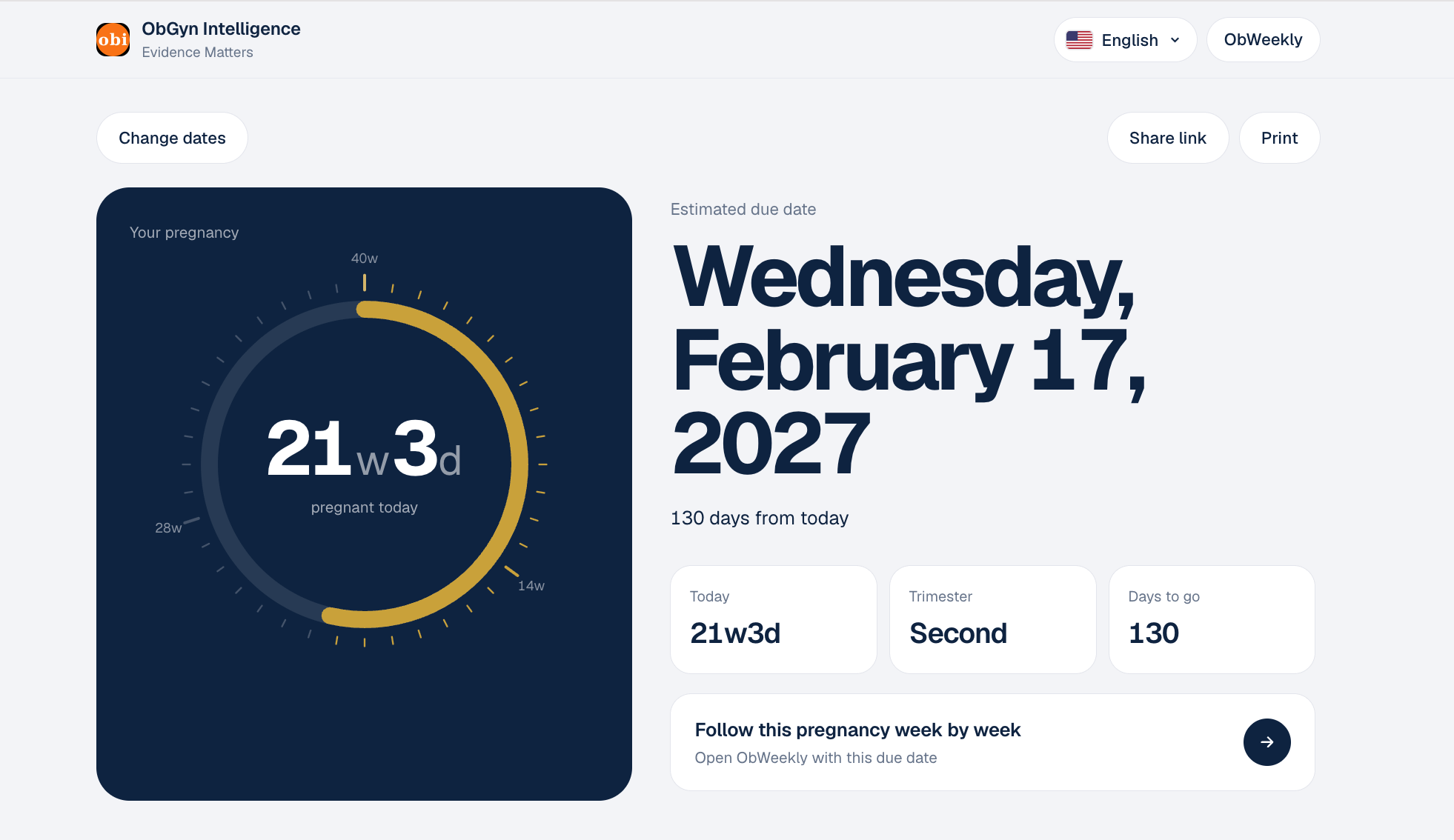
The first thing you see is a personalized pregnancy dashboard.
Instead of a wall of numbers, a circular pregnancy graphic displays your current gestational age and visually represents your progress through pregnancy.
Next to it, the calculator shows your estimated due date in large, easy-to-read text.
It also displays:
Current gestational age in weeks and days
Current trimester
Number of days remaining until the estimated due date
A visual representation of the pregnancy’s progress
A direct connection to ObWeekly for week-by-week pregnancy information
For example, a pregnancy with an estimated due date of February 17, 2027, can be explored here:
https://tools.obmd.com/due-date-calculator?due=2027-02-17
The link opens the calculator with that due date already entered.
This means you don’t have to start over each time you want to see the same pregnancy.
2. The pregnancy calendar: every day, from beginning to end
This may be my favorite feature.
I wanted to recreate the practical usefulness of the traditional obstetric pregnancy wheel, but make it substantially more powerful.
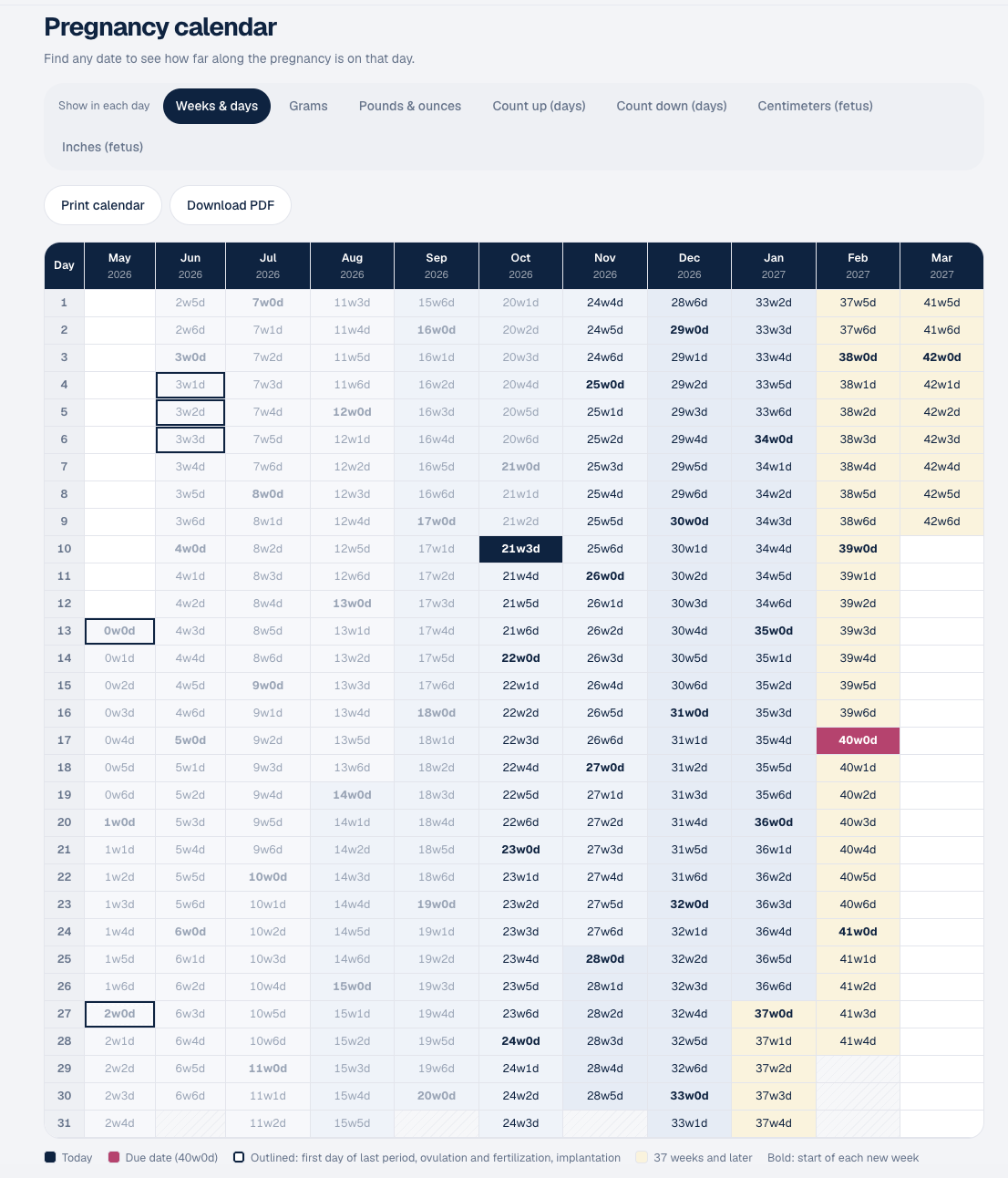
The result is an interactive pregnancy calendar displaying the entire pregnancy across consecutive months.
Every date has its own pregnancy information.
On any particular day, you can immediately see the corresponding gestational age.
The entire pregnancy is visible without repeatedly entering dates.
The calendar highlights important information with intuitive visual cues, including the estimated due date, the beginning of each new pregnancy week, and the dates associated with the last menstrual period, estimated ovulation, fertilization, and implantation.
The late-pregnancy period is shaded differently, making the approach to term immediately apparent.
Every date becomes meaningful in the context of pregnancy.
More than weeks and days
The calendar offers multiple ways to view its information.
You can switch between:
Weeks and days of gestation
Grams
Pounds and ounces
Count-up days
Countdown days
Centimeters and feet
Inches and feet
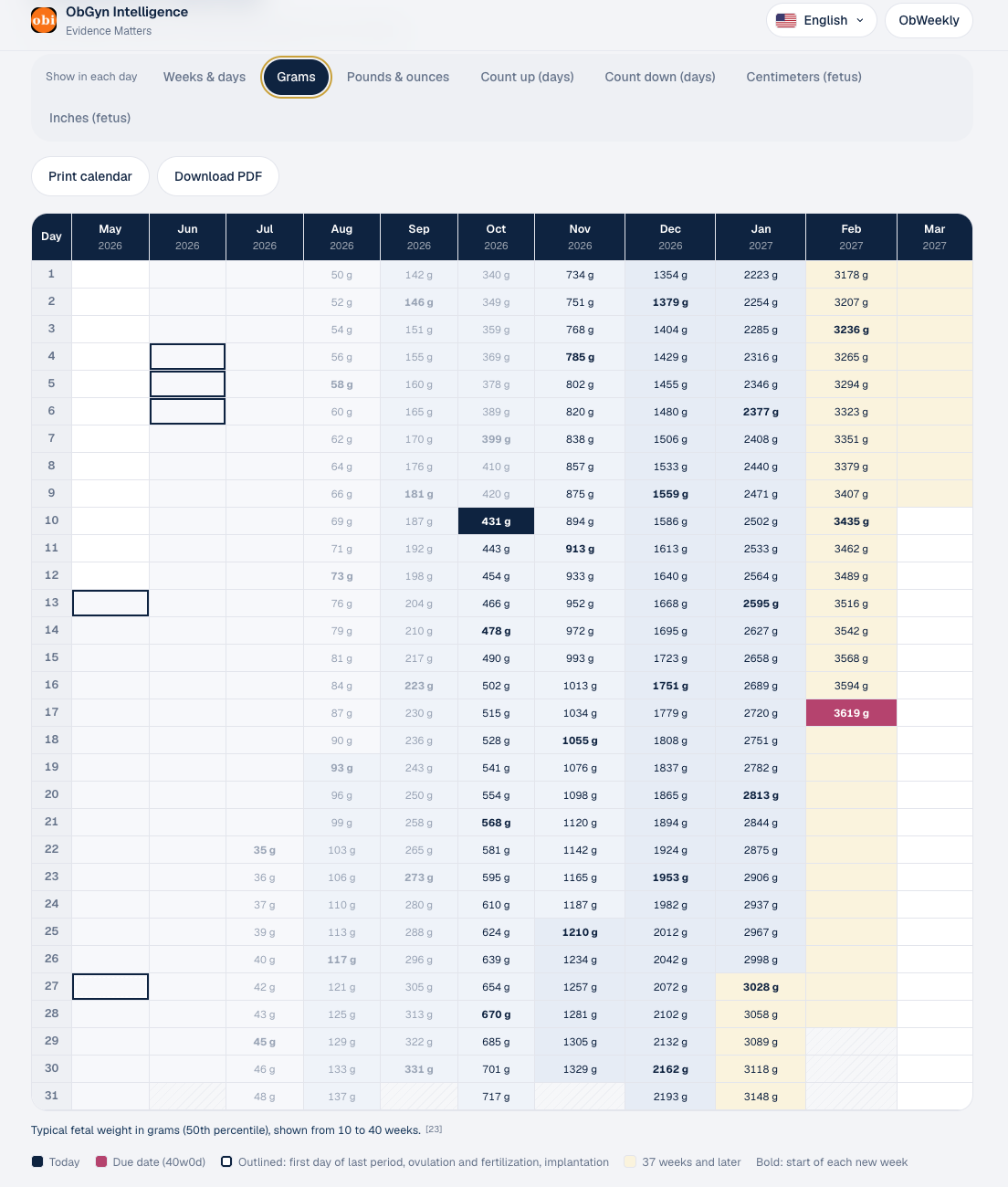
This makes the calendar useful for different questions and different ways of understanding pregnancy.
Want to know how many days pregnant someone will be on a particular date? Or how many days remain until the due date?
You can change the display rather than recalculate everything.
And the calendar can be printed or downloaded as a PDF.
This is particularly useful for prenatal consultations, patient education, and personal pregnancy planning.
3. A complete timeline of key pregnancy dates
Pregnancy is organized around clinical milestones, not merely calendar months.
That is why I included a separate Key Dates section.
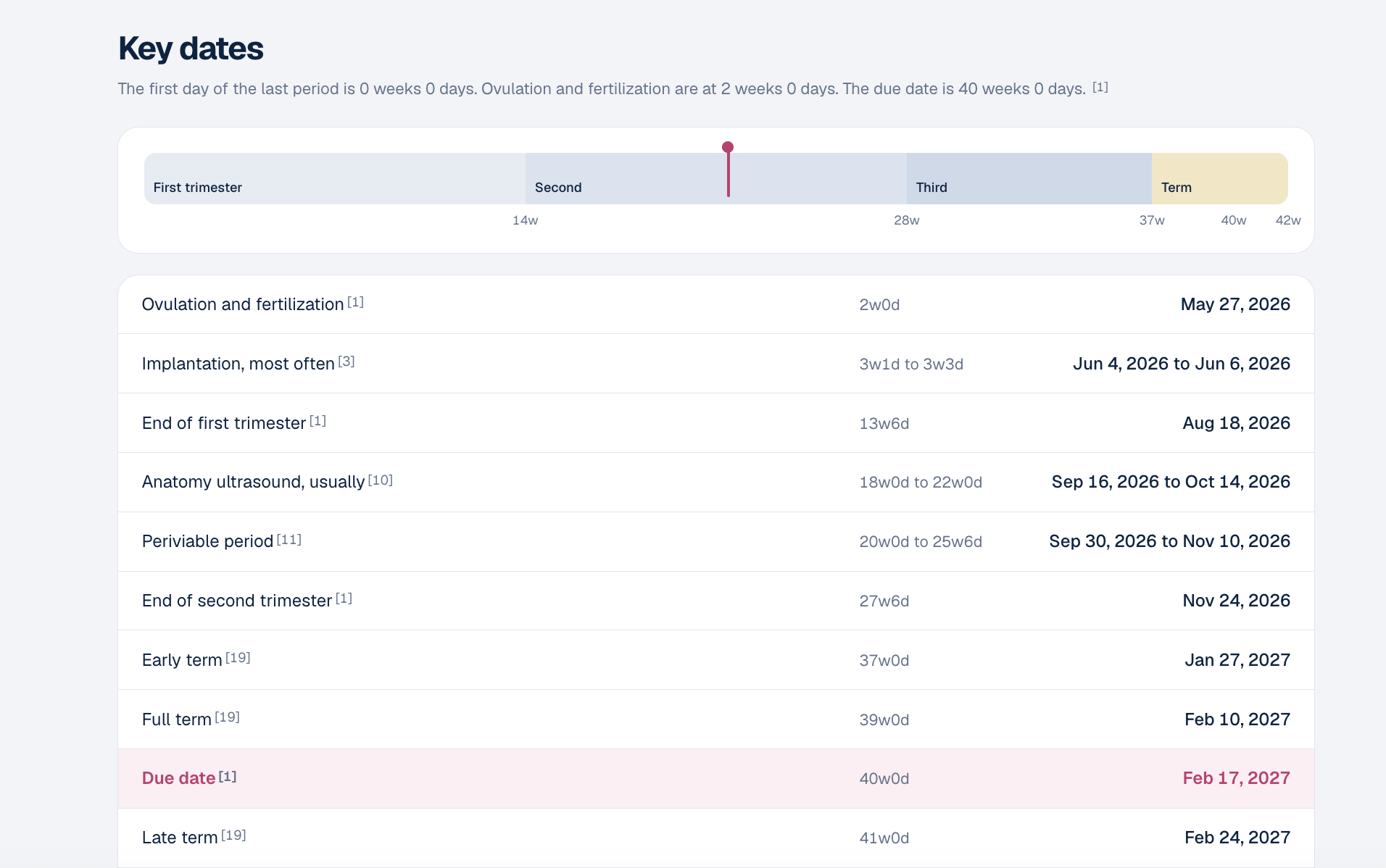
For each pregnancy, the calculator generates a timeline of important milestones, with their corresponding gestational ages and actual calendar dates.
These include:
Early pregnancy
Estimated ovulation and fertilization, the usual implantation window, and the end of the first trimester.
Midpregnancy
The customary timing for the fetal anatomy ultrasound, an illustrative periviability period, and the transition into the third trimester.
Late pregnancy
The beginning of early term at 37 weeks, full term at 39 weeks, the estimated due date at 40 weeks, and late term at 41 weeks.
The information is presented in two complementary formats.
First, a visual pregnancy timeline shows the first, second, and third trimesters, followed by the term period.
Second, a detailed table translates gestational-age milestones into actual dates.
That distinction matters.
Saying that an anatomy examination is usually performed between 18 and 22 weeks is useful.
But showing a particular patient the exact calendar range corresponding to 18–22 weeks in her pregnancy makes the information immediately actionable.
Of course, dates alone do not determine clinical management. Ultrasound dating, individual circumstances, and professional guidelines remain essential. The calendar is an educational and planning resource, not a substitute for medical judgment.
4. One of the most useful features: a shareable pregnancy URL
I believe this is a particularly valuable innovation.
Every pregnancy should be easy to share without requiring another person to repeat the calculation.
The calculator can generate a URL containing the estimated due date.
For example:
https://tools.obmd.com/due-date-calculator?due=2027-02-17
Open that URL, and the calculator loads the pregnancy with an estimated due date of February 17, 2027.
The recipient can then explore the personalized calendar, timeline, and gestational information.
Think about the possibilities.
A physician could send the link to a patient following an initial prenatal visit.
A sonographer could share the pregnancy dates after dating has been confirmed.
An expectant parent could share the calendar with a partner or family member.
A patient living far from her obstetrician could use the same pregnancy timeline as her clinical team.
No account is needed to use the link.
No names or medical records need to be included in the URL.
The date itself is sufficient to generate the calendar.
There is one important privacy consideration: an estimated due date can itself be personal information.
Share these links only with people you intend to receive that information.
One due date. One link. A shared understanding of the pregnancy timeline.
5. Available in eight languages
Pregnancy is universal. Access to understandable pregnancy information should be, too.
That is why I wanted the calculator to support multiple languages from the beginning.
The tool is available in eight languages, with language selection directly from the interface.
For patients and families who are more comfortable receiving information in a language other than English, this can make the tool substantially more accessible.
And for clinicians working in multilingual environments, the ability to provide a pregnancy calendar in a patient’s preferred available language is a practical advantage.
A patient’s understanding should not depend on being fluent in the language of her obstetrician.
The calculations are universal. The explanations should be accessible.
6. Built for patients, but also for healthcare professionals
Although the calculator is designed to be understandable to anyone, I created it with clinical workflows in mind.
Gestational age is central to virtually every aspect of obstetric care.
It determines how we interpret fetal growth, when we perform screening tests, how we assess preterm birth, when we consider interventions, and how we plan delivery.
A clear and consistent pregnancy calendar can help physicians, midwives, nurses, genetic counselors, sonographers, and other healthcare professionals communicate these dates more effectively.
Imagine a prenatal consultation in which the patient and clinician are looking at the same calendar.
The clinician can point to the recommended anatomy ultrasound window, explain the difference between 37 and 39 weeks, or identify a future gestational age without performing a new calculation.
The patient can take that same calendar home, save it as a PDF, or revisit it through a shareable URL.
This doesn’t replace professional care.
It improves how we communicate information that is already fundamental to professional care.
7. Print it. Download it. Share it. Return to it.
A good clinical calculator shouldn’t simply display an answer and disappear.
I wanted a tool that could be used throughout pregnancy.
That is why the interface includes options to print, download the pregnancy calendar as a PDF, and share a link.
Patients can revisit the same pregnancy over time.
Healthcare professionals can generate a calendar during a consultation and provide it to patients afterward.
The experience is designed to be practical, not merely impressive on a screen.
And because the pregnancy calendar is based on dates rather than a static screenshot, users can explore the entire pregnancy and ask different questions at different stages.
8. Connecting the calendar to ObWeekly
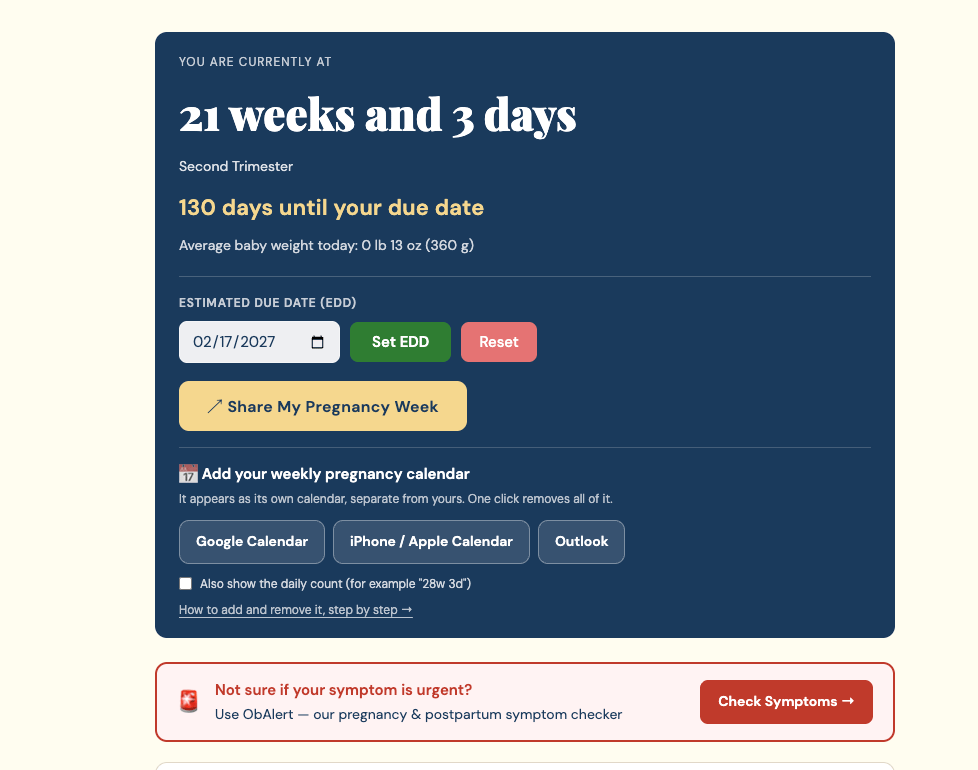
The calculator also provides a direct connection to ObWeekly, the companion pregnancy information experience.
This connection reflects another important principle behind the project.
Knowing that you are 21 weeks and 3 days pregnant is useful.
Here: https://tools.obmd.com/obweekly?due=2027-02-17
But understanding what that stage of pregnancy means is even better.
The calendar provides the temporal framework.
ObWeekly offers a way to follow the pregnancy week by week.
Together, they move beyond giving a patient a due date toward helping her follow the progression of pregnancy.
Add the calendar to your own Google calendar and it will show you every day of your pergnancy.
9. What building this calculator taught me
The most interesting part of developing this tool was not the arithmetic.
It was deciding how the information should be organized.
Physicians are accustomed to thinking in gestational weeks and days. We understand immediately what 20w0d, 28w0d, or 39w0d means.
Patients often think differently.
They think about calendar dates, upcoming appointments, work schedules, family events, and how much time remains before delivery.
I wanted the calculator to accommodate both ways of thinking.
That meant bringing together accurate date calculations, an intuitive interface, multiple display options, a readable calendar, a clinical timeline, and the ability to share a pregnancy without recreating it.
It also required thinking carefully about what should be shown prominently and what should remain available for those who want more detail.
My goal was not to make pregnancy more complicated.
It was to make the information already embedded in pregnancy dating easier to understand.
And I wanted it to be freely available.
Good medical information should not be difficult to access, interpret, or share.
10. An important clinical reminder: the estimated due date is still an estimate
No pregnancy calculator, however sophisticated, can predict exactly when a baby will be born.
An estimated due date is a reference point, not a promised birthday.
Furthermore, the accuracy of the calculated dates depends on the accuracy of the dating information used.
An uncertain last menstrual period, irregular ovulation, assisted reproductive technology, or ultrasound findings may require a different dating approach.
Once the best obstetric estimate of gestational age and due date has been established, that estimate should guide the pregnancy calendar.
A calculator should help patients understand an established due date, not encourage them to change clinically determined dates without appropriate evaluation.
Likewise, estimated ovulation, implantation, and fetal-size information are approximations, not direct measurements of an individual pregnancy.
These distinctions matter, especially when technology presents information with apparent precision.
Precision in displaying a date is not the same as certainty about the biology of pregnancy.
The larger idea: Better information, better conversations
Throughout my career, I have believed that one of the most important responsibilities of physicians is to make complex medical information understandable.
That principle applies as much to a pregnancy calendar as it does to genetic counseling, fetal ultrasound, or a difficult clinical decision.
Pregnancy dating is one of the simplest calculations in obstetrics.
Yet it underlies many of the most consequential decisions we make.
I wanted to bring that information together in one place and make it useful, understandable, multilingual, interactive, and shareable.
The result is more than a due date calculator.
It is a calendar, a timeline, a gestational-age reference, a patient education resource, and a communication tool.
For expectant parents, it provides a clearer view of the months ahead.
For healthcare professionals, it offers an accessible way to illustrate the pregnancy timeline.
And for both, it creates a common language around one of the most important numbers in obstetrics: gestational age.
Try it yourself
The ObGyn Intelligence Due Date & Pregnancy Calculator and Calendar is free to use.
Open the Due Date & Pregnancy Calculator
Or explore a sample pregnancy with an estimated due date of February 17, 2027:
Open the sample pregnancy calendar
Change the dates. Explore the calendar. Switch between gestational age and other displays. Download the PDF. Share the link. Try it in another language.
And let me know what you think.
After more than 40 years in obstetrics, I am still convinced that improving how we communicate medical information is one of the most important things we can do.
One pregnancy. Every important date. Eight languages. One shareable calendar.
Dr. Amos Grünebaum
ObGyn Intelligence — Evidence Matters