

700 Women a Day, Preventable. By Whom?
The government dismantles gun violence research. The food industry drives the obesity epidemic. The Medicaid system most OBs refuse. The postpartum period no one monitors. Then we call the deaths preventable.
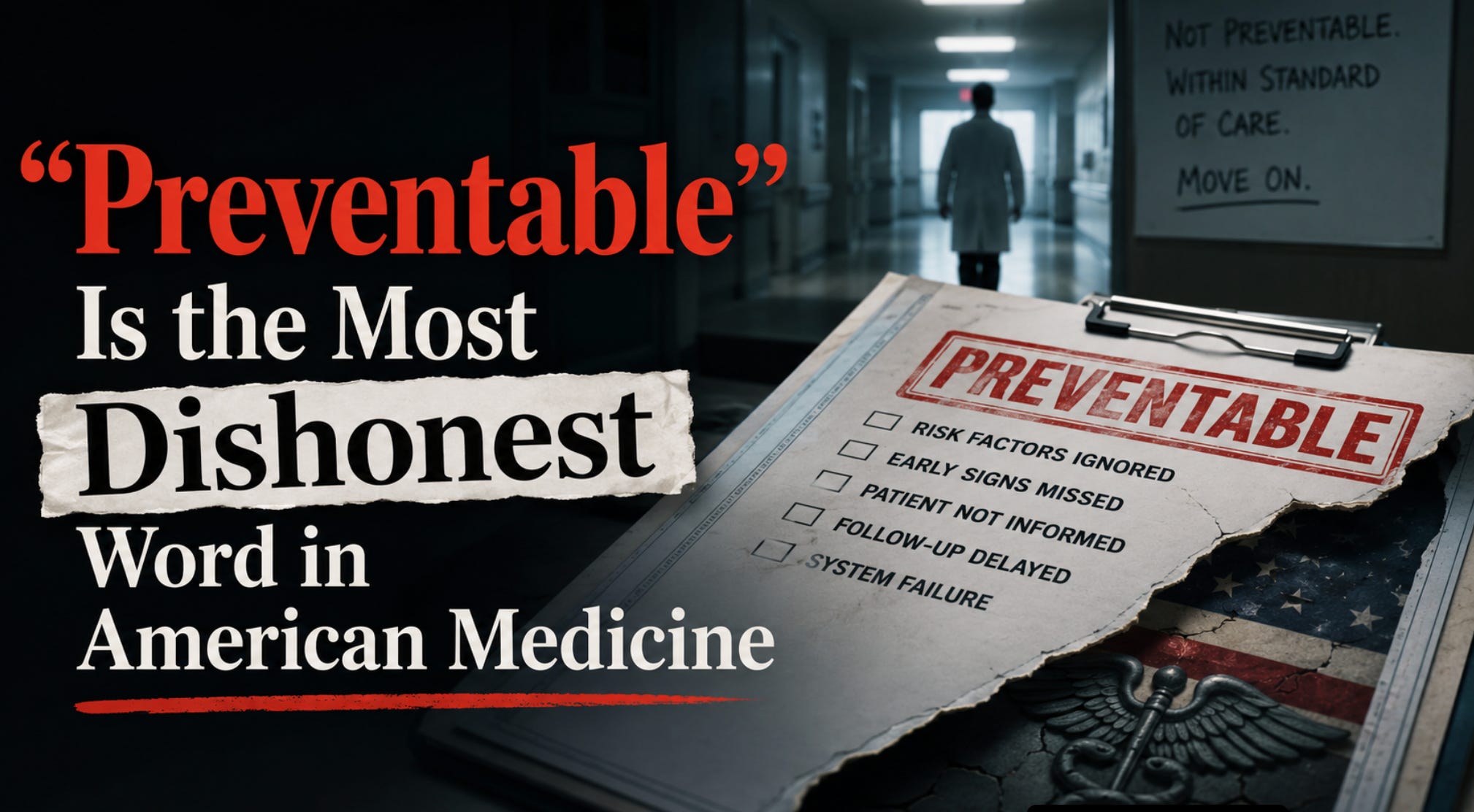
Preventable. Except We Are Actively Working Against Prevention.
Overdose, homicide, and suicide now lead US maternal mortality. What the country is actually doing about each one is a story about choosing not to prevent.
Most maternal deaths in the United States happen after a woman leaves the hospital. n Germany, statutory insurance covers postpartum midwife care, often including daily home visits early after birth and, in some descriptions, up to 20 visits in the first 10 days. The Netherlands provides kraamzorg, a maternity care aide/nurse system, usually about 49 hours of in-home support during the first 8 days after birth, adjusted by clinical and family need. The United States sends a six-week appointment letter. Then calls the death preventable. If you want to understand American maternal mortality, start there.
Overdose, homicide, and suicide now account for more than a quarter of US maternal deaths. The government has cut the CDC division that tracks gun violence, canceled $100 million in gun violence prevention grants, and proposed eliminating the CDC maternal health and safety programs entirely. It still calls these deaths preventable. The word “preventable” when spoken by a government actively dismantling prevention is not a health policy. It is a statement of indifference.
Over 700 women die worldwide every day from preventable causes related to pregnancy and childbirth.
The United Nations published that figure in 2025.
The World Health Organization confirms it.
The number is accurate.
The word “preventable” is doing something specific in that sentence. It creates a moral category without naming a responsible actor. In the United States, that missing name is doing a great deal of damage.
A study published in the New England Journal of Medicine in February 2026 analyzed every maternal death in the United States from 2018 to 2023. The leading cause was unintentional drug overdose, at 5.2 deaths per 100,000 live births. The second was violence, meaning homicide and suicide combined, at 3.9 per 100,000. Together, those three causes accounted for more than one quarter of all US maternal deaths, nearly matching the combined total from cardiovascular disease, infection, hypertension, and hemorrhage.1
None of those deaths are primarily an obstetric failure.
They are failures of addiction medicine access, gun legislation, mental health coverage, poverty policy, and food systems. The obstetrician is in the room. The insurer, the legislature, the food industry, and the law enforcement system are not. So the obstetrician absorbs the guilt by proximity, the responsible institutions remain unnamed, and the deaths continue.
The Postpartum Abandonment
Here is a structural fact about American maternity care that is not in the UN statement. Most US pregnancy-related deaths do not happen during delivery. The majority happen after a woman goes home. CDC data from Maternal Mortality Review Committees show that over half of pregnancy-related deaths occur in the postpartum period, and 39 percent occur between six weeks and one year after delivery, the period when standard US care provides the least contact.2,3
The standard US postpartum protocol for a woman with no identified complications is this: leave the hospital within 24 to 48 hours after a vaginal birth, or 72 to 96 hours after a cesarean. Then nothing, until a single appointment at six weeks. In those six weeks, postpartum depression can escalate to psychosis. Hypertension can worsen toward stroke. Cardiomyopathy can declare itself. A violent partner can become lethal. A substance use disorder can end in overdose. The healthcare system is watching none of it.
Now consider what other wealthy countries do with the same six-week window.
In Germany, all women are entitled by law to home visits from a midwife: up to 20 visits in the first 10 days after discharge, then up to 16 additional visits until the baby is 12 weeks old.4 In the Netherlands, a qualified maternity nurse, known as a kraamverzorgster, provides in-home care for up to 8 to 10 days after birth, with a standard allocation of 49 hours covered by basic national health insurance.4 In Denmark, a midwife calls the day after discharge and an at-home health visitor arrives within four to five days. In the United Kingdom, every woman receives at least one postnatal home visit from a midwife, with more available based on clinical need.5 In France, one to four home visits are provided, depending on maternal and infant status.5
A 2024 comparative study of six high-income countries found that every country in the analysis except the United States offers universal at-home postnatal visits.5 The United States is the only country in this group that sends women home from the hospital and provides no structured professional contact until six weeks later. The United States also has the highest maternal mortality rate of any high-income country. Calling these deaths preventable while maintaining the only postpartum care system in the developed world that provides no home visits is not a public health position. It is a performance of concern without any of its costs.
The Medicaid Wall
Medicaid covers 41 percent of all births in the United States. It covers 64 percent of births to Black women and nearly 50 percent of all rural births.6 It is the primary payer of maternity care for the women at highest risk. It reimburses at an average of 82 percent of the Medicare rate.7
In South Florida, a cross-sectional study contacted 178 obstetricians and found that 97 to 98 percent accepted major private insurers, while only 45 percent accepted Medicaid.8 That pattern repeats nationally. A coverage program that nominally insures 41 percent of pregnant women but is refused by the majority of specialists in many markets is not a functioning system. It is a designation attached to a care gap. Women with Medicaid on paper, in markets where no OB within a reasonable distance accepts it, receive delayed care or no care. Then their deaths are classified as preventable.
The coverage cliff compounds the problem. Standard pregnancy Medicaid ends 60 days after delivery. One quarter of pregnancy-related deaths occur between six weeks and one year postpartum, the period immediately outside standard coverage.2 The expansion to 12-month postpartum Medicaid coverage, implemented in most states between 2022 and 2024, was an evidence-based correction to an obvious structural failure. Federal budget reconciliation legislation passed in 2025 is now projected to cut Medicaid spending in rural areas alone by an estimated $155 billion over 10 years, accelerating the closure of rural obstetric units that already cite low Medicaid reimbursement as their primary reason for shutting down.6
The Government as Active Counterpreventer
In April 2025, the Department of Health and Human Services eliminated more than 10,000 CDC positions.
The CDC Division of Violence Prevention, which studies gun deaths, domestic violence, suicide, and maternal homicide, lost approximately three quarters of its staff. The White House Office of Gun Violence Prevention was shut down. A Surgeon General advisory on gun violence as a public health emergency was removed from official websites. The National Violent Death Reporting System, which generates the data researchers use to understand homicide and suicide trends during pregnancy, was operationally gutted.9
Since 2019, Congress had restored $25 million per year to the CDC and NIH for gun violence research, ending a 20-year federal ban. In 2025, despite Congress retaining that allocation, neither agency posted a single new grant opportunity for firearms or violence prevention research. The Trace found that more than $100 million in gun violence grants across federal departments was canceled, including programs in cities that had documented historic reductions in gun violence in direct response to those grants. States including South Carolina, Louisiana, and Alabama lost funding alongside blue-state cities.9
The White House proposed a budget cutting the CDC by more than 50 percent, from $9.2 billion to $4.2 billion. Among the programs specifically listed for elimination: maternal health and safety at the CDC. The programs that collect, analyze, and publish the data that tell us how and why pregnant women die would cease to exist under this proposal.10
This is what it looks like when a government calls deaths preventable while systematically removing the infrastructure required to prevent them.
The word “preventable” in a press release does not cost anything. Funding the Violence Prevention Division, maintaining gun violence research grants, keeping rural obstetric units open through adequate Medicaid reimbursement, and building a postpartum home visit infrastructure: those cost something. The United States has chosen, with specificity and consistency, not to pay those costs.
The Obesity Pipeline and the Food Industry
Obesity contributed to approximately 29 percent of all pregnancy-related deaths reviewed by state Maternal Mortality Review Committees.11 In cardiovascular maternal deaths specifically, the most common direct obstetric cause of death in the United States, obesity was identified as a contributing circumstance in nearly half of all cases.12 The cardiovascular risk associated with pregnancy is substantially amplified by obesity, and the trajectory from obesity to hypertensive disorder to cardiomyopathy to maternal death is well documented.
Obesity does not appear from nowhere. It is the predictable output of a food system in which ultra-processed, calorie-dense, nutritionally depleted products are the cheapest and most available option in lower-income communities. Research links high ultra-processed food intake to increased risk of maternal preeclampsia, gestational hypertension, and gestational diabetes.13 A meta-analysis published in 2025 found that the highest quartile of ultra-processed food consumption was associated with a 15 percent increase in all-cause mortality.14 Women consuming the highest share of ultra-processed foods are more likely to be lower-income, less educated, and food-insecure: the same population that Medicaid covers, that the home visit infrastructure does not reach, and that the rural hospital closure trend is leaving without obstetric services.
The industries producing these products are not regulated in proportion to their documented health consequences. They have lobbied against nutrition labeling requirements, against restrictions on marketing to children, and against policies that would make fresh food competitive in price with processed alternatives. The cost of that political success is externalized onto the bodies of low-income pregnant women and onto the maternal mortality statistics that the government then calls preventable.
What “Preventable” Is Actually Doing
The word “preventable” in maternal mortality discourse functions as a morally charged passive construction. It says that a preventable death occurred without saying who failed to prevent it. That ambiguity is not accidental. It allows every responsible actor to read the statistic and feel that the problem belongs to someone standing closer to the patient.
The insurer who reimburses at rates that drive OBs out of Medicaid: not named.
The legislature that cut gun violence research: not named.
The food industry that engineered the obesity crisis: not named.
The government that proposed eliminating CDC maternal health programs: not named.
The hospital system that discharges a woman 48 hours after a cesarean section into a country with no home visit structure: not named.
The six-week gap between discharge and the first postpartum appointment, in the period when most maternal deaths occur: not named.
These are not minor oversights.
They are the mechanism by which a wealthy country sustains one of the highest maternal mortality rates in the developed world while generating advocacy statements about preventable deaths.
My Take
I have practiced obstetrics for 50 years. I have seen what it looks like when a woman dies in the postpartum period from a complication that was predictable, identifiable, and treatable. I have also seen what it looks like when an institution classifies that death as preventable and then changes nothing about the system that produced it.
The United States has a specific, identifiable maternal mortality problem that is not primarily a clinical problem.
It is a postpartum access problem, an insurance coverage problem, a gun policy problem, an addiction medicine access problem, a food system problem, and a government investment problem.
Every one of those problems has a known solution. Every one of those solutions requires political will and public funding.
Every one of them is currently being cut, defunded, or reversed by the federal government that simultaneously calls these deaths preventable.
When Germany sends a midwife to a new mother’s home 20 times in the first 20 days and the United States sends nothing until six weeks, and then classifies the deaths that occur in those six weeks as preventable, the word has stopped describing reality. It has become a way of assigning moral weight to a problem while declining to do anything about it.
I want the word “preventable” retired from general use in maternal mortality statistics unless it comes with a thorough explanation. “Preventable” how and by whom?
Not because the deaths are not preventable: many of them clearly are. But because “preventable” without a named actor, a named intervention, and a named funding source is not a public health position. It is an alibi. Every maternal mortality statement should be required to answer: preventable by whom, with what, funded how, and why is that not happening right now.
Until those questions have answers attached to them, the 700 deaths a day will continue, and the word “preventable” will continue to do exactly what it has always done: sound like accountability while ensuring that none is ever assigned.
Bottom Line
Most US pregnancy-related deaths happen after discharge, in the postpartum period that the US healthcare system has chosen not to monitor. Every high-income peer country except the United States sends a trained professional to the home. Overdose, homicide, and suicide lead US maternal mortality. The government has cut the research programs and community interventions that address each of those causes. The Medicaid system covers 41 percent of births but is refused by most OBs in many markets. Obesity drives nearly half of cardiovascular maternal deaths and is the product of a food system that faces no regulatory accountability for those outcomes. Calling these deaths preventable without naming the actors responsible for preventing them is not a health policy.
It is a description of a choice.
If you believe evidence should carry consequences, a paid subscription to ObGyn Intelligence keeps this analysis going. The evidence is not hard to find. The willingness to name what it shows is.
References
1. Azad HA, Goin D, Nathan LM, Goffman D, Rajan S, Reddy U, et al. Overdose, homicide, and suicide as causes of maternal death in the United States. N Engl J Med. 2026;394(7):722-3. doi:10.1056/NEJMc2512078
2. Petersen EE, Davis NL, Goodman D, Cox S, Syverson C, Seed K, et al. Vital signs: pregnancy-related deaths, United States, 2011-2015, and strategies for prevention, 13 states, 2013-2017. MMWR Morb Mortal Wkly Rep. 2019;68(18):423-9. doi:10.15585/mmwr.mm6818e1
3. New York City Department of Health and Mental Hygiene. Maternal mortality annual report 2023. New York: NYC DOHMH; 2023. Available from: https://www.nyc.gov/assets/doh/downloads/pdf/data/maternal-mortality-annual-report-2023.pdf
4. Feather Insurance. Pregnancy, childbirth and family planning in Germany. 2025. Available from: https://feather-insurance.com/blog/pregnancy-childbirth-germany
5. Molenaar J, Korstjens I, Hendrix M, de Vries R, Nieuwenhuijze M. Maternal outcomes and pre, syn, and post-partum care in the United States and five high-income countries: an exploratory comparative qualitative study. Health Policy. 2024. doi:10.1016/j.healthpol.2024.105073
6. Daw JR, Kolbe A, White K, Benfer EA. Medicaid cuts threaten pregnancy and postpartum coverage, access to care, and health. Health Aff Forefront. 2025. doi:10.1377/forefront.20251016.231218
7. American College of Obstetricians and Gynecologists. Equitable payment rates for maternity and surgical care [internet]. Washington (DC): ACOG; 2024. Available from: https://www.acog.org/advocacy/policy-priorities/equitable-payment-rates-for-maternity-and-surgical-care
8. Sheridan L, Bhimavarapu A, Roman A, Mehta A, Falk M, Saade G, et al. Accessibility to obstetric care in South Florida based on insurance: a cross-sectional study. Cureus. 2023;15(9):e44730. doi:10.7759/cureus.44730 [VERIFY DOI]
9. The Trace. Trump has slashed federal funding for gun violence prevention. January 2026. Available from: https://www.thetrace.org/2026/01/trump-public-safety-gun-violence-funding/
10. CNN/KFF Health News. Inside the CDC, shooting adds to trauma as workers describe projects, careers in limbo. August 2025. Available from: https://www.cnn.com/2025/08/11/health/cdc-crisis-limbo-kff-health-news
11. Centers for Disease Control and Prevention. Pregnancy-related deaths: data from maternal mortality review committees in 36 US states, 2017-2019. Atlanta (GA): CDC; 2022. Available from: https://archive.cdc.gov/www_cdc_gov/maternal-mortality/php/data-research/mmrc-2017-2019.html
12. Briller J, Trost SL, Busacker A, Joseph NT, Davis NL, Petersen EE, et al. Pregnancy-related mortality due to cardiovascular conditions: maternal mortality review committees in 32 US states, 2017 to 2019. JACC Adv. 2024;3(12):101382. doi:10.1016/j.jacadv.2024.101382
13. Zhang M, et al. Ultra-processed foods and risk of preterm birth and pregnancy complications. [Published 2026; full citation pending VERIFY.]
14. Huang J, Zhou Y, Wang Y, et al. Ultra-processed foods and risk of all-cause mortality: an updated systematic review and dose-response meta-analysis of prospective cohort studies. PMID:40033461. doi:[VERIFY]
The piece commits a category error: it identifies that the leading causes of maternal mortality are social/behavioral, then argues for solutions that are primarily obstetric system reforms, without demonstrating that those reforms address those specific causes. The international comparisons are applied to the wrong problem. A more honest framing would be: home visits and Medicaid reform would help reduce some maternal deaths — those with a clear obstetric intervention pathway — but the overdose and homicide epidemic requires a fundamentally different set of interventions that the piece gestures at but never seriously engages with.
It’s good advocacy. It’s weak epidemiology.