

This is a critical evidence review of what actually prevents preterm birth, organized around a distinction the field routinely blurs: preventing preterm birth versus mitigating its consequences once it occurs.
It surveys the interventions offered for prevention — vaginal progesterone, cervical cerclage, the cervical pessary, 17-hydroxyprogesterone caproate, low-dose aspirin, omega-3 supplementation, screening and treatment of genital infection, and tocolytics — alongside the population-level data on preterm birth rates, the spontaneous-versus-iatrogenic split, and the durable racial disparity, and it sets each against the strongest interventions in the field (antenatal corticosteroids and magnesium neuroprotection) to make the prevention-versus-mitigation line explicit.
The research was conducted with the assistance of a large language model (Claude, running its Fable 5 model), used deliberately as a check on individual subjectivity rather than as an authority: every rate, effect size, and regulatory fact was then verified against primary sources — CDC National Vital Statistics Reports, PubMed-indexed randomized trials and individual-patient-data meta-analyses, Cochrane systematic reviews, and the Federal Register — with all references given in Vancouver format with real identifiers, established evidence distinguished from emerging and contested findings, and points of genuine uncertainty flagged rather than smoothed over.
The perspective throughout is a preventive-ethics one: where “reasonable to offer” has outrun the data, the paper says so.
Bottom line
Two interventions genuinely prevent spontaneous preterm birth, and only in narrow phenotypes: vaginal progesterone for a sonographic short cervix, and cerclage for a short cervix with a prior spontaneous preterm birth. Almost everything else adopted with enthusiasm — 17-OHPC, the Arabin pessary, screening-and-treating bacterial vaginosis, periodontal treatment, antioxidant vitamins — has failed to replicate, been withdrawn, or was never real. Meanwhile the US rate is higher than a decade ago (10.41% in 2024 versus a 2014 low of 9.57%), the Black–White gap is unmoved at roughly 1.6-fold, and the growth sits in late-preterm, largely iatrogenic delivery. The obstetric wins of the last thirty years — antenatal steroids, late-preterm steroids, magnesium neuroprotection — are all damage control. None of them stops a preterm birth.
The population reality
In 2024 the preterm rate was 10.41%: early preterm (<34 weeks) 2.72%, late preterm (34–36 weeks) 7.69%.
The critical structural fact is that early preterm has barely moved for a decade while the entire rise sits in late preterm — the window dominated by clinician-initiated delivery, not by failure to arrest early spontaneous labor. About two-thirds of preterm births are spontaneous (preterm labor plus PPROM) and one-third medically indicated, and the share of indicated late-preterm delivery has grown. The disparity is durable and does not track income: non-Hispanic Black 14.86% versus non-Hispanic White 9.49% in 2024, and Black was the only group with a significant year-over-year rise.

What actually works — and only here
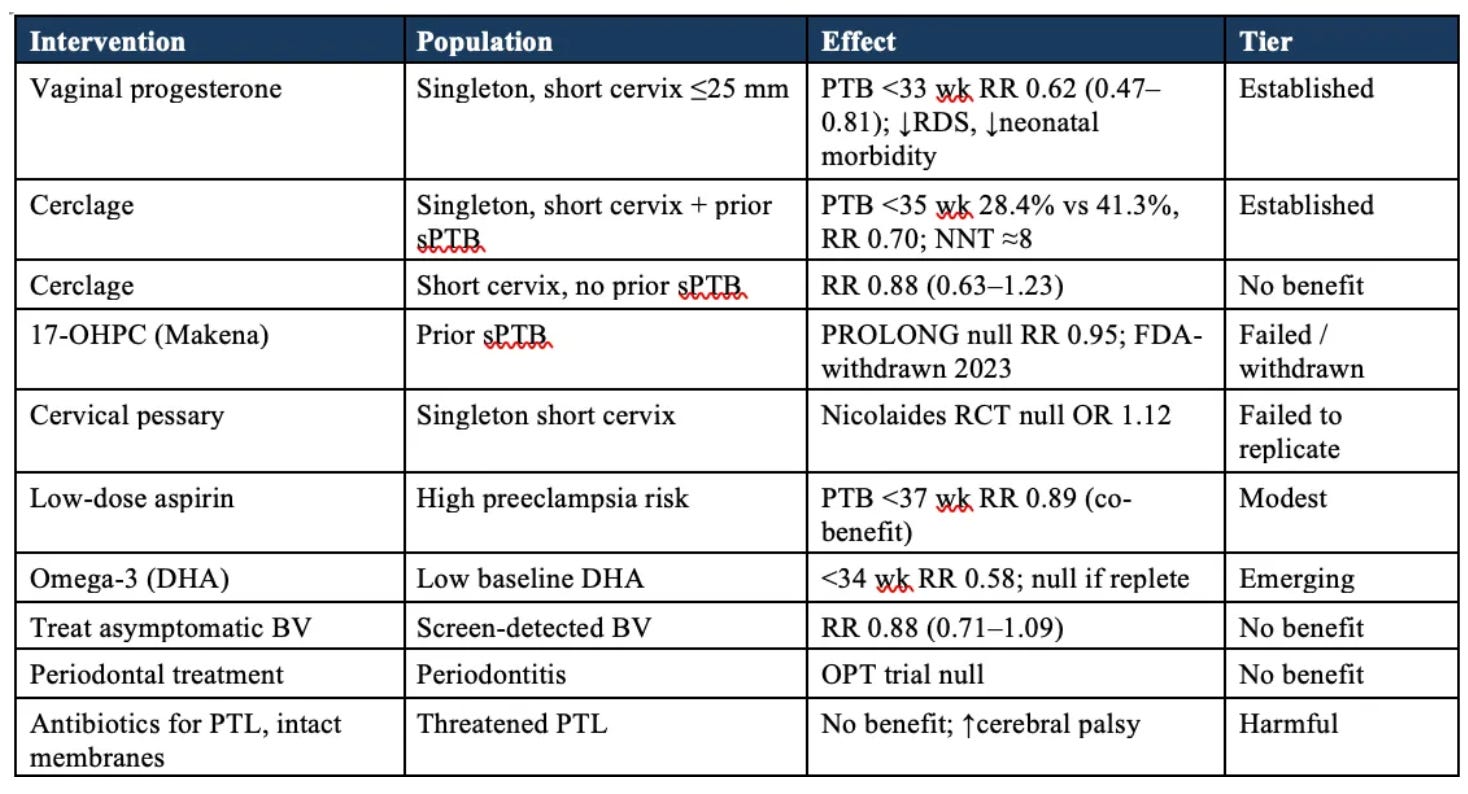
Vaginal progesterone and cerclage are roughly equivalent for the short-cervix-plus-prior-sPTB phenotype on indirect comparison, so the non-invasive option reasonably goes first. The honest weakness underneath: the pivotal cerclage trial (Owen 2009) missed its own primary endpoint; the indication rests on the IPD meta-analysis and the <15 mm subgroup, not a single positive trial. EPPPIC, the definitive synthesis (31 trials, 11,644 women), put vaginal progesterone at RR 0.78 (0.68–0.90) for PTB <34 weeks in high-risk singletons, with benefit concentrated where the cervix is short, and explicitly questioned efficacy in women without a short cervix.
What collapsed or was oversold
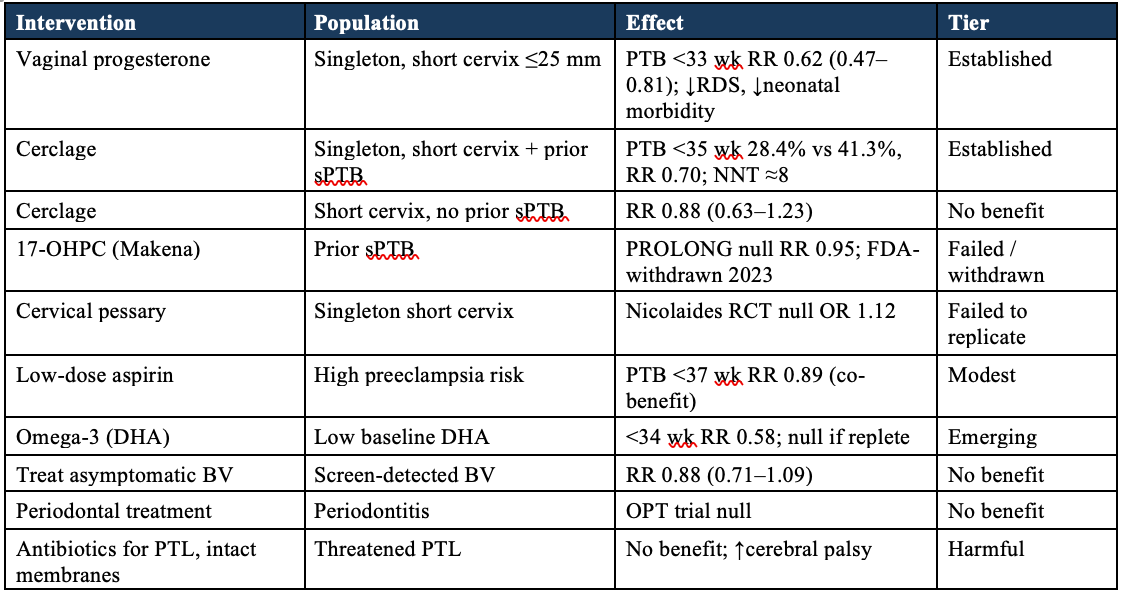
17-OHPC (Makena) is the emblem. Meis 2003 showed recurrent PTB <37 weeks falling 54.9% to 36.3% (RR 0.66), on the strength of which the FDA gave accelerated approval in 2011. The confirmatory PROLONG trial was flatly null: PTB <35 weeks 11.0% versus 11.5%, RR 0.95 (0.71–1.26). EPPPIC put the pooled 17-OHPC singleton effect at RR 0.83 (0.68–1.01), crossing 1.0. The FDA formally withdrew Makena and eight generics in April 2023. Women received weekly intramuscular injections for a decade for a drug that, on confirmatory testing, did nothing.
The Arabin pessary is the same story. Goya 2012 was spectacular — spontaneous birth <34 weeks 6% versus 27%, OR 0.18. It did not replicate: Nicolaides’s 932-woman NEJM trial was null (OR 1.12), and SMFM now recommends against it in singletons. And a long list never worked: treating asymptomatic bacterial vaginosis (RR 0.88, despite eradicating the BV); periodontal treatment (OPT, flatly null); vitamin C/E. Antibiotics for preterm labor with intact membranes are not merely useless — the ORACLE II seven-year follow-up found more cerebral palsy. That one is a do-no-harm line, not a neutral negative.
The distinction the field blurs: prevention versus mitigation
The interventions with the strongest evidence in all of preterm medicine do not prevent a single preterm birth. Antenatal corticosteroids cut neonatal death, RDS, and IVH — and move birthweight essentially zero, because they do nothing to the timing of birth. Late-preterm steroids (ALPS) reduce respiratory morbidity — applied, with some irony, to the very iatrogenic late-preterm deliveries driving the rate up. Magnesium sulfate protects the brain of a baby who is going to be born early regardless. These are triumphs, and every one is damage control. Conflating them with prevention lets the field claim progress on a number it has not moved.

Tocolytics: a bridge to mitigation, not prevention
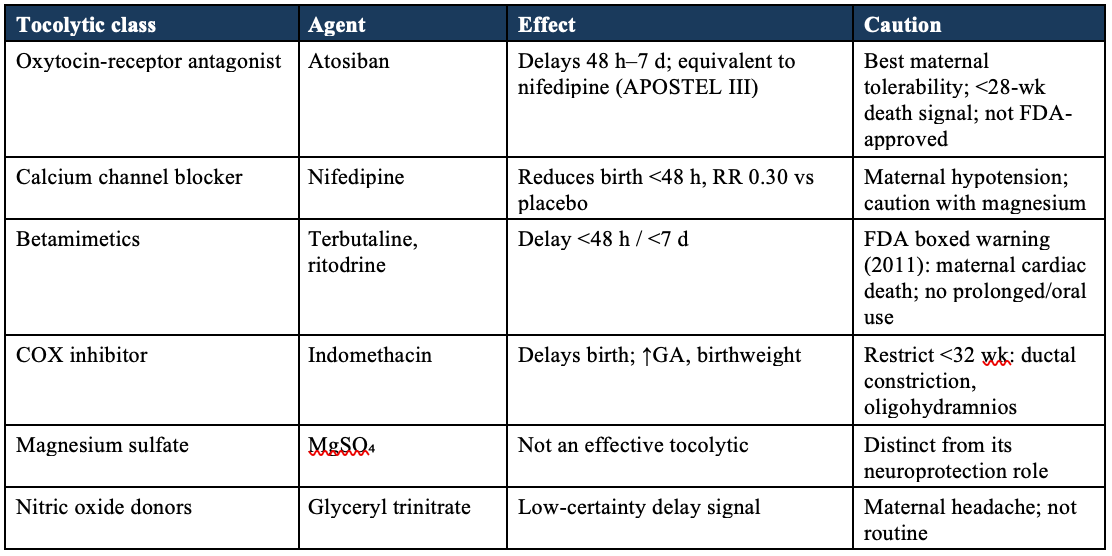
Tocolytics belong in this section, not the prevention column — and they are its weakest entry, because their only proven job is to buy a 48-hour-to-7-day window for the interventions that actually help the neonate. Every class delays birth versus placebo; none has proven independent reduction in neonatal mortality or serious morbidity. The 2022 Cochrane network meta-analysis (122 trials, 13,697 women) found all six classes probably delay birth but left the effects on neonatal and perinatal mortality uncertain; Haas’s earlier network meta-analysis found no clear neonatal RDS benefit of any agent over placebo. The benefit to the baby comes entirely from what is done during the window — completing antenatal corticosteroids, magnesium neuroprotection, and in-utero transfer to a NICU — not from the tocolytic. ACOG restricts tocolysis to short-term prolongation (≤48 h) for exactly those purposes, does not recommend maintenance tocolysis, and cautions against tocolysing contractions without cervical change.
The European pattern is worth stating precisely, because it is often read as evidence the US is missing something. Heavy European use — especially of atosiban (Tractocile) — reflects licensing and tolerability, not superior outcomes. Atosiban is EMA-approved and a European mainstay; the FDA declined it in 1998 and never approved it. The pivotal placebo-controlled trial (Romero 2000) missed its primary endpoint (median 25.6 vs 21.0 days, P=.6), with benefit only at ≥28 weeks, and carried a safety signal — pooled Cochrane data show more births <28 weeks (RR 3.11, 1.02–9.51) and more infant deaths to 12 months (RR 6.13, 1.38–27.13) in the atosiban arms, though confounded by more very-early-gestation women randomized to atosiban. Head-to-head, atosiban and generic nifedipine were equivalent: APOSTEL III (Lancet 2016) found composite adverse perinatal outcome 14% vs 15%, RR 0.91 (0.61–1.37). Heavy European atosiban use is therefore not evidence of a prevention tool the US missed; it is a licensing divergence plus a preference for a better-tolerated drug, over a class that on both continents has never improved the outcome that matters.
The modest and the emerging
Low-dose aspirin genuinely lowers preterm birth, but modestly and mostly as a co-benefit of preeclampsia prevention (ASPIRIN trial PTB <37 weeks 11.6% versus 13.1%, RR 0.89). There is an unresolved tension: an IPD meta-analysis found the antiplatelet effect on spontaneous PTB carried by parous women and null in first pregnancies, so it should not be oversold. Omega-3 is the live question: Cochrane found early PTB <34 weeks RR 0.58 across 70 trials, but the well-nourished ORIP population showed nothing and a signal toward LGA/post-term. The reconciliation is baseline DHA status, pointing toward test-and-treat in low-DHA women rather than universal supplementation. Group prenatal care, despite the enthusiasm, was null for preterm birth on intention-to-treat in the CRADLE trial; the publicized dose-response benefit is confounded by who attends.
Counterpoint: Romero’s prediction-and-prevention paradigm
The strongest affirmative case against the population-failure framing is Roberto Romero’s. His position is that prevention has not failed because the tools fail, but because we do not deploy them systematically: universal transvaginal cervical-length screening of all singleton pregnancies, with vaginal progesterone for the short cervix identified. On his reading, the population rate has not fallen because most health systems never adopted universal screening, so the effective progesterone he validated (his individual-patient-data meta-analyses) reaches only a fraction of the women it could help. He has argued explicitly that spontaneous preterm labor can be predicted and prevented, and that inaction — not the intervention — is the failure. This is the serious counter-argument, and any contrarian piece should engage it directly. The rebuttal is empirical and narrow: universal screening plus progesterone addresses the short-cervix pathway, which is a minority of spontaneous preterm birth, and even full uptake would not touch the late-preterm iatrogenic growth that dominates the recent rise. Both things can be true — his paradigm is the best available primary prevention, and it is still not enough to move the population number.
My read, and the ethics of it
Primary prevention of preterm birth has largely failed at the population level, and the honest response is to say so rather than recycle interventions that do not survive confirmatory testing. This is a preventive-ethics problem as much as a scientific one. A decade of weekly 17-OHPC injections is what happens when accelerated approval substitutes for a confirmatory trial and the profession treats “reasonable to offer” as a standing license. The informed-consent implication is direct: a woman with a prior preterm birth and a normal cervix should be told plainly that, after Makena’s withdrawal, there is no proven drug for her — that serial cervical-length surveillance with treatment if she shortens is a monitoring strategy, not a prevention guarantee. The field should stop selling mitigation as prevention, concentrate the real prevention tools on the phenotypes where they work, and be honest that for most women at risk we do not yet have an answer. That is not defeatism. It is the precondition for looking in the right place.
Caveats
The strongest, cleanest claims are the CDC rates, the Makena withdrawal, EPPPIC, and the steroid and magnesium mitigation effects.
Genuinely contested or emerging: progesterone in twins with a short cervix (a moderate-quality signal, RR ~0.69, not a settled indication); the aspirin parity discordance; and omega-3’s dependence on baseline DHA.
This review is organized around intervention efficacy for prevention; it does not attempt Romero’s mechanistic corpus (intra-amniotic infection and sterile inflammation, the preterm parturition syndrome, amniotic-fluid sludge, the cervical microbiome), which is cause-and-mechanism rather than intervention, and which explains why several of the negatives above behave as they do.
References
1. Osterman MJK, Hamilton BE, Martin JA, Driscoll AK, Valenzuela CP. Births: final data for 2024. Natl Vital Stat Rep. 2026;75(2). [rates confirmed from NVSR PDF]
2. Martin JA, Osterman MJK. Describing the increase in preterm births in the United States, 2014–2016. NCHS Data Brief No. 312; 2018.
3. Goldenberg RL, Culhane JF, Iams JD, Romero R. Epidemiology and causes of preterm birth. Lancet. 2008;371(9606):75-84. PMID: 18177778.
4. Fonseca EB, Celik E, Parra M, Singh M, Nicolaides KH. Progesterone and the risk of preterm birth among women with a short cervix. N Engl J Med. 2007;357(5):462-9. PMID: 17671254.
5. Hassan SS, Romero R, Vidyadhari D, Fusey S, Baxter JK, Khandelwal M, et al. Vaginal progesterone reduces the rate of preterm birth in women with a sonographic short cervix (PREGNANT trial). Ultrasound Obstet Gynecol. 2011;38(1):18-31. PMID: 21472815.
6. Romero R, Conde-Agudelo A, Da Fonseca E, O’Brien JM, Cetingoz E, Creasy GW, et al. Vaginal progesterone for preventing preterm birth and adverse perinatal outcomes in singleton gestations with a short cervix: a meta-analysis of individual patient data. Am J Obstet Gynecol. 2018;218(2):161-80. PMID: 29157866.
7. Berghella V, Rafael TJ, Szychowski JM, Rust OA, Owen J. Cerclage for short cervix on ultrasonography in women with singleton gestations and previous preterm birth: a meta-analysis. Obstet Gynecol. 2011;117(3):663-71. PMID: 21446209.
8. Berghella V, Ciardulli A, Rust OA, To M, Otsuki K, Althuisius S, et al. Cerclage for sonographic short cervix in singleton gestations without prior spontaneous preterm birth: IPD meta-analysis. Ultrasound Obstet Gynecol. 2017;50(5):569-77. PMID: 28295722.
9. Conde-Agudelo A, Romero R, Da Fonseca E, O’Brien JM, Cetingoz E, Creasy GW, et al. Vaginal progesterone is as effective as cervical cerclage to prevent preterm birth in women with a singleton gestation, previous spontaneous preterm birth, and a short cervix: updated indirect comparison meta-analysis. Am J Obstet Gynecol. 2018;219(1):10-25. PMID: 29630885.
10. Owen J, Hankins G, Iams JD, Berghella V, Sheffield JS, Perez-Delboy A, et al. Multicenter randomized trial of cerclage for preterm birth prevention in high-risk women with shortened midtrimester cervical length. Am J Obstet Gynecol. 2009;201(4):375.e1-8. PMID: 19788970.
11. EPPPIC Group. Evaluating Progestogens for Preventing Preterm birth International Collaborative (EPPPIC): meta-analysis of individual participant data. Lancet. 2021;397(10280):1183-94. PMID: 33773630.
12. Meis PJ, Klebanoff M, Thom E, Dombrowski MP, Sibai B, Moawad AH, et al. Prevention of recurrent preterm delivery by 17 alpha-hydroxyprogesterone caproate. N Engl J Med. 2003;348(24):2379-85. PMID: 12802023.
13. Blackwell SC, Gyamfi-Bannerman C, Biggio JR Jr, Chauhan SP, Hughes BL, Louis JM, et al. 17-OHPC to prevent recurrent preterm birth in singleton gestations (PROLONG). Am J Perinatol. 2020;37(2):127-36. PMID: 31652479.
14. US Food and Drug Administration. Final decision on withdrawal of Makena (hydroxyprogesterone caproate) and eight ANDAs following public hearing. Federal Register. 2023 May 15;88(93). [order signed April 6, 2023]
15. Goya M, Pratcorona L, Merced C, Rodó C, Valle L, Romero A, et al. Cervical pessary in pregnant women with a short cervix (PECEP): an open-label randomised controlled trial. Lancet. 2012;379(9828):1800-6. PMID: 22475493.
16. Nicolaides KH, Syngelaki A, Poon LC, Picciarelli G, Tul N, Zamprakou A, et al. A randomized trial of a cervical pessary to prevent preterm singleton birth. N Engl J Med. 2016;374(11):1044-52. PMID: 26981934.
17. Brocklehurst P, Gordon A, Heatley E, Milan SJ. Antibiotics for treating bacterial vaginosis in pregnancy. Cochrane Database Syst Rev. 2013;(1):CD000262. PMID: 23440777.
18. Michalowicz BS, Hodges JS, DiAngelis AJ, Lupo VR, Novak MJ, Ferguson JE, et al. Treatment of periodontal disease and the risk of preterm birth (OPT). N Engl J Med. 2006;355(18):1885-94. PMID: 17079762.
19. Rumbold A, Ota E, Nagata C, Shahrook S, Crowther CA. Vitamin C supplementation in pregnancy. Cochrane Database Syst Rev. 2015;(9):CD004072. PMID: 26415762.
20. Kenyon S, Pike K, Jones DR, Brocklehurst P, Marlow N, Salt A, et al. Childhood outcomes after prescription of antibiotics to pregnant women with spontaneous preterm labour: 7-year follow-up of the ORACLE II trial. Lancet. 2008;372(9646):1319-27. PMID: 18804276.
21. McGoldrick E, Stewart F, Parker R, Dalziel SR. Antenatal corticosteroids for accelerating fetal lung maturation for women at risk of preterm birth. Cochrane Database Syst Rev. 2020;12:CD004454. PMID: 33368142.
22. Gyamfi-Bannerman C, Thom EA, Blackwell SC, Tita ATN, Reddy UM, Saade GR, et al. Antenatal betamethasone for women at risk for late preterm delivery (ALPS). N Engl J Med. 2016;374(14):1311-20. DOI: 10.1056/NEJMoa1516783. [PMID not independently re-verified]
23. Doyle LW, Crowther CA, Middleton P, Marret S, Rouse D. Magnesium sulphate for women at risk of preterm birth for neuroprotection of the fetus. Cochrane Database Syst Rev. 2009;(1):CD004661. PMID: 19160238.
24. Hoffman MK, Goudar SS, Kodkany BS, Metgud M, Somannavar M, Okitawutshu J, et al. Low-dose aspirin for the prevention of preterm delivery in nulliparous women with a singleton pregnancy (ASPIRIN). Lancet. 2020;395(10220):285-93. PMID: 31982074.
25. van Vliet EOG, Askie LA, Mol BWJ, Oudijk MA. Antiplatelet agents and the prevention of spontaneous preterm birth: a systematic review and meta-analysis. Obstet Gynecol. 2017;129(2):327-36. PMID: 28079785.
26. Middleton P, Gomersall JC, Gould JF, Shepherd E, Olsen SF, Makrides M. Omega-3 fatty acid addition during pregnancy. Cochrane Database Syst Rev. 2018;11:CD003402. PMID: 30480773.
27. Makrides M, Best K, Yelland L, McPhee A, Zhou S, Quinlivan J, et al. A randomized trial of prenatal n-3 fatty acid supplementation and preterm delivery (ORIP). N Engl J Med. 2019;380(11):1035-45. PMID: 31509674.
28. Crockett AH, Chen L, Heberlein EC, et al. Group vs traditional prenatal care for improving racial equity (CRADLE). Am J Obstet Gynecol. 2022. [intention-to-treat null; design paper PMID: 28403832]
29. Romero R, Conde-Agudelo A, El-Refaie W, Rode L, Brizot ML, Cetingoz E, et al. Vaginal progesterone decreases preterm birth in women with a twin gestation and a short cervix: updated IPD meta-analysis. Ultrasound Obstet Gynecol. 2017;49(3):303-14. PMID: 28067007.
30. Romero R, Nicolaides KH, Conde-Agudelo A, Tarca AL, Hassan SS. Spontaneous preterm labor can be predicted and prevented. Ultrasound Obstet Gynecol. 2021;57(1):15-18. DOI: 10.1002/uog.23565. [author position/opinion; DOI verified]
31. Wilson A, Hodgetts-Morton VA, Marson EJ, Markland AD, Larkai E, Papadopoulou A, et al. Tocolytics for delaying preterm birth: a network meta-analysis. Cochrane Database Syst Rev. 2022;8:CD014978. PMID: 35947046.
32. Haas DM, Caldwell DM, Kirkpatrick P, McIntosh JJ, Welton NJ. Tocolytic therapy for preterm delivery: systematic review and network meta-analysis. BMJ. 2012;344:e6226. PMID: 23048010.
33. Romero R, Sibai BM, Sanchez-Ramos L, Valenzuela GJ, Veille JC, Tabor B, et al. An oxytocin receptor antagonist (atosiban) in the treatment of preterm labor: a randomized, double-blind, placebo-controlled trial with tocolytic rescue. Am J Obstet Gynecol. 2000;182(5):1173-83. PMID: 10819855.
34. Flenady V, Reinebrant HE, Liley HG, Tambimuttu EG, Papatsonis DN. Oxytocin receptor antagonists for inhibiting preterm labour. Cochrane Database Syst Rev. 2014;(6):CD004452. PMID: 24903678.
35. van Vliet EOG, Nijman TAJ, Schuit E, Heida KY, Opmeer BC, Kok M, et al. Nifedipine versus atosiban for threatened preterm birth (APOSTEL III): a multicentre, randomised controlled trial. Lancet. 2016;387(10033):2117-24. PMID: 26944026.
36. Committee on Practice Bulletins—Obstetrics, American College of Obstetricians and Gynecologists. Practice Bulletin No. 171: Management of Preterm Labor. Obstet Gynecol. 2016;128(4):e155-64. PMID: 27661654.
37. US Food and Drug Administration. Drug Safety Communication: new warnings against use of terbutaline to treat preterm labor. 2011.