

“Reproductive freedom” has become one of the most repeated phrases in American medicine.
The major medical groups use it constantly.
When they do say ‘reproductive freedom’, they almost always mean one thing: abortion.
ACOG says abortion is essential health care and that it is committed to protecting and increasing access to it.
The American Medical Association says much the same.
The phrase appears on banners, in press releases, and in the title of a federal bill. Strip away the packaging and the message is direct: a woman should be able to end a pregnancy without the government standing in her way.
I do not write to argue about abortion. I write to argue about the word “freedom,” because the people using it have made it far too small.
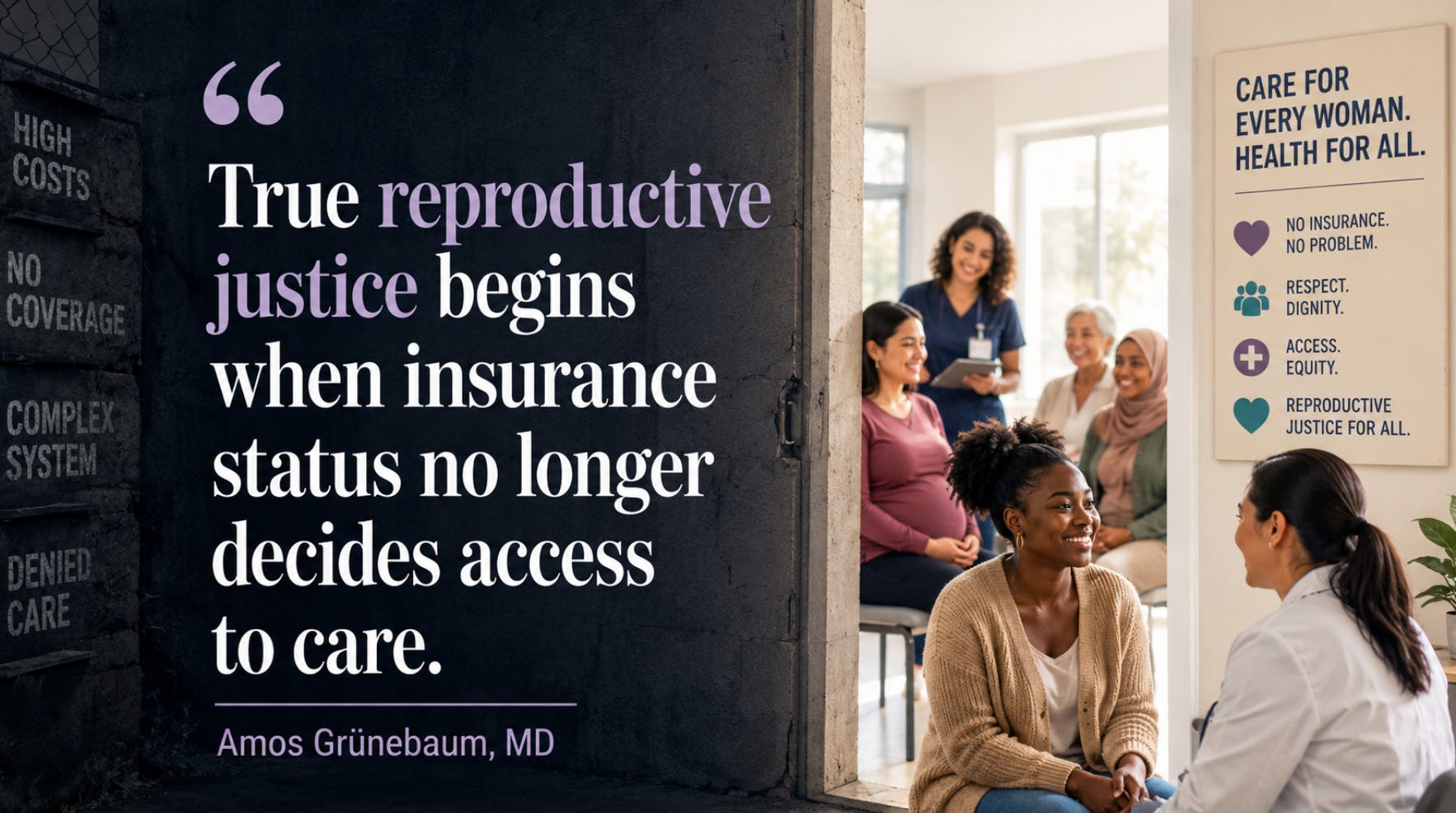
I say that reproductive freedom means that every woman independent of her race, religion, or insurance status should be allowed to see the doctor of her choice.
Freedom to make a choice means nothing if you cannot reach a doctor to carry it out.
A right you cannot use is not a right. It is a slogan.
And for millions of American women, the door to ordinary obstetric and gynecologic care is harder to open than the speeches admit.
Start with who pays. Medicaid covers about 4 in 10 births in the United States. For Black mothers the share is far higher, around 64 to 65 percent. For Hispanic mothers it is close to 59 percent. For white mothers it is about 28 percent.
Roughly 1 in 4 Black women of any age relies on Medicaid for her health coverage. If you want to talk about reproductive freedom for Black women, you are, whether you say so or not, talking about Medicaid.
Here is the part the slogans skip. Having Medicaid is not the same as having a doctor. A doctor must agree to see you. And neither ACOG nor the AMA says that doctors have to. Or that they should. They are mum about it. Silence.
The AMA Code of Medical Ethics is explicit. A physician is, except in an emergency, free to choose whom to serve. The Code says doctors are not ethically required to accept every patient who asks. The duty to treat without regard to payment is framed as a shared, voluntary, professional ideal, not a rule any individual doctor must follow. ACOG, for its part, publishes statement after statement demanding that lawmakers, hospitals, and insurers expand access. I have read them closely. They ask everyone else to act. They do not tell their own members that each of them must take Medicaid patients.
That silence is the whole game.
So what happens in the real world? On paper, ob-gyns accept Medicaid at higher rates than most specialties. But “accepts Medicaid” is a stated policy, not a delivered service, and the gap between the two is where access quietly dies. A practice can say yes and still cap how many Medicaid patients it takes each month, close its Medicaid panel while keeping the private one open, push those patients into a single crowded clinic session, or simply offer them a later date. National survey data show that even among doctors with open appointments, a meaningful share decline Medicaid patients outright. One widely cited survey found about a quarter of primary care practices were not accepting new Medicaid patients at all. A separate physician survey in large cities found only about 55 percent of ob-gyns accepting Medicaid, and that number measures willingness to bill the program, not a guaranteed appointment.
Researchers have tested this directly by posing as patients and calling offices. The picture is uneven, and I will report it honestly. For routine general ob-gyn visits, a 2024 nationwide study found Medicaid callers waited only about 5 percent longer than privately insured callers, a difference that was not statistically significant. The bigger barrier there is not the wait. It is whether the office takes the insurance at all. But for subspecialty care, the gap is stark. A 2023 national study of ob-gyn subspecialists found Medicaid patients waited 44 percent longer for a new appointment, and the difference was highly significant. When a woman needs a gynecologic oncologist for a cancer, a maternal-fetal medicine specialist for a high-risk pregnancy, or a urogynecologist for a prolapse, her insurance card changes how long she waits and sometimes whether she is seen at all. No law requires any private insurer or Medicaid plan to keep a gynecologic oncologist in network.
The standard answer is that these women can go to a community health center or a hospital clinic. Many can, and the people who work in those clinics are often excellent. But notice the language we have settled on. We call them “safety-net” clinics. The word quietly tells the patient that this is the place you land when you fall, the catch beneath the trapeze, the option of last resort. It frames public-insurance care as a step below the care everyone else gets, a separate and lesser track. I think the term itself is a misnomer that does real harm. A clinic that delivers good medicine is not a net under a fall. It is medicine. When we label it a safety net, we have already conceded that Medicaid patients are routed to a different door, and we have made that routing sound like generosity instead of segregation by payment.
This is the contradiction at the center of the reproductive freedom campaign. The same organizations that say abortion access is a right do not say that ordinary obstetric and gynecologic care is one their members must provide regardless of insurance. They will fight a state legislature over a gestational limit. They will not tell a private practice in a wealthy suburb that it has to open its schedule to the Medicaid patient across town. The first fight is public and political. The second would cost their members money. Guess which one stays unspoken.
What it means for patients is simple and hard. If you carry Medicaid, your “freedom” depends on finding a physician who will actually see you, in a timely way, for the full range of care you might need, from contraception to a complicated delivery to a cancer. That freedom is real for some women and theoretical for others, and which group you land in has a great deal to do with your zip code, your insurer, and your race. A right that strong for the privately insured and thin for the publicly insured is not equal freedom. It is freedom rationed by payment.
My take is direct. Reproductive freedom that begins and ends at abortion is too narrow to deserve the name. Real reproductive freedom is the ability of any woman to obtain the full range of reproductive health care, including the care that keeps her alive during pregnancy and the care that catches her cancer early, no matter how she is insured. Until ACOG and the AMA are willing to say plainly that accepting Medicaid is a professional obligation and not an act of charity, their support for patients is partial. They are defending the choice while leaving the door to the exam room half closed. I have spent fifty years inside this system. I have watched the speeches get bolder and the schedules stay the same. The women covered by Medicaid, who are disproportionately Black, are owed more than a slogan. They are owed an appointment.
If a professional society means what it says about reproductive freedom, the test is not how loudly it opposes a law. The test is whether it will ask its own members to take the patient who pays the least. Watch for who says it out loud.
Share this with a colleague who uses the phrase “reproductive freedom” without asking who actually has it. The data should travel. ObGyn Intelligence is free; a paid subscription keeps it independent.
References
1. American College of Obstetricians and Gynecologists. Abortion policy. Statement of policy. Washington, DC: ACOG; 2025.
2. American Medical Association. Abortion: preserving access to reproductive health services. D-5.999. Chicago, IL: AMA; 2025.
3. American Medical Association. Prospective patients. Code of Medical Ethics Opinion 1.1.2. Chicago, IL: AMA. Accessed June 23, 2026.
4. American Medical Association. Physician exercise of conscience. Code of Medical Ethics Opinion 1.1.7. Chicago, IL: AMA. Accessed June 23, 2026.
5. Osterman MJK, Martin JA. Primary source of payment for the delivery: United States, 2021. NCHS Data Brief No. 468. Hyattsville, MD: National Center for Health Statistics; 2023.
6. March of Dimes. Medicaid coverage by race/ethnicity: United States, 2021-2023 average. PeriStats. Accessed June 23, 2026.
7. Medicaid and CHIP Payment and Access Commission. Physician acceptance of new Medicaid patients: findings from the National Electronic Health Records Survey. Washington, DC: MACPAC; 2021.
8. Holgash K, Heberlein M. Physician acceptance of new Medicaid patients: what matters and what doesn’t. Health Affairs Forefront. April 10, 2019.
9. Kyllo HM, Bresnitz W, Bickner M, Matous MA, Mulenga NM, O’Brien EA, et al. Access to general obstetrics and gynecology care among Medicaid beneficiaries and the privately insured: a nationwide mystery caller study in the USA. Minerva Obstet Gynecol. 2024;76(5):444-451.
10. Corbisiero MF, Tolbert B, Sanches M, Shelden N, Hachicha Y, Dao H, et al. Medicaid coverage and access to obstetrics and gynecology subspecialists: findings from a national mystery caller study in the United States. Am J Obstet Gynecol. 2023;228(6):722.e1-722.e9.
11. Knisely AT, Michael JE, Eskander RN, et al. Insurance-mediated disparities in gynecologic oncology care. Obstet Gynecol. 2022;139(2):305-312.
BRAVO! When I opened my own practice to friendly, OB told me not to take mainecare/Medicaid. Of course, if Medicaid reimburse better, they probably would not be this problem.