

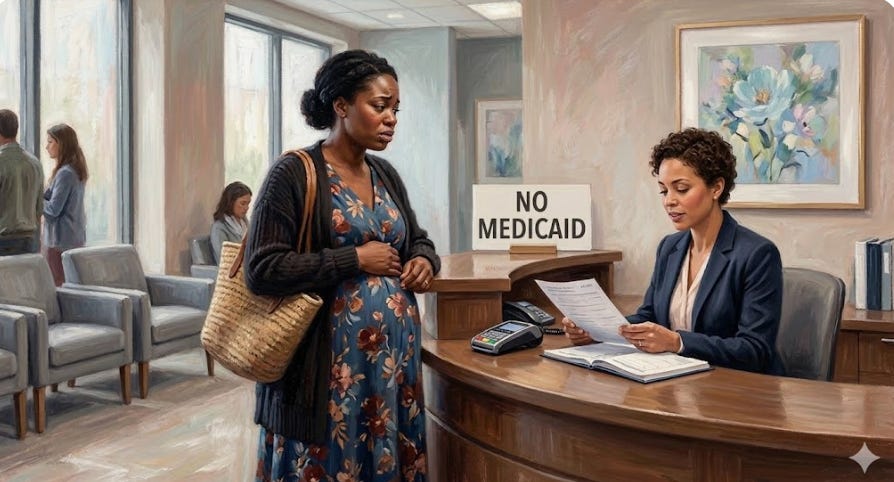
A woman is 12 weeks pregnant. She calls a doctor’s office for a prenatal appointment. She is told the doctor does not accept her insurance. She calls another office. Same answer. She calls a third.
She is not in a rural area. She is not uninsured. She has coverage. It is just the wrong coverage. And at 12 weeks, with a pregnancy that needs to be seen, she is sitting at home making phone calls instead of sitting in an exam room.
Nobody calls this a reproductive justice issue. But it is!
It does not make the advocacy websites. It does not appear in the policy statements. It is not what reproductive justice organizations march for.
It is just a woman at 12 weeks who cannot find a doctor, because her insurance is the wrong kind, and the movement that was built to protect her has not gotten around to naming it.
That is reproductive injustice.
What Reproductive Justice Means
The term was created in 1994 by a group of Black women at a conference in Chicago. The lead voice was Loretta Ross. The framework they built had three pillars: the right not to have a child, the right to have a child, and the right to parent in a safe and healthy environment.
This was a deliberate expansion beyond abortion rights alone. It centered race, gender, and structural oppression. It said reproductive health cannot be separated from housing, poverty, immigration status, and environmental safety. That framework changed how many advocates and researchers think about women’s health.
It is a good framework. It is also incomplete.
What It Leaves Out
The reproductive justice movement is largely silent on two things that shape reproductive outcomes more than almost any other factor: health insurance and money.
Start with Prenatal care is next. In the United States, Medicaid pays for roughly half of all births. But Medicaid reimbursement rates for obstetric care are, on average, about 50 percent of what private insurance pays. Many of the best-trained obstetricians and maternal-fetal medicine specialists do not accept Medicaid, not because they do not care, but because the math does not work.
A woman on Medicaid is not getting the same access to care as a woman with private insurance.
This is not a secret. It is policy.
Fertility treatment is a gap almost never mentioned in reproductive justice conversations. The right to have a child is a core pillar of the framework. But in vitro fertilization costs between $12,000 and $15,000 per cycle on average. Only 19 states require any insurance coverage for fertility treatments, and the requirements vary widely. For most women in most of the country, the right to have a child -- when biology does not cooperate -- is available only to people who can pay for it out of pocket.
Postpartum coverage is another gap. Medicaid traditionally ended 60 days after delivery. Sixty days. That is when postpartum depression often peaks. That is when many complications become visible. Many states have now extended coverage to 12 months under new federal rules, but not all have done so, and the coverage itself is still Medicaid -- meaning limited networks and the same access problems described above.
Contraception is another. The Affordable Care Act required most private plans to cover contraception without cost sharing. But that does not cover everyone. Women without insurance, women in states with religious exemptions for employers, and women whose plans predate ACA requirements can still face significant out-of-pocket costs for contraception.
And then there is abortion. The Hyde Amendment has blocked federal Medicaid funding for abortion since 1976. That means a low-income woman on Medicaid in most states has a legal right to abortion -- and no realistic way to pay for it. About 1 in 4 women who want an abortion and are on Medicaid cannot get one because of cost.
Having a right that costs money you do not have is not really having a right.
The Door That Does Not Open
All of that — the Hyde Amendment, the Medicaid reimbursement gaps, the fertility coverage deserts — happens at the policy level. It is invisible. What is not invisible is this: a woman calls an OB’s office, gives her insurance, and is told there are no appointments available. She calls back with a different insurance card and gets an appointment the same week. Or she calls with no insurance at all and is told, politely, that the practice does not offer payment plans.
Doctors and practices have the legal right to decline patients they do not wish to see. Outside of emergency rooms, there is no law requiring a physician to accept any particular insurance or any particular patient. And so, every day, women are turned away from obstetric and gynecologic care not because the doctor is not skilled, not because the office is full, but because her insurance pays too little or she has no insurance at all.
This is not hypothetical. A 2024 study found that Medicaid patients attempting to schedule obstetric appointments were significantly less likely to get one than patients with private insurance, even when calling the same practices. [CITATION NEEDED - check Medicaid access audit studies, e.g. JAMA or Health Affairs] The gap was not subtle. In some markets, Medicaid patients were turned away at double the rate of privately insured patients.
We talk about reproductive justice as though access to care is a given and the only fight is over what happens once a woman is in the door. But the door itself is the problem. A woman who cannot get an appointment for prenatal care in her first trimester because of her insurance card is experiencing reproductive injustice as direct and immediate as any legislative ban. The mechanism is different. The outcome -- a woman without care she needs -- is the same.
And it falls hardest on the women the reproductive justice framework was built to protect. Black women. Latina women. Low-income women. Women in rural areas where the only OB who takes Medicaid is two counties away. The framework named these women. It did not name the receptionist who puts them on hold and never calls back.
Why This Gap Exists
Reproductive justice advocacy grew out of a civil rights tradition. Its natural language is rights and dignity and structural racism. That language is correct and necessary. But rights without resources are rhetoric. The movement has been better at naming what women deserve than at fighting the payment systems that decide what women actually get.
Insurance companies, Medicaid reimbursement rates, hospital billing departments, and federal appropriations committees are not as compelling as the image of a woman being denied care. They are harder to put on a poster. But they determine outcomes in ways that race-focused advocacy alone does not capture.
To be clear: racial disparities in maternal outcomes are real and documented. But the evidence increasingly points to insurance status as a primary driver. Countries with universal coverage show dramatically smaller racial gaps in maternal mortality. The racism is real. The financial mechanism that amplifies it is also real. Both deserve sustained attention.
My Take
The reproductive justice framework gave us something important: a way to think about reproductive health that goes beyond a single procedure or a single right. But it has not gone far enough. Telling a woman she has the right to decide about her pregnancy -- without fighting for the insurance coverage, the Medicaid reimbursement rates, the fertility treatment coverage, and the postpartum support that make that right real -- is not justice. It is a promise without a delivery system.
The next evolution of reproductive justice has to be financial justice. That means fighting Hyde. That means demanding Medicaid parity with private insurance for obstetric care. That means mandating fertility coverage. That means making postpartum Medicaid extension permanent and national.
Rights on paper are a start. Rights you can actually use are the goal.