

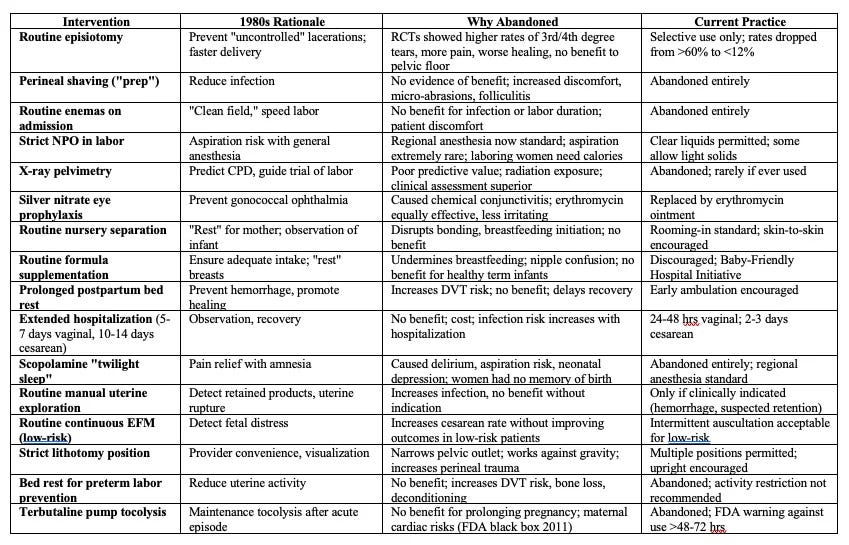
The Obstetric Interventions We Abandoned
Medicine advances not only by discovering what works, but by finally stopping what does not.
Obstetrics has accumulated an impressive list of practices that were once routine and are now abandoned or sharply restricted: routine episiotomy, perineal shaving, enemas on admission, strict fasting during labor, X-ray pelvimetry, routine nursery separation, formula supplementation of healthy newborns, prolonged postpartum bed rest, extended hospitalization, “twilight sleep,” routine manual uterine exploration, mandatory lithotomy positioning, bed rest for prevention of preterm birth, maintenance terbutaline pumps, and several other practices that once seemed entirely reasonable.
The interesting question is not why our predecessors did such foolish things.
Most of these practices were not foolish when introduced. They were plausible.
An episiotomy would substitute a controlled incision for an uncontrolled tear. Shaving and enemas would make birth cleaner. Keeping women NPO would protect them if general anesthesia became necessary. X-ray pelvimetry would identify cephalopelvic disproportion before labor became dangerous. Bed rest should decrease uterine activity. Continuous fetal monitoring should identify hypoxia before permanent neurologic injury occurred.
Each intervention had a mechanism.
Each had experts who could explain why it ought to work.
And that is precisely the problem.
What we used to do
Routine episiotomy. For decades, an episiotomy was almost part of the definition of an attended vaginal delivery, particularly for nulliparous women. The rationale sounded surgical and orderly: a clean incision should heal better than an irregular spontaneous tear and might protect the pelvic floor. Randomized trials showed that routine use did not deliver those benefits and could increase severe perineal trauma, pain, and morbidity. Episiotomy did not disappear, but it changed from a routine procedure to a selective one.
Perineal shaving. Shaving pubic and perineal hair before delivery was once standard preparation for childbirth. Hair was presumed to interfere with cleanliness and increase infection risk. Evidence did not demonstrate the anticipated infectious benefit, while shaving produced discomfort, irritation, and small abrasions that themselves could provide portals for infection. What once looked like hygienic medical preparation eventually came to look like what it was: an unnecessary ritual.
Routine enemas on admission. Women entering labor were also routinely given enemas, partly to empty the rectum, reduce fecal contamination, and perhaps accelerate labor. These claims sounded reasonable but did not survive clinical testing. Enemas did not meaningfully reduce maternal or neonatal infection or shorten labor. They did, however, add discomfort and indignity at precisely the moment when women already had enough to contend with.
Strict NPO during labor. For much of modern obstetric history, laboring women were forbidden to eat and often to drink because of the possibility that emergency general anesthesia might be required and gastric contents aspirated. That concern arose from a genuine anesthetic hazard. But obstetric anesthesia changed dramatically. Neuraxial anesthesia became dominant, airway management improved, and aspiration during contemporary obstetric anesthesia became uncommon. Policies consequently evolved toward permitting clear liquids in many low-risk laboring women, although recommendations about solid food remain more restrictive and vary by clinical risk and institution. The broader lesson is important: a precaution appropriate to one technological era may become inappropriate when the surrounding technology changes.
X-ray pelvimetry. Pelvimetry promised something obstetricians have always wanted: an objective measurement that could predict whether a fetus would fit through a maternal pelvis. Unfortunately, the pelvis and labor are not static mechanical systems, and radiographic measurements performed poorly as predictors of successful vaginal birth. Routine X-ray pelvimetry also exposed mother and fetus to ionizing radiation without demonstrating sufficient clinical benefit. Clinical labor became a better test than a radiograph of whether labor could progress.
Silver nitrate eye prophylaxis. Instilling silver nitrate into newborn eyes was once a major public-health intervention against gonococcal ophthalmia neonatorum, a potentially blinding disease. It was historically important, but silver nitrate commonly produced chemical conjunctivitis. As alternative antimicrobial prophylaxis became available, silver nitrate was largely replaced. In the United States, erythromycin ophthalmic ointment became the standard neonatal prophylactic agent. This example is slightly different from some others on the list: the original intervention was not useless. It was superseded by a better-tolerated strategy and by changes in screening and treatment of maternal infection.
Routine nursery separation. Hospitals once routinely removed healthy newborns from their mothers after delivery so mothers could rest and nurses could observe infants in centralized nurseries. The model was efficient for hospitals, but efficiency for the institution was not necessarily physiology for mother and baby. Rooming-in, skin-to-skin contact, and early breastfeeding support became preferred for healthy dyads because separation can interfere with breastfeeding initiation and maternal-newborn contact without providing a demonstrated advantage for most healthy infants.
Routine formula supplementation. Healthy breastfed newborns were once frequently given formula simply because they were in the hospital, because milk had not yet “come in,” or because supplementation was thought to guarantee adequate intake and allow mothers to rest. We learned to distinguish normal neonatal physiology from pathology. Colostrum is not evidence of breastfeeding failure, and routine supplementation can interfere with establishment of breastfeeding. Formula remains medically important when indicated, but “just in case” supplementation of healthy breastfeeding infants is no longer considered benign routine care.
Prolonged postpartum bed rest. Women were once kept in bed for prolonged periods after childbirth in the belief that rest promoted recovery and reduced hemorrhage. We eventually recognized the hazards of immobility, particularly venous thromboembolism and deconditioning. Early mobilization became part of routine postpartum recovery. Again, the conceptual reversal is striking: the intervention intended to protect the patient turned out to expose her to preventable harm.
Extended postpartum hospitalization. Historically, uncomplicated vaginal birth might be followed by many days in the hospital and cesarean delivery by substantially longer stays. Improvements in anesthesia, surgical technique, infection prevention, postpartum monitoring, neonatal care, and outpatient follow-up progressively shortened hospitalization. Longer hospitalization is not intrinsically better care. But neither should shorter hospitalization automatically be equated with progress. Safe discharge depends on maternal stability, neonatal status, social circumstances, access to follow-up, and an effective system for detecting complications after discharge. The lesson is not “shorter is always better.” It is that hospitalization itself requires evidence and justification.
Scopolamine and “twilight sleep.” One of the more extraordinary chapters in obstetric history was the use of scopolamine, often with morphine, to produce amnesia during labor. Women could remain physically distressed or agitated while subsequently having little or no memory of the experience. Maternal delirium, respiratory complications, aspiration risk, and neonatal depression were substantial concerns. The development of safer and more controllable analgesia, particularly neuraxial techniques, made twilight sleep obsolete. Eliminating memory of pain is not the same as treating pain.
Routine manual uterine exploration. Manual exploration of the uterine cavity after delivery was once performed much more liberally to look for retained placental tissue or occult uterine injury. But inserting a hand into the postpartum uterus is not a harmless examination. It is painful, invasive, and may increase infection risk. Exploration therefore became an intervention reserved for clinical indications, such as suspected retained placental tissue, abnormal bleeding, or concern about uterine integrity, rather than a routine demonstration that the uterus was empty.
Routine continuous electronic fetal monitoring in low-risk labor. Continuous fetal monitoring deserves special attention because it demonstrates how difficult deimplementation becomes once technology is embedded in medical culture. The original proposition was compelling: identify fetal hypoxia early, intervene sooner, and prevent neurologic injury. Yet randomized evidence comparing continuous cardiotocography with intermittent auscultation has shown fewer neonatal seizures but no convincing reduction in cerebral palsy or overall perinatal mortality, while operative vaginal delivery and cesarean delivery increase. Continuous monitoring remains indicated in many clinical circumstances, but its routine use in every low-risk labor illustrates the gap that can develop between physiologic plausibility, technological capability, and demonstrated patient benefit.
Strict lithotomy positioning. Delivering flat on the back with the legs in stirrups became standard largely because it gave the clinician excellent access and visualization. That should immediately tell us whose convenience drove the practice. Upright, lateral, squatting, kneeling, and other maternal positions may be comfortable and physiologically reasonable, and women without contraindications should generally not be required to remain in a single position for the convenience of the birth attendant. An intervention does not become patient-centered simply because clinicians find it easier.
Bed rest to prevent preterm birth. This may be the purest example of physiologic reasoning overwhelming clinical evidence. If uterine activity threatens pregnancy, reducing physical activity seems as though it should help. But activity restriction has not been shown to prevent preterm birth, while prolonged restriction can result in venous thromboembolism, deconditioning, muscle and bone loss, psychosocial distress, and financial harm. For years, women were asked to reorganize their lives around a treatment whose benefit had never been convincingly established.
Terbutaline pump maintenance tocolysis. Continuous subcutaneous terbutaline pumps were promoted as a way to suppress recurrent contractions and prolong pregnancy after an episode of preterm labor. Yet maintenance beta-agonist therapy did not demonstrate the hoped-for improvement in pregnancy outcomes and carried meaningful maternal cardiovascular risks. In 2011, the FDA issued strong warnings against prolonged terbutaline use for prevention or prolonged treatment of preterm labor. A sophisticated delivery system cannot rescue a therapy whose benefit-risk balance is unfavorable.
Plausibility is not evidence
These examples differ in important ways. Some interventions were ineffective. Some were harmful. Some were useful in selected circumstances but became harmful when applied routinely. Others, such as silver nitrate prophylaxis, were rational interventions that were eventually replaced by better alternatives.
But together they reveal a recurring epistemologic error in medicine: we move too easily from “this makes biological sense” to “therefore we should do it.”
Those are not equivalent statements.
A mechanism can justify studying an intervention. It cannot establish its effectiveness.
We did not abandon bed rest because uterine physiology suddenly became ridiculous. We abandoned it because clinical evidence failed to confirm the expected benefit.
We did not restrict episiotomy because controlled incisions stopped looking orderly. We did so because outcomes contradicted the theory.
And we did not reconsider routine continuous fetal monitoring because detecting fetal heart-rate abnormalities stopped being technologically impressive. We reconsidered it because the outcomes that mattered most failed to improve as expected.
Adoption is easier than abandonment
Medicine has a powerful asymmetry.
New interventions can spread rapidly. Old interventions can survive for decades after their evidentiary foundations weaken.
Once something becomes routine, it develops institutional armor.
Residents are trained to do it. Hospitals incorporate it into protocols. Nurses expect it. Quality departments measure compliance. Professional societies mention it. Electronic records create checkboxes for it. Patients come to expect it. Malpractice lawyers may eventually treat it as part of the standard of care.
Eventually the question changes.
Instead of asking:
“Does this intervention improve outcomes?”
we start asking:
“Why didn’t you do it?”
That is how an intervention can travel from hypothesis to custom without ever adequately passing through evidence.
There is also a powerful psychological asymmetry. If we intervene and the patient has a bad outcome, we can tell ourselves that we did everything possible. If we refrain from an intervention and the outcome is poor, everyone can see the thing we did not do.
Doing something therefore feels safer than doing less, even when the evidence says otherwise.
What are we doing today that will look foolish in 2050?
It is easy to smile at twilight sleep, enemas, perineal shaving, week-long postpartum hospitalization, and X-ray pelvimetry.
Hindsight is extraordinarily powerful.
The useful exercise is not to judge obstetricians practicing in 1960 or 1980. It is to imagine obstetricians in 2050 judging us.
Which of our current interventions are supported mainly by biological plausibility?
Which became standard before adequate comparative outcome data existed?
Which depend on surrogate endpoints rather than outcomes important to mothers and babies?
Which interventions change something we can measure without improving anything patients actually value?
Which persist because discontinuing them makes clinicians uncomfortable?
And perhaps most importantly:
Which practices would have difficulty gaining approval if they were introduced today as entirely new interventions and required to demonstrate benefit before widespread adoption?
That is a much more uncomfortable question.
Deimplementation is medical progress
We tend to define progress by addition: another drug, another device, another screening test, another protocol, another algorithm.
But subtraction can be equally important.
Every intervention has consequences. Even seemingly minor interventions may produce pain, complications, anxiety, cost, loss of autonomy, downstream procedures, and opportunity costs. An ineffective intervention is therefore rarely neutral.
Removing unnecessary care is not therapeutic nihilism.
It is treatment.
The history of abandoned obstetric practices should also produce intellectual humility. Many were promoted by serious physicians using persuasive reasoning. Some became textbook medicine. Some became quality measures. Some became standards of care. Some seemed so self-evidently beneficial that asking for randomized evidence may have appeared almost unethical.
Then the evidence arrived.
Sometimes it took decades.
That history should influence how we evaluate every new obstetric technology, protocol, surgical maneuver, drug, screening strategy, and now artificial-intelligence system.
The relevant question is never merely:
Can we explain why this should work?
The question is:
Does it improve outcomes that matter enough to justify its harms, burdens, and costs?
And when the answer eventually becomes no, medicine has another obligation that is sometimes harder than innovation itself.
We have to stop.
Perhaps one of the most scientifically mature sentences a physician can say is:
“We used to do this. The evidence changed. So we don’t do it anymore.”
Hence the homebirth movement of the 70s/ 80s
Midwives (and women ) did none of these and helped ( forced?) medicine to look at these practices !