

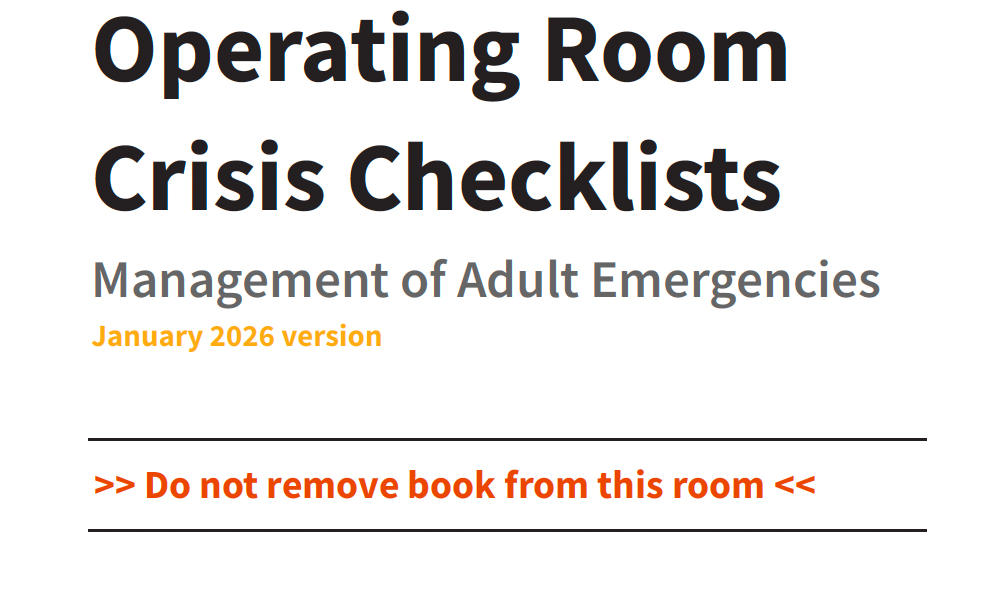
I have been looking at a document published in January 2026 by Ariadne Labs, the patient safety center jointly run by Brigham and Women’s Hospital and the Harvard T.H. Chan School of Public Health. It is called the Operating Room Crisis Checklists. It covers 17 emergencies — cardiac arrest, OB hemorrhage, malignant hyperthermia, failed airway, anaphylaxis, fire — and a debriefing protocol. The content is good. The evidence base is solid. The drug doses are correct. The differential diagnoses are thoughtful.
On the cover, in bold orange type, is this instruction:
>> Do not remove book from this room <<
Seven words. And in those seven words, the entire problem with how medicine uses checklists in 2026 is perfectly summarized.
It is a book. It must stay in the room. Someone has to find it, open it to the right page, and read it aloud during a crisis. This is the state of the art from one of the most respected patient safety organizations in the world, published three months ago.
Here is a “Shoulder Delivery Phase Timer”
This checklist is available 24/7. Unmovable. Accessible to everyone. Use it for every vaginal births and it will safe lives. I promise. And at the very least it will improve communications.
Or even better, install a display in each room (I just bout a 50 inch display for under $300).
Every L&D room needs a MOM — a Maternal Obstetric Monitor — a 50-inch display on the wall driven by the smartphone in every clinician's pocket. Pilots have had this for 30 years. Mothers deserve it too.

Where This Started
On October 30, 1935, a Boeing Model 299 lifted off a runway in Dayton, Ohio. It was the most advanced bomber ever built — so capable that a test pilot with thousands of flight hours forgot to release the elevator lock before takeoff. The plane climbed briefly, stalled, and crashed. Two crew members died.
Boeing’s engineers did not blame the pilot. They created a piece of paper. A short list of items to be checked, out loud, before each phase of flight. Not because pilots were incompetent. Because the aircraft had become too complex for any human memory to manage reliably alone.
That piece of paper became the foundation of modern aviation safety. The Boeing B-17 went on to fly 291,000 combat missions in World War II. The checklist was not a sign of failure. It was an acknowledgment of human limits.
How Aviation Evolved
What began as a laminated card grew into a system. By the 1970s, commercial aviation had developed crew resource management — a structured approach where every crew member has a defined role in running checklists. Challenge and response. Every item called, every response spoken aloud, every step logged.
Today, pilots do not hold a laminated card or open a book. They use an Electronic Flight Bag — an iPad running aviation software that tracks checklist completion in real time, records which items were confirmed and when, flags skipped steps, and updates automatically when procedures change. If a hydraulic system fails mid-flight, the abnormal checklist for that exact failure appears on the screen. The pilot does not flip through binders. The right checklist finds the pilot.
In 90 years, aviation went from a handwritten card after a crash to an integrated digital system embedded in every aircraft’s operating environment. The goal never changed: make sure nothing important is forgotten. The delivery mechanism changed completely.
Medicine’s Late Arrival
It took medicine another 70 years to pay serious attention. In 2001, Peter Pronovost at Johns Hopkins developed a five-item checklist for central line insertion in the ICU. The items were not complicated. Wash hands, use full sterile barrier, clean the skin with chlorhexidine, avoid the femoral vein, remove unnecessary catheters. Every physician knew these things. And yet, implementing the checklist reduced central line infection rates in Michigan ICUs by 66 percent over 18 months. More than 1,500 lives saved. [1]
The World Health Organization’s Surgical Safety Checklist followed — 19 items, three phases of surgery. A randomized trial across eight hospitals on four continents showed a 36 percent reduction in major complications and a 47 percent reduction in deaths. [2]
Obstetrics adopted the surgical timeout for cesarean delivery. Labor and delivery units developed hemorrhage bundles and sepsis protocols. The Safe Childbirth Checklist targeted birth attendants in low-resource settings. The evidence was clear. Checklists save lives.
But medicine made the same mistake aviation made in 1935: it stopped at the piece of paper. Or in 2026, the book.
The Book in the Room
Look at what the Ariadne Labs OR Crisis Checklists document is asking operating room teams to do. During a cardiac arrest, someone must find the book, open to checklist 04 or 05 depending on the rhythm, designate a checklist reader, and have that person read each step aloud while the team manages the patient. During OB hemorrhage, checklist 15. During malignant hyperthermia — a rare, rapidly fatal reaction — checklist 13, after calling the MH hotline at 1-800-644-9737, a number that is printed in the book because without the book you would not have it.
The checklist content itself is excellent. The OB hemorrhage checklist correctly identifies the four T’s — tone, trauma, tissue, thrombin. Drug doses are specific and current. The debriefing protocol, using the WATER framework, is thoughtful. Ariadne Labs has done real work here.
But the delivery mechanism is a physical book that must not leave the room. In an emergency, someone must find it. Someone must hold it. Someone must be designated to read it. If the book is in the wrong place, or the team skips the designation step because things are moving fast, the checklist does not happen.
This is not a criticism of Ariadne Labs. This is a description of where medicine is. The book is the standard. Most operating rooms and delivery suites do not have anything better.
The Timeout as Theater
The surgical timeout has the same problem. Someone calls it. The team pauses. Someone reads from a laminated sheet or a whiteboard. Patient name, procedure, site, allergies, anticipated blood loss. The team confirms. Then the surgery begins.
How often is this done correctly? How often are all items actually addressed? How often does a team member raise a concern? Studies suggest: not reliably. A 2012 observational study found that surgical timeouts were completed fully less than 50 percent of the time in real practice, even in institutions reporting high compliance. [3] Nobody logs whether the timeout was done. Nobody knows if an item was skipped. There is no record. The timeout either happened or it did not, and most of the time no one can say which.
A laminated sheet does not create accountability. A dry-erase whiteboard in a labor and delivery room can display a patient’s GBS status and gestational age. It cannot alert the team when blood pressure crosses a critical threshold. It cannot flag that a patient’s hemorrhage risk changed because her labor required oxytocin augmentation. It cannot be read from the nursing station at 2 a.m. It cannot hand off to the incoming night team. It is a static snapshot in a dynamic, high-risk environment. That gap is where errors live.
What Aviation Is Doing Right Now
Commercial aviation carries 4.5 billion passengers per year. The fatal accident rate for large commercial aircraft is approximately 0.07 per million flights. [4] This did not happen because pilots became better people. It happened because the system was redesigned around the assumption that humans make errors, and the system’s job is to catch those errors before they become crashes.
The Electronic Flight Bag does not replace pilot judgment. It handles memory so the pilot can handle thinking. The checklist is embedded in the workflow, time-stamped, logged, and integrated with the aircraft’s actual systems. There is no book that must not leave the room. The right checklist appears on the screen when it is needed, triggered by the situation itself.
Medicine is nowhere near this. Most hospitals do not have systems that automatically escalate when a patient’s early warning score crosses a threshold. Most labor and delivery units do not have integrated digital checklists that record completion and hand off between shifts. Most obstetric teams still rely on memory, verbal communication, a whiteboard, and a book that must stay in the room.
What This Costs
The Joint Commission reviewed 1,000 maternal deaths and found that in the majority of cases, warning signs were either not recognized or not acted upon in time. [5] This is exactly the failure a well-designed checklist system is built to prevent. Hemorrhage is the leading cause of preventable maternal death worldwide. California’s Maternal Quality Care Collaborative showed that implementing a structured hemorrhage bundle reduced severe maternal morbidity by 20 percent. [6] That bundle is, at its core, a checklist.
The tools exist. The evidence exists. The gap is the delivery mechanism. A checklist that requires someone to find a book during a hemorrhage is not a safety system. It is a good intention dressed as one.
What 2026 Should Look Like
Electronic health records in most major hospitals already capture the data needed to drive dynamic, context-sensitive checklists. A patient whose hemorrhage risk score crosses a threshold should trigger an automatic display of the hemorrhage readiness checklist on every screen in the room. A second-stage labor duration alert should prompt the provider to document a decision. A sepsis bundle should activate when vital sign criteria are met, not when someone remembers to order it.
The OR Crisis Checklists that Ariadne Labs published in January 2026 should exist as an integrated application in every operating room’s display system, triggered by the documented clinical event, logged when completed, time-stamped for each step, and automatically handed off to the next team. Not a book. Not a laminated card. Not a whiteboard. A system.
This is not futuristic. Aviation has been doing it since the 1990s. The technology exists in medicine. What is missing is the will to accept that a book with a warning not to leave the room is not a safety system — it is 1935 technology with a Harvard logo on the cover.
A better checklist: Always available. To everybody. FREE:
Example: The Shoulder Delivery Phase Timer. Use it. Every Vaginal delivery.
My Take
I have been in delivery rooms for 50 years. I have watched checklists get introduced, celebrated, and quietly ignored when the unit got busy. I have seen timeouts that lasted 15 seconds and documented nothing. I have seen whiteboards with information that was never updated.
The Ariadne Labs OR Crisis Checklists are well-made. The OB hemorrhage checklist, the cardiac arrest checklists, the debriefing protocol — the content is right.
The people who wrote this document care about patient safety.
I do not question that.
What I question is the delivery mechanism. The book. The instruction not to remove it from the room. That instruction exists because if someone takes it out, it will not be there when it is needed. Which tells you exactly how the system works: it depends on a physical object being in the right place at the right moment, held by the right person, in the middle of a crisis.
Pilots figured out that this was not good enough. They kept improving the delivery mechanism until the checklist was part of the aircraft itself. Medicine should do the same. The Boeing engineers in 1935 had the right idea. It has now been 91 years. The book is not the answer.
Today, every pilot on every commercial flight runs checklists on an iPad. Every one of us has a smartphone in our pocket with more computing power than the Apollo mission. And in our operating rooms and delivery suites, we are still telling people not to remove the book from the room."
References
1. Pronovost P, Needham D, Berenholtz S, et al. An intervention to decrease catheter-related bloodstream infections in the ICU. N Engl J Med. 2006;355(26):2725-2732.
2. Haynes AB, Weiser TG, Berry WR, et al. A surgical safety checklist to reduce morbidity and mortality in a global population. N Engl J Med. 2009;360(5):491-499.
3. Vats A, Vincent CA, Nagpal K, et al. Practical challenges of introducing WHO surgical checklist: UK pilot experience. BMJ. 2010;340:b5433.
4. International Air Transport Association. Safety Report 2023. Montreal: IATA; 2024.
5. The Joint Commission. Sentinel Event Alert: Preventing maternal death. Issue 44. 2010.
6. Main EK, Goffman D, Scavone BM, et al. National partnership for maternal safety: consensus bundle on obstetric hemorrhage. Obstet Gynecol. 2015;126(1):155-162.