

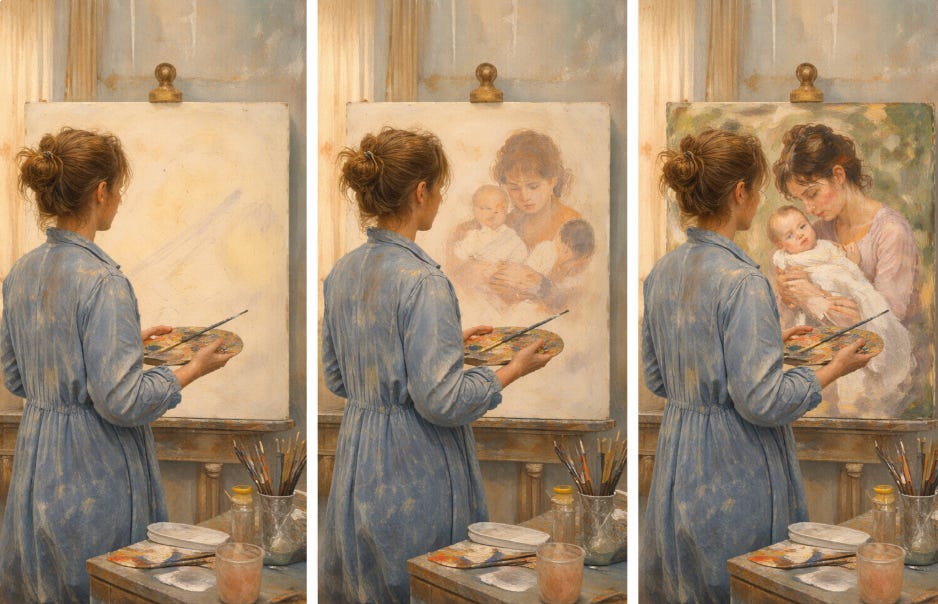
It is 10 o’clock at night. You are the department chair, or the quality officer, or the attending who was there. Something bad happened today. You do not have the full chart yet. You do not have the nursing notes or the EFM strips. You have the outcome, a rough timeline in your head, and the knowledge that tomorrow someone is going to ask you what happened.
Most people in that situation do one of two things. They wait — for the chart, for the lawyers, for the M&M conference three months from now. Or they write a paragraph in an email to risk management and consider the matter documented.
I want to suggest a third option. Open the canvas. Start painting.
The Blank Canvas Is Not a Problem. It Is the Beginning.
When a painter begins a work, the canvas is not empty in the sense of being useless. It is empty in the sense of being ready. The first marks on it are not the finished painting. They are the underdrawing — the rough geometry of what the painting will become. Without them, nothing that follows has a foundation.
The ObGyn Adverse Outcome Investigation tool works the same way. You do not need the complete picture before you start. You need three things: what happened, roughly when, and what the outcome was. That is your first brushstroke. Enter it. Then ask Claude to take a look.
What Claude gives you back is not an analysis. Not yet. What Claude gives you back is a map of what is still blank — the questions that cannot be answered with what you have entered, the legal elements that are unsupported, the phases of the investigation that have no data. That map is valuable. It tells you what to find out next.
The painting has begun. The canvas is no longer blank.
The First Brushstroke: What You Know Right Now
Go to tools.obmd.com/ob-case-review. Open the Case Identification section. Enter the outcome category. Write three to five sentences describing what happened, in chronological order, based on what you know at this moment. Do not wait until you know everything. Do not worry that the description is incomplete. Incomplete is exactly where this starts.
Then select the outcome category from the dropdown and the legal status — even if that status is simply “internal review, no claim.” Hit “Analyze this case.”
Claude will read what you have entered and produce a structured response covering the four legal elements — duty, breach, causation, and damage — based only on what is there. For most first entries, duty may be the only element with enough information to assess. Breach, causation, and damage will come back flagged as unresolved. Claude will tell you specifically what is missing: no timeline has been established, no standard of care has been identified for any decision point, no documentation review has been conducted.
That list of missing things is your assignment for tomorrow. The gap analysis has already started.
The Second Layer: The Timeline and the Record
A day or two later, you have the chart. Not fully reviewed — but in hand. You have the nursing notes and the attending’s notes from the hours before the event. You have the medication administration record. You have at least part of the EFM tracing.
Return to the tool. Open Phase 1 — The Event — and work through it. Check the items you have addressed. Leave unchecked the ones you have not. Write your findings in the notes field: what the timeline shows, where the gaps are, what the last safe moment appears to be. Then open Phase 2 — The Clinical Record — and do the same. Note what documentation exists, what is missing, whether there are periods with no entries.
When you have filled in what you have, run “Identify investigation gaps.” Claude will now give you something more precise than it could the first time. It knows what phases have data and which ones are still blank. It will tell you, specifically, which documentation has not been reviewed, which legal elements remain unsupported, and what the review team needs to address before any probable cause determination is possible.
The painting is acquiring its first shapes. You can see where the light is and where the shadows still have no detail.
The Third Layer: Standard of Care and the Breach Question
This is the layer where the painting either resolves or reveals something uncomfortable. Phase 3 — Standard of Care — is the hardest part of any case review, and the part most likely to be avoided or softened in a standard M&M conference. The tool forces you to be specific.
For each major decision point in the case — triage assessment, EFM interpretation, escalation, the timing of intervention — you are asked to state the applicable standard in writing and then assess whether it was met. Not whether the clinician tried hard. Not whether the system was understaffed. Whether what happened at that specific moment was consistent with what a reasonably competent ObGyn should have done.
This is where the breach question lives. Many case reviews never get here because they stay at the level of narrative: this is what happened, these were the challenges, the team did their best. The tool does not allow that stop. It asks for a written determination: deviation identified, possible deviation requiring expert review, or no deviation found. Checking that box — any of the three — is itself an act of institutional honesty that most hospitals never perform.
Enter your Phase 3 findings. Add your notes. Then run “Analyze this case” again. Claude will now have a materially different picture than it did on day one. The breach element either has support or it does not. The gap analysis will be more specific. If a deviation has been identified, Claude will flag that causation — the direct link between the breach and the damage — is now the critical unresolved question.
The painting has a subject now. You can see what it is about.
The Fourth and Fifth Layers: Communication and System
Most adverse outcomes in obstetrics, when examined carefully, have a communication failure somewhere in the chain. A handoff where the clinical picture was not fully transmitted. A nurse who raised a concern that was not escalated. A family who was not told the specific risks of the plan that was chosen. A consent form signed without a real conversation.
Phase 4 of the tool is dedicated entirely to communication — clinician-to-patient, nurse-to-physician, handoff, chain of command, disclosure after the event. Work through it when you have interviewed the staff involved or reviewed the nursing notes in detail. The findings field is where the most important material often surfaces: “The nurse documented concern about the Category II tracing at 02:14. There is no documented physician response until 03:47.”
Phase 5 examines system factors — staffing ratios, on-call structure, protocol existence and currency, prior similar events and whether their recommendations were implemented. This is the layer that most individual clinicians cannot complete alone. It requires data from nursing administration, from the EHR system log, from the risk management database. But it is also the layer where the most important institutional learning lives. If the same documentation gap appears in this case and in two prior cases with no change between them, that is not a coincidence. That is a system that has chosen not to learn.
As you complete each phase, run the gap analysis again. Each time, the response will be more specific, more useful, and in some ways more demanding. The painting is filling in. The dark corners are getting harder to explain away.
The Finished Work: Causation, Determination, and the Recommendations
Phase 6 — Causation — is where the painting either resolves into a coherent image or reveals an irreducible complexity that requires an expert opinion. The tool walks you through the “but-for” test, counterfactual analysis, pre-existing conditions as independent contributors, and hindsight bias. It requires a written probable cause statement. Not a summary of what happened. A specific statement of what caused the adverse outcome and whether a deviation from the standard of care was in the causal chain.
When you reach this stage with substantial data entered across all phases, run “Analyze this case” one final time. Claude will now produce something that looks genuinely different from what it produced on day one with three sentences. It will assess all four legal elements with the evidence that supports or contradicts each one. It will flag what is still unresolved. It will produce a preliminary case assessment that a review team can use as the foundation for their own deliberation.
Then run “Generate prevention recommendations.” This is the NTSB step — the one that makes the whole investigation worth doing. Claude will produce an NTSB-style Safety Recommendation Bulletin: immediate actions within 30 days, system-level changes within 90 days, long-term institutional changes, and for each one a responsible party, a deadline, and a measurable compliance metric. Not “improve communication.” The exact change, who owns it, by when, and how you will know it happened.
The painting is finished. Or as finished as it will get without an independent investigator. What you have is a documented, structured, phase-by-phase case review that covers all four legal elements, identifies the probable cause, and produces specific prevention recommendations with accountability attached.
What a Half-Finished Canvas Is Worth
I want to say something directly about incomplete investigations, because the most common reason case reviews never start is that someone decides they do not yet have enough information to begin.
A half-finished investigation that has identified three specific gaps is more valuable than no investigation. It tells the next person exactly where to look. It creates a record that something was examined — and what was found. It identifies, at minimum, which of the four legal elements can be addressed with current information and which ones require further work.
The blank canvas criticism — “we should wait until we have the full picture” — is actually the argument for starting. You do not know what the full picture will require until you start building it. Claude’s gap analysis after a minimal first entry is often the most useful output the tool produces, precisely because it tells an institution what it does not know and what it needs to find out.
Start now. Enter what you have. Let Claude tell you what is still blank. Come back tomorrow with the next layer.
My Take
The best painting I have ever seen in a hospital was not on a wall.
It was a completed adverse outcome review — eight phases, every finding documented, a probable cause statement that named the deviation and the causal chain without equivocation, and five prevention recommendations that were implemented within ninety days.
I have seen perhaps three of those in fifty years of clinical practice.
The rest were mostly incomplete.
The reason is not that clinicians and institutions do not care. The reason is that the investigation has always required a perfect start — full information, dedicated time, a structured process that nobody built. The tool exists now. The structured process is there. The AI analysis is there. The only thing required to begin is three sentences and the willingness to see what the canvas looks like when you start painting.
Every case that goes unexamined is a lesson that never gets learned. Every institution that waits for the perfect moment to begin its investigation is an institution that will face the same outcome again.
Start with a blank canvas. That is exactly where every finished work begins.
ObGyn Adverse Outcome Investigation Checklist — free, interactive, AI-powered. tools.obmd.com/ob-case-review