

If you’re struggling to conceive or newly pregnant, you’ve likely encountered advice to adopt an “anti-inflammatory diet.” The pitch is seductive: inflammation causes infertility, inflammation harms pregnancy, so eat salmon and turmeric to have a baby.
The logic sounds plausible. But what does the evidence actually show?
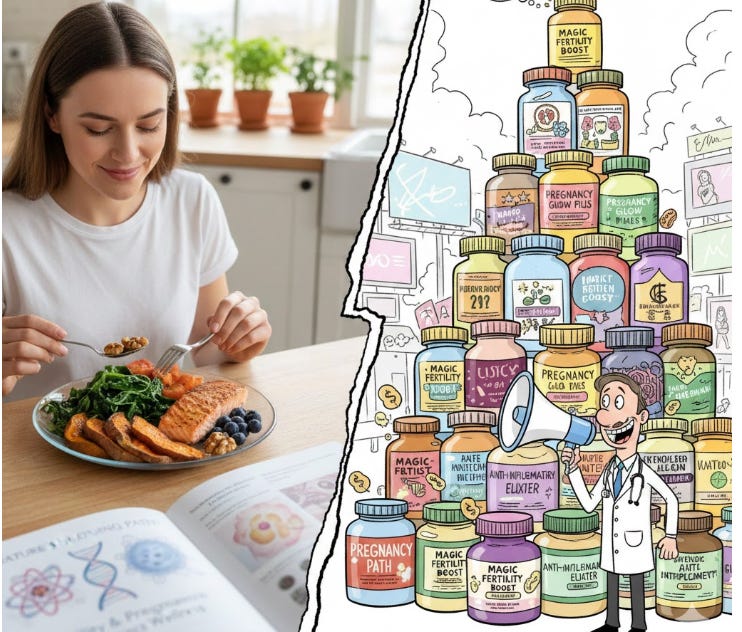
The Fertility Claims
Let’s start with what appears to support the narrative. A 2022 review in Nutrients concluded that adherence to “anti-inflammatory diets” improves fertility and assisted reproductive technology (ART) success. Headlines followed. The problem? Read beyond the abstract and the picture gets complicated.
A 2024 NHANES analysis found women eating pro-inflammatory diets had 61% higher odds of infertility. Another cross-sectional study reported an 86% increased risk. Sounds alarming—until you realize these are observational studies that can’t establish causation. Women who eat processed food diets also differ in dozens of other ways: income, stress, sleep, BMI, smoking, alcohol use. The diet may be a marker, not a cause.
What about IVF? Here the evidence fractures. A Greek prospective cohort of 357 women found Mediterranean diet adherence associated with higher clinical pregnancy rates. But an Iranian study of 144 IVF patients found no association between dietary inflammatory index (DII) scores and any treatment outcome. An Italian study of 474 women? No association with pregnancy, live birth, oocyte yield, or embryo quality. A Dutch cohort? Also no significant associations.
A 2023 systematic review examining female dietary patterns and IVF outcomes concluded there was “insufficient evidence to support recommending any single dietary pattern for the purpose of improving pregnancy or live birth rates” in women undergoing IVF.
The honest summary: some observational studies show associations; others don’t. No randomized trials have demonstrated that changing diet from “pro-inflammatory” to “anti-inflammatory” improves pregnancy rates in infertile women.
