

For most of the AI era, medicine has protected itself with a reassuring formulation:
AI will assist physicians. It will not replace physician judgment.
The American Medical Association even prefers the term “augmented intelligence,” emphasizing that AI should enhance, rather than supplant, human clinicians. The American College of Physicians similarly argues that AI should support clinical decision-making rather than replace it.
That position is increasingly difficult to defend as a scientific principle.
In a provocative new JAMA Perspective, Ezekiel Emanuel and colleagues argue that autonomous AI may ultimately provide better cognitive medical care than physicians, including physicians working with AI.
For obstetrics and gynecology, we should take that possibility very seriously.
I suspect they may be right.
We are asking the wrong question
The usual question is:
Will AI replace the ObGyn?
That is too simplistic.
A better question is:
For which parts of being an ObGyn will AI eventually make better decisions than the ObGyn?
And the answer may be: a very large part of what we currently call clinical judgment.
Consider what fills much of our cognitive work:
obtaining and organizing a history;
calculating gestational age;
interpreting laboratory values;
generating differential diagnoses;
estimating risk;
choosing diagnostic tests;
selecting medications;
applying guidelines;
recognizing contraindications;
integrating multiple comorbidities;
reviewing longitudinal records;
predicting complications;
counseling about probabilities.
These are precisely the kinds of tasks at which modern AI systems are improving extraordinarily quickly.
Emanuel and colleagues summarize evidence suggesting that AI already rivals or exceeds physicians in five fundamental cognitive domains: eliciting clinical information, diagnosis, test selection, guideline-concordant treatment, and chronic disease management.
That matters enormously for ObGyn.
Imagine the autonomous AI obstetrician
A sufficiently capable obstetric AI could simultaneously know:
every blood pressure during pregnancy;
every laboratory result;
every ultrasound measurement;
the fetal growth trajectory;
every medication and potential interaction;
the patient’s prior pregnancies;
every applicable guideline;
the patient’s cesarean probability;
her hemorrhage risk;
her preeclampsia risk;
her venous thromboembolism risk;
and every change in fetal status occurring during labor.
It would not become tired during a 24-hour call.
It would not forget whether the creatinine was 0.8 or 1.2.
It would not confuse one patient with another.
It would not rely on a vaguely remembered Practice Bulletin.
It could continuously update risk as new information became available.
Most importantly, it could compare the current patient with an amount of medical knowledge and clinical data that no individual physician could possibly retain.
That does not mean today’s LLM can safely run a labor floor.
It means we should stop assuming that human cognition is the ceiling against which medical intelligence must be measured.
It probably is not.
The physician in the loop may not always improve care
This is the most uncomfortable part of Emanuel and colleagues’ argument.
We have generally assumed that the safest configuration is:
AI recommendation → physician review → physician decision.
But there is no law of nature saying the physician improves the answer.
A meta-analysis cited in the Perspective found that when humans outperform AI, combining humans with AI can improve performance. But when AI already outperforms humans, the human-AI combination can perform worse than AI alone.
That makes intuitive sense.
Imagine an AI correctly recognizes evolving severe preeclampsia and recommends delivery.
The physician says, “She looks fine. Let’s wait.”
Or the AI identifies subtle fetal deterioration.
The physician dismisses it because the tracing “doesn’t look that bad.”
The human has not added safety.
The human has introduced error.
Medicine tends to describe this as “clinical judgment.”
Sometimes it is.
Sometimes it is simply wrong judgment delivered with confidence.
Obstetrics may be particularly suited to AI superiority
Obstetrics contains an extraordinary mixture of structured data and high-stakes decisions.
Gestational age.
Blood pressure.
Proteinuria.
Platelets.
AST and ALT.
Estimated fetal weight.
Amniotic fluid.
Cervical dilation.
Contraction frequency.
Fetal heart rate.
Prior cesarean history.
Maternal age.
BMI.
Diabetes.
Hypertension.
These variables interact across time.
Humans are not especially good at continuously integrating dozens or hundreds of changing variables.
Computers are.
An autonomous obstetric AI could eventually perform continuous surveillance rather than episodic evaluation.
That is a fundamentally different model of care.
Today, the obstetrician reviews the chart, examines the patient, interprets the fetal tracing, and makes a decision.
Tomorrow, the AI may have been analyzing the pregnancy continuously for months and detecting trajectories that no clinician ever consciously noticed.
The physician may increasingly become the person who acts on the intelligence rather than generates all of it.
And gynecology?
The same transformation is easy to imagine.
Abnormal bleeding.
Adnexal masses.
Infertility.
Menopause.
Contraceptive counseling.
Cervical screening abnormalities.
Hereditary cancer risk.
Medication selection.
Longitudinal surveillance.
Much of outpatient gynecology involves integrating history, laboratory results, imaging, guidelines, risk estimates, and patient preferences.
An autonomous system with complete access to the patient’s longitudinal record could potentially perform much of that cognitive synthesis more consistently than an individual clinician seeing the patient for 15 minutes.
That is not science fiction.
The remaining question is how quickly reliability, regulation, liability, data integration, and real-world validation catch up with capability.
But AI cannot deliver a baby
Correct.
Emanuel and colleagues explicitly acknowledge that procedures remain a major boundary. Surgery, delivery, interventional radiology, colonoscopy, and physical examination still require human clinicians because robotics cannot yet replace those functions in most settings.
But this is not an argument against autonomous medical intelligence.
It simply separates thinking from doing.
The AI may decide that cesarean delivery is indicated.
The obstetrician performs it.
The AI may identify postpartum hemorrhage and recommend the optimal sequence of uterotonics, tranexamic acid, transfusion, balloon tamponade, and escalation.
Humans carry out those interventions.
The fact that a pilot does not personally calculate every navigational parameter does not mean the aircraft lacks automation.
Medicine may evolve in the same direction.
The hardest objection is not technical. It is professional.
Physicians have built professional identity around judgment.
We perform procedures, certainly.
But what distinguishes the physician has traditionally been the claim:
I know what should be done.
If a machine can know what should be done more accurately, more consistently, and with access to vastly more information, that threatens something deeper than employment.
It threatens professional hierarchy.
Yet preserving physician authority cannot be the objective of medical ethics.
The objective is better patient care.
If autonomous AI eventually produces fewer diagnostic errors, fewer treatment errors, more guideline-concordant care, better risk prediction, and better outcomes than physicians, then insisting that a physician retain final control merely because the decision is “medical” would become difficult to justify ethically.
Professional authority is not an entitlement.
It must be earned by superior performance.
There are still important limitations
The case is not yet proven.
The authors appropriately acknowledge that much of the evidence comes from simulated tasks rather than actual autonomous clinical practice. Real patient communication remains a potential failure point. AI can be brittle. Cybersecurity, hallucinations, infrastructure failure, liability, reimbursement, and regulation remain unresolved.
These limitations are substantial.
But they should affect how autonomous AI is introduced, not whether we permit ourselves to consider that it may ultimately outperform us.
The appropriate response is rigorous prospective testing.
If autonomous AI performs worse, do not deploy it.
If physician plus AI performs best, use that model.
But if autonomous AI repeatedly produces better outcomes than physician-controlled care, medicine must be willing to accept that result too.
The ObGyn of the future may have a very different job
Physicians will not disappear.
Obstetricians will still operate, deliver babies, manage emergencies, examine patients, communicate devastating news, navigate values and preferences, and take responsibility in circumstances in which algorithms cannot act physically.
But the assumption that the physician must remain the supreme cognitive authority may not survive.
By 2030, Emanuel and colleagues argue, autonomous AI could be ready for real-world deployment in at least some cognitive medical workflows.
In ObGyn, I think we should prepare for something even more consequential:
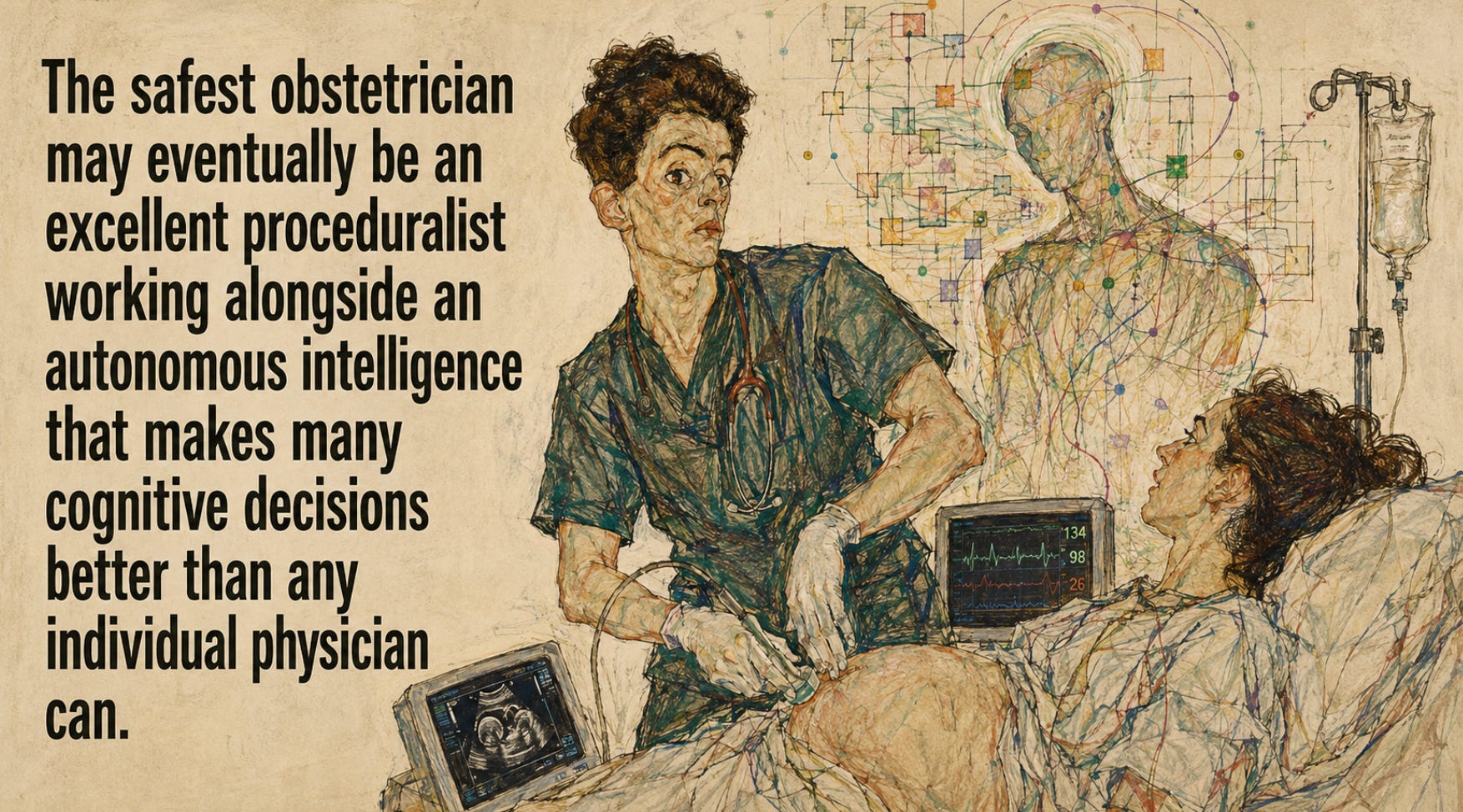
The safest obstetrician may eventually be an excellent proceduralist working alongside an autonomous intelligence that makes many cognitive decisions better than any individual physician can.
And eventually, for some areas of care, the question may no longer be:
Should the AI be allowed to make this decision without the doctor?
It may become:
If the AI consistently makes this decision better than the doctor, what is our justification for allowing the doctor to overrule it?
That is the question our profession needs to start confronting now.
Reference
Emanuel EJ, Baker-Butler A, Khosla N, Khosla V. Will autonomous AI exceed AI-aided physicians as the best medical care? JAMA. Published online August 17, 2026. doi:10.1001/jama.2026.15380.