

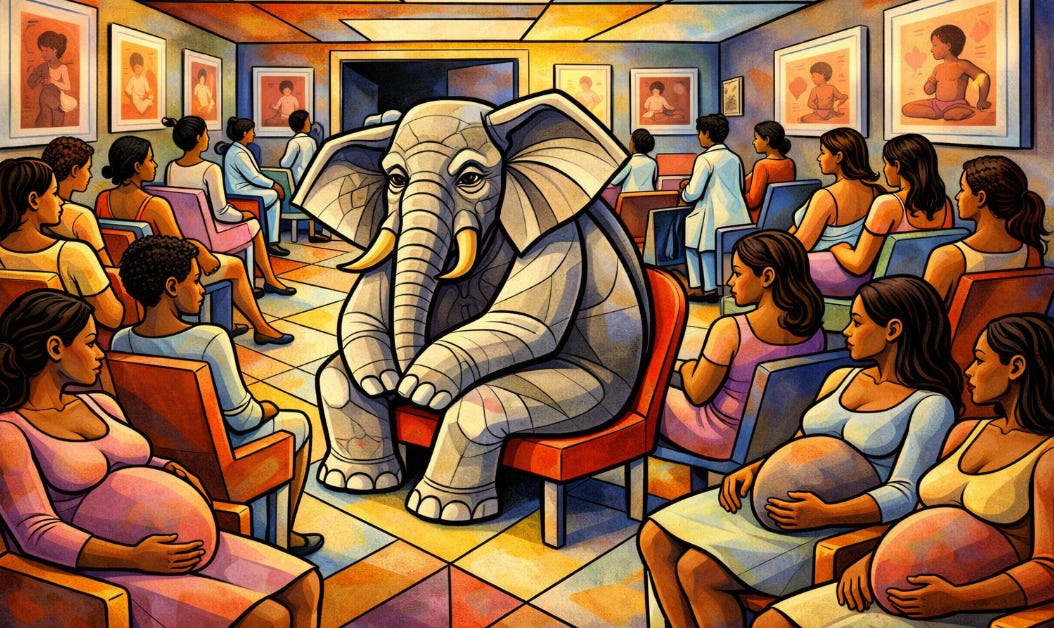
The Elephant in the Delivery Room
I was invited to a conference. The title: Advancing Maternal Health Outcomes for All: Addressing Key Drivers of Maternal Morbidity and Mortality.
Key drivers. That is a specific claim. A driver is a cause. Not a contributing element, not a social context, not a lived experience. A driver is something whose presence makes the outcome worse and whose absence would make it better. If you say you are addressing key drivers, you are promising to name causes and do something about them.
I have been to versions of this conference many times. The rooms change. The title changes slightly each year. The elephant does not move.
Here is what will be said.
Black women die at two to three times the rate of white women during pregnancy and in the weeks after birth. This is true. It is well documented in CDC data going back decades. Implicit bias will be named. Cultural competence will be called for. Diverse workforces will be recommended. Community health workers and doulas will be celebrated. Someone will say the word dignity more than once. A panelist will share a story that lands heavily in the room. The audience will nod. There will be a shared commitment to advancing maternal well-being for all.
All of this is real. None of it is the key driver.
What a Key Driver Actually Means
In epidemiology and health systems research, a key driver is a factor that meets a specific test: when you change it at the population level, the outcome changes at the population level. It is not enough for the factor to be associated with bad outcomes, or to be present in the histories of women who died. Association is not causation. A key driver moves the needle when you intervene on it directly.
We have clear examples of this in obstetrics, and they are worth naming precisely.
Postpartum hemorrhage is the leading cause of maternal death worldwide. The key driver is not that clinicians lack empathy or cultural awareness. The key driver is delayed recognition and delayed treatment. When California implemented mandatory, standardized hemorrhage protocols with required drills, required equipment, and required response timelines, maternal mortality from hemorrhage fell sharply. The intervention worked because it targeted the actual mechanism of death: time to transfusion, time to uterotonics, time to surgical control. Those are drivers. They are measurable, modifiable, and when you change them, women stop dying.
Hypertensive disease in pregnancy, including preeclampsia, is the second leading cause of maternal death in the United States. The key driver of death from preeclampsia is not that the patient was not heard. It is that her blood pressure was not treated quickly enough after it crossed a dangerous threshold. A 2022 study in the New England Journal of Medicine showed that a simple bundle requiring antihypertensive treatment within 30 to 60 minutes of a severe-range blood pressure reading cut the rate of severe maternal morbidity significantly. The driver was treatment delay. The intervention was a clock and a protocol. It worked.
Racial disparities in these outcomes are real and well documented in CDC data. But when researchers have looked carefully at what explains them, insurance status and hospital resources consistently account for a substantial portion of the gap. A 2021 analysis found that Black women were more likely to deliver at hospitals with higher complication rates for all patients, regardless of race. The hospital mattered more than the bias of any individual provider. That is a driver. The hospital’s resources, its staffing ratios, its blood bank capacity, its ability to run the protocols that California proved work: those are driven by one thing above all others, which is how the hospital is paid.
Here is what will not be said.
Medicaid reimburses hospitals and physicians at roughly half the rate of private insurance. The hospitals that serve the highest proportion of Black women in America are therefore the hospitals with the fewest resources to deliver care. The same hemorrhage protocol at a safety-net hospital with a limited blood bank produces different outcomes than the same protocol at a well-funded academic center. That difference is not bias. It is what happens when the payment system assigns the least to the patients who need the most.
Black women in America are more likely to be uninsured or on Medicaid, and more likely to deliver in under-resourced facilities. At the population level, where the mortality numbers are made, this is the pattern. In countries with universal coverage, the racial gap in maternal mortality is dramatically smaller. Not gone. Smaller. That is a data point that should be on the first slide of every conference with the words key drivers in the title.
Delay in seeing a doctor is a driver too, and it belongs in this conversation. Women without adequate insurance coverage start prenatal care later, see specialists less often, and are less likely to have a postpartum visit where early warning signs of complications get caught. Preeclampsia that goes unmonitored between appointments does not announce itself politely. Gestational diabetes unmanaged in the first trimester has consequences that no amount of dignity in the delivery room can undo. The first prenatal visit is not a formality. For women with limited access, it is often the only early warning system available, and for too many it comes too late.
Prior authorization belongs on that slide too. A high-risk patient whose specialist consultation is delayed three weeks while her insurer reviews the request is a patient at risk. That delay has a race and a zip code and an insurance card attached to it. But it does not have a face in the conference room, because the people in the conference room generally have good insurance.
And then there is the bias nobody at these conferences wants to name out loud. Many obstetricians and maternal-fetal medicine specialists do not accept Medicaid. Many do not accept certain lower-reimbursing commercial plans either. This is not hidden. It is simply never called what it is: a form of discrimination based on the card in a patient’s wallet. A woman with private insurance can call virtually any practice in her city and be seen within a week. A woman on Medicaid calls and is told the practice is not accepting her insurance, or is directed to a clinic with a six-week wait and rotating residents. We talk endlessly about implicit bias at the bedside. We say almost nothing about the explicit, structural, perfectly legal bias that happens at the front desk, before the patient ever reaches a bed.
I am not saying bias does not exist. After more than fifty years in obstetrics I know it does. It is unacceptable. I am saying that we have built an entire conference circuit around a conversation that names the symptom while carefully avoiding the cause. Racism in medicine is real. So is a financing structure that assigns the worst-resourced care to the most vulnerable patients and then convenes panels to express concern about the outcomes.
If the title says key drivers, then the key driver belongs in the room. The key driver is money. Specifically, it is the gap between what Medicaid pays and what good care costs, and the downstream consequences of that gap for the women who need care the most.
My Take
I will go to this conference. I will listen carefully. I believe the people in the room care about this problem. But there is a difference between caring about a problem and naming its cause. Key drivers is not a decorative phrase. It is a promise. If the afternoon ends without a serious conversation about insurance coverage, reimbursement rates, and hospital resources, then the conference will have broken that promise, politely and with good intentions, exactly as it has every year before. The elephant is very comfortable in that room. It has been coming for years. It knows where to sit.