
The First Fertility Test Every Couple Should Do (And Most Couples Skip)
Men contribute to more than half of the trouble couples have getting pregnant, yet the workup almost always starts with the woman. The single most useful test is cheap, fast, and easily available

Men contribute to more than half of the trouble couples have getting pregnant, yet the workup almost always starts with the woman. The single most useful first test is cheap, fast, and now available on a man’s own phone. Here is how to do it, and when the phone is not enough.

We throw bachelor parties, register for china, and plan the seating chart down to the cousin nobody likes. The one test that covers half of a couple’s future fertility never makes the list.
More than half of the difficulty couples have getting pregnant involves the man. In about 1 in 2 cases, a sperm problem is part of the picture, and in about 1 in 5 cases it is the whole picture.1 2 Despite this, the fertility workup almost always begins with the woman. She gets the bloodwork, the ultrasound, the timed cycles. He gets asked to wait.
That order is backwards. The first fertility test a couple should do is a semen analysis, and the man can take the first version of it without leaving the house.
What a Semen Analysis Actually Tests
A semen analysis looks at a fresh sample under controlled conditions and reports several separate numbers. Each one answers a different question, and a couple should know what each means before reading a report.
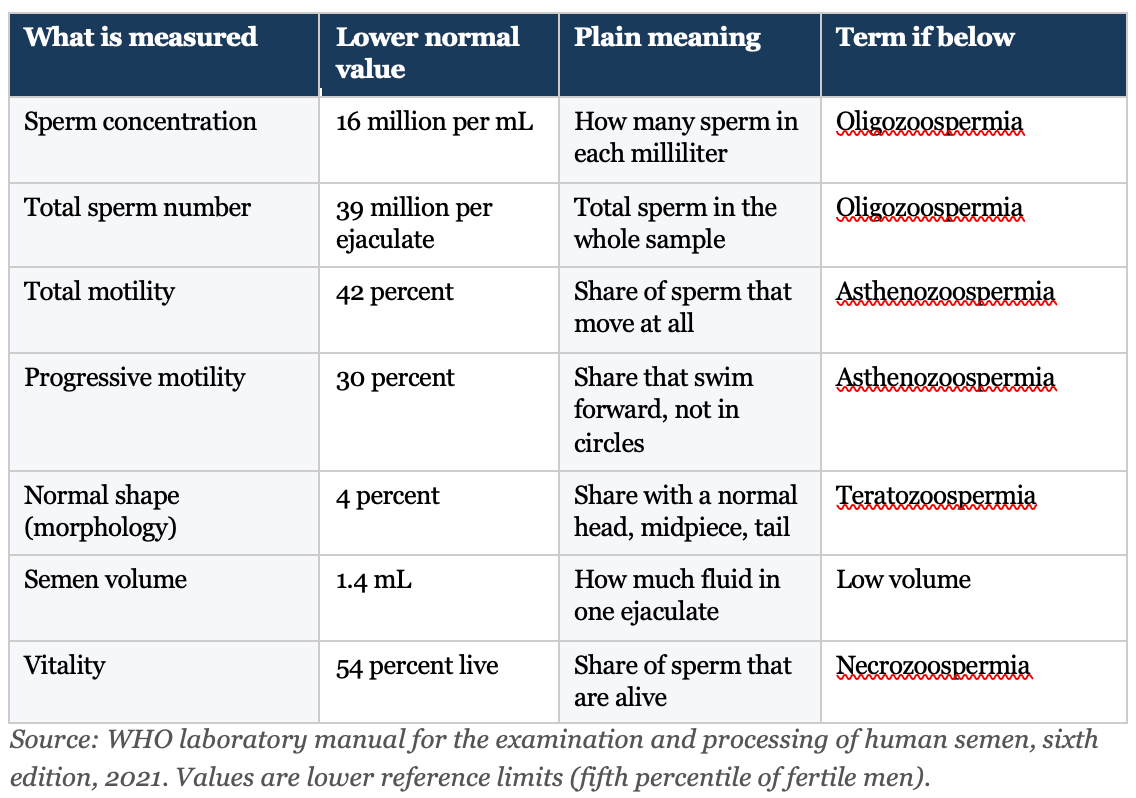
Concentration is how many sperm are in each milliliter of fluid. Total sperm number is the count in the whole sample, which matters more than concentration alone because two men with the same concentration can have very different totals if their volumes differ.3
Motility is the share of sperm that move. Progressive motility is the share that swim forward in a straight line, which is the part that counts, since sperm have to travel to reach the egg. Morphology is the share with a normal shape. Volume, vitality, and pH round out the report.
Here are the current World Health Organization sixth-edition lower normal values. These are not pass-or-fail lines. They are the fifth percentile of men who fathered a child within a year, so a number just below the cutoff does not mean a man cannot father a child.4 5
Why the Man Should Go First
The reason to test the man first is simple arithmetic. A semen analysis is faster, cheaper, and far less invasive than the female workup, and it covers half the possible problem in one step.1 2 Skipping it does not protect anyone. It only delays an answer.
Most sperm problems cause no symptoms. A man can feel fine, have a normal sex life, and still have a low count or poor motility. 6 The only way to know is to look. And one survey found that fewer than half of obstetrician-gynecologists routinely considered evaluating the male partner before ordering tests on the woman.2 That gap is exactly the kind of habit worth breaking.
Here is a reason to do this test now rather than later.
Telehealth has made testosterone easy to start with a few taps and a short video call, and prescriptions have climbed. What too many of these visits skip is the warning that testosterone is, in effect, a male contraceptive. When a man takes testosterone from outside the body, his brain reads the supply as sufficient and shuts down the signals that tell the testicles to make sperm. The result is predictable. In one large study, after six months of weekly testosterone injections, roughly two in three men had no sperm at all in the ejaculate, and the average time to reach that point was about 120 days.¹³ Other series put the share of testosterone users with a low or absent sperm count even higher.¹⁴
The effect is usually reversible, but recovery can take 6 to 12 months or longer after stopping, and a meaningful number of men never return to their starting count.¹³
This is why every man of reproductive age should have a baseline semen analysis before he starts testosterone, and one study found that fewer than 2 percent actually do.¹⁵
A man who wants children, now or someday, should know his number before the first dose, not after a year of trying.
The next part is the practical playbook: how the at-home test compares to the clinic test, exactly how each one is done, and the one rule that keeps a single bad result from sending you down the wrong path. Paid subscribers read on.
