

The Lancet Commission’s most important finding is not simply what threatens humanity, but how much suffering we might prevent if we make better decisions today.
We spend enormous amounts of time worrying about the next pandemic, nuclear war, artificial intelligence, and climate change. These threats deserve serious attention.
But what if some of the greatest threats to human health are already unfolding in front of us, slowly, predictably, and with far less public attention?
On October 11, 2026, The Lancet published a major Commission led by Christopher Murray and Natalia Kanem, examining global threats to health through the year 2100.
The report, The Lancet Commission on 21st century global threats to health, attempts something unusually ambitious: placing chronic diseases, social inequality, climate change, infectious diseases, war, and potentially catastrophic technologies into a common framework.
Its central question is important:
How much death and disability could humanity plausibly prevent over the remainder of this century?
The findings challenge some conventional assumptions about global health priorities.
They also raise important questions about how we define risk, measure preventable harm, and decide which interventions deserve public investment.
A Different Way to Measure Global Health Threats
Most discussions of global threats focus on what might happen.
A devastating pandemic. A nuclear exchange. An artificial intelligence catastrophe.
The Commission instead asks what could change if societies took effective action.
Its principal measure is the disability-adjusted life-year, or DALY. One DALY represents one year of healthy life lost through premature death or disability.
The investigators estimated future health outcomes under three scenarios: a reference scenario based on continuing trends, a plausible best scenario, and a plausible worst scenario.
They then calculated the difference in cumulative DALYs between the best and worst scenarios from 2025 through 2100.
They call this the expected amenable burden.
This distinction is critical.
A projection of 10 billion amenable DALYs does not mean that 10 billion healthy years will necessarily be lost. Nor does it mean that an intervention has been demonstrated to prevent that amount of harm.
It represents the modelled difference between two possible future trajectories.
This makes the analysis informative, but its estimates should not be confused with established treatment effects.
The Biggest Threat Is Not Nuclear War or AI
Perhaps the most striking finding concerns obesity.
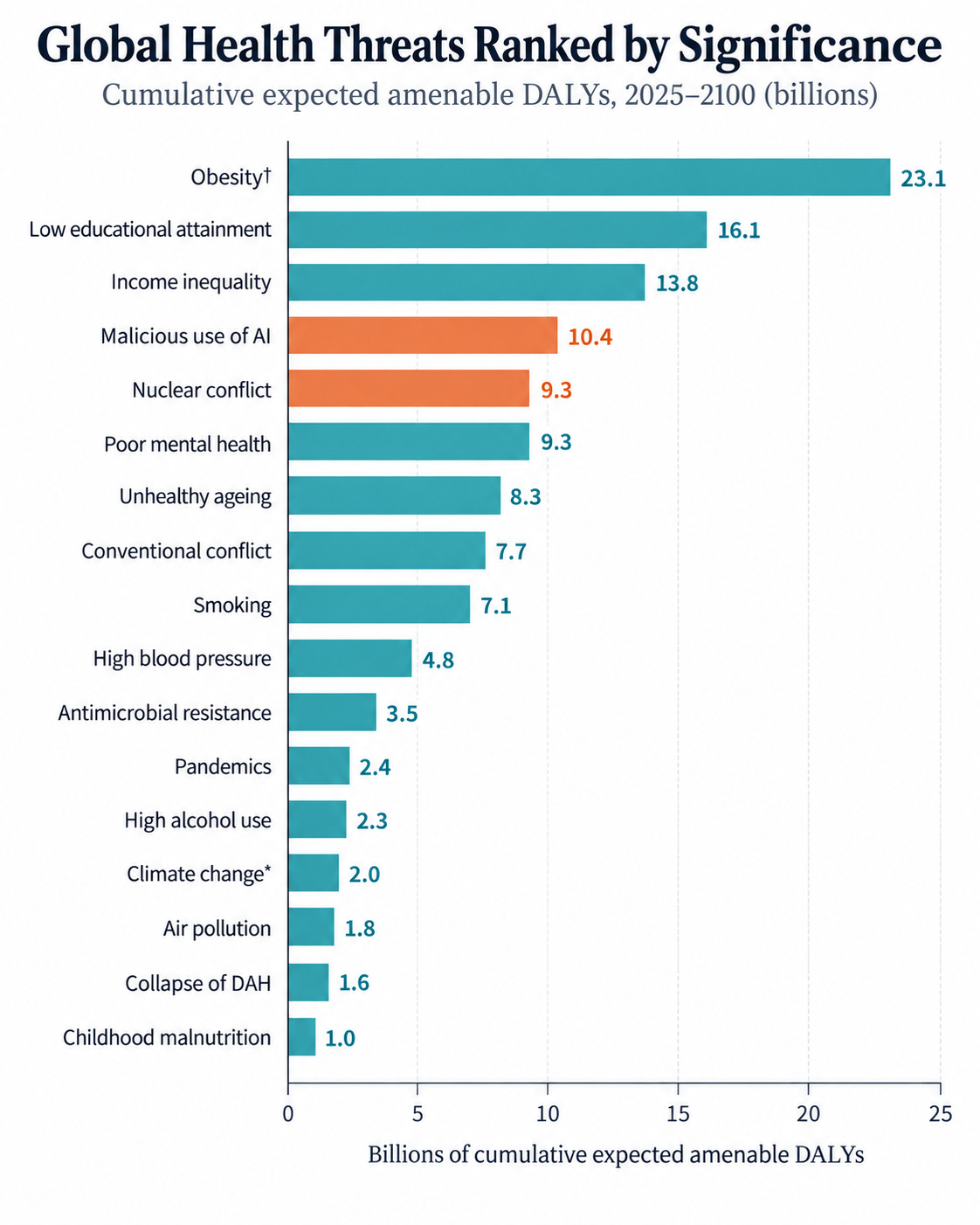
The Commission estimates that the combination of high body mass index, poor diet, and inadequate physical activity accounts for 23.1 billion potentially amenable DALYs through 2100.
That is the largest estimated burden among the 17 threats assessed.
Importantly, the Commission uses the word obesity as shorthand for all three risk factors, not obesity alone.
The next largest estimated burdens are:
Low educational attainment: 16.1 billion DALYs.
Income inequality: 13.8 billion.
Malicious use of AI: 10.4 billion.
Nuclear conflict: 9.35 billion.
Poor mental health: 9.35 billion.
Unhealthy ageing: 8.26 billion.
Conventional conflict: 7.71 billion.
Smoking: 7.06 billion.
Other major threats include high blood pressure, antimicrobial resistance, naturally occurring pandemics, alcohol, climate change, air pollution, reductions in global health assistance, and childhood malnutrition.
These numbers are not interchangeable measures of proven preventability. Their underlying scenarios and evidence differ considerably.
They also must not be added together because many threats overlap.
Nevertheless, the overall message is remarkable.
Slowly developing health problems may account for a greater cumulative opportunity to prevent suffering than the dramatic catastrophes dominating public debate.
The Commission explicitly warns that the figures are not a ranking of policy priorities. A lower expected burden may still demand urgent action when the consequences could be catastrophic.
We May Live Longer, but Not Necessarily Healthier
One of the most concerning projections involves the relationship between life expectancy and healthy life expectancy.
The Commission forecasts that between 2025 and 2100, global life expectancy could increase by approximately 8.65 years.
But healthy life expectancy is projected to increase by only 5.69 years.
That difference suggests that people may spend more years living with disability or chronic illness.
Diabetes, cardiovascular disease, dementia, musculoskeletal conditions, and mental disorders will place increasing demands on health systems.
This is a profound change in the meaning of medical progress.
Survival alone is no longer an adequate measure of success.
We should increasingly ask whether medical advances extend healthy, independent, productive life.
For physicians, this means prevention cannot remain secondary to treatment. Managing chronic conditions after they develop is necessary, but preventing disease and disability should receive substantially greater attention.
Education and Inequality Are Health Issues
The Commission’s estimates for education and income inequality deserve particular attention.
Low educational attainment is associated with 16.1 billion potentially amenable DALYs, while income inequality accounts for 13.8 billion.
These are enormous figures.
Education influences health through employment, income, health literacy, autonomy, and the ability to obtain appropriate medical care.
Its effects begin before birth and extend across generations.
The report estimates that approximately 68% of the amenable burden attributed to inadequate education would occur in sub-Saharan Africa.
For those of us practicing obstetrics and maternal-fetal medicine, these findings are especially relevant.
Maternal education, poverty, nutrition, and access to effective health systems are closely linked to maternal and neonatal outcomes.
But there is an important methodological concern.
The educational model incorporates lower fertility associated with higher educational attainment. Consequently, some reduction in total DALYs arises because fewer people are projected to be born, not solely because individuals experience better health.
That is not necessarily a modelling error. However, it creates a serious ethical and interpretive challenge.
Fewer DALYs in a smaller population are not equivalent to improved health among individuals who would otherwise have been born.
Any comparison of education with other interventions must acknowledge this distinction.
Artificial Intelligence: Both Threat and Opportunity
The Commission identifies malicious use of artificial intelligence as one of only two categories of threats with potential to cause human extinction by 2100.
The other is nuclear conflict, including the possibility of nuclear famine.
Its concerns about AI include the development of biological weapons, attacks on critical infrastructure, and possible loss of human control over advanced autonomous systems.
The Commission estimates 10.4 billion amenable DALYs from malicious AI, but this figure is exceptionally uncertain.
Unlike obesity, hypertension, or smoking, there is no historical dataset of AI-driven global catastrophes from which to estimate future probabilities.
The investigators therefore rely on expert judgments and forecasting exercises.
For AI-related extinction, the report describes median probability estimates of 0.4% among superforecasters and 3.0% among AI experts.
These are subjective forecasts, not measured event frequencies.
I would caution against treating them as established probabilities.
Yet the Commission also recognizes that AI could accelerate the development of vaccines, medications, diagnostics, and new approaches to preventing disease.
This dual role deserves more attention.
For medicine, the appropriate response is neither uncritical adoption nor categorical rejection.
It is competent, independently validated, carefully governed use.
The immediate professional responsibility is to prevent unsafe AI use while also evaluating opportunities to improve patient outcomes.
Climate Change and the Limits of Prediction
The Commission estimates 1.89 billion amenable DALYs associated with climate change through 2100.
Its model includes heat exposure, air pollution, infectious diseases, malnutrition, flooding, and other pathways.
The investigators acknowledge important omissions, including some effects of drought, migration, sea-level rise, and disruption of health systems.
At the same time, the selected high-emissions scenario may overstate the range of plausible future warming.
The resulting estimate therefore has uncertainty in both directions.
This illustrates a larger lesson.
A precisely reported number is not necessarily a precise estimate.
Models are constrained by the data, assumptions, and causal pathways included in them.
We should use projections to guide preparedness, not present them as predictions of an inevitable future.
What About Pregnancy, Mothers, and Newborns?
As an obstetrician and maternal-fetal medicine specialist, I was particularly interested in how the Commission addressed pregnancy and childbirth.
Maternal and neonatal disorders appear throughout the report, particularly in the analyses of obesity, education, income inequality, antimicrobial resistance, and reductions in international health assistance.
However, maternal mortality, stillbirth, preterm birth, and neonatal mortality are not separately evaluated among the 17 major threats.
This is an important limitation for obstetricians. Pregnancy outcomes are among the measures of health-system performance, and adverse outcomes can have consequences extending far beyond delivery.
Future assessments should explicitly quantify the preventable burden of major maternal and perinatal outcomes, distinguish the effects of social determinants from those of clinical care, and identify interventions supported by evidence of improved outcomes.
If we want to forecast the health of future generations, we should also examine how those generations begin life.
What Must Health Systems Do Differently?
The Commission makes three major recommendations.
First, governments should build health systems capable of anticipating, preventing, preparing for, and responding to threats rather than reacting only after crises emerge.
Second, investment in breakthrough innovation should increase, particularly where existing interventions are insufficient.
Third, the Commission proposes an annual global health threat monitoring system to update estimates and inform government decisions.
All three recommendations are reasonable. But their effectiveness will depend on implementation.
For clinicians, the practical implications extend beyond global policy.
Health systems need to improve prevention, recognize patients at risk, provide access to effective treatments, and evaluate whether interventions actually reduce meaningful adverse outcomes.
For obstetricians, this includes addressing chronic hypertension, obesity, diabetes, infectious diseases, and nutritional deficiencies before and during pregnancy. It also requires attention to postpartum health and the long-term consequences of pregnancy complications.
Importantly, identifying a large disease burden does not establish that a particular program will reduce it.
Every proposed intervention needs evidence of effectiveness, safety, cost-effectiveness, and equitable implementation.
These requirements are especially important when resources are limited.
My Assessment: An Important Commission With Important Limitations
The Commission’s greatest contribution may be conceptual rather than numerical.
It moves global health discussions away from asking only which threats are most frightening and toward asking what societies can realistically change.
But several limitations deserve emphasis.
The 75-year forecasts depend on assumptions that cannot be fully validated today. Historical differences between countries do not necessarily demonstrate that policy can reproduce the best observed outcomes everywhere. The estimates for nuclear conflict and malicious AI are much more speculative than those for established medical risk factors.
Furthermore, comparing health losses does not tell us which interventions provide the greatest benefit per dollar spent.
An intervention addressing a smaller threat may be more effective, affordable, or immediately achievable than one aimed at a much larger burden.
These distinctions matter when projections are translated into public policy.
The Bottom Line
The Lancet Commission offers a challenging message.
The future of human health will not be determined exclusively by the next pandemic, advances in artificial intelligence, nuclear conflict, or climate change.
It will also be shaped by the decisions we make about education, nutrition, chronic disease prevention, mental health, and access to effective medical care.
Some threats require scientific breakthroughs. Others require applying interventions we already understand.
And some require institutions capable of making difficult decisions today for benefits that may not become visible for decades.
The greatest failure would not be predicting the future incorrectly. It would be recognizing preventable threats, possessing effective means to address them, and repeatedly failing to act.
That is the central challenge for medicine, public health, and governments throughout the remainder of this century.
Source
Murray CJL, Kanem N, Abed S, et al. The Lancet Commission on 21st century global threats to health. Lancet. Published online October 11, 2026. doi:10.1016/S0140-6736(26)01714-9.
This article is a synthesis and independent clinical interpretation of the Commission. Forecasts are identified as model-based projections rather than observed outcomes.