

A woman comes to a labor and delivery unit. She is induced first with misoprostol then with high dose oxytocin.
Her uterus begins contracting too fast, too hard, and without stopping.
Her baby is starved of oxygen.
The staff is happy because the cervix dilates fast.
The delivery is complicated by shoulder dystocia, the baby’s shoulder lodges behind the mother’s pelvis. Minutes pass. The child is born with brain damage that will define the rest of his life.
Cerebral palsy.
Most of the time cerebral palsy happens before labor, but often it happens during labor.
This sequence, or some version of it, generates the largest malpractice verdicts in American medicine.
It is the story behind the seven consecutive years of rising obstetric liability premiums the American Medical Association reported last week. It is the reason OB-GYNs in Miami-Dade County are paying nearly $244,000 annually for malpractice coverage, and why maternity units are closing across the country.
It is also, in a significant proportion of cases, preventable. We know this because we prevented it. We published exactly how in 2011. Then we watched most of the profession decline to do the same.
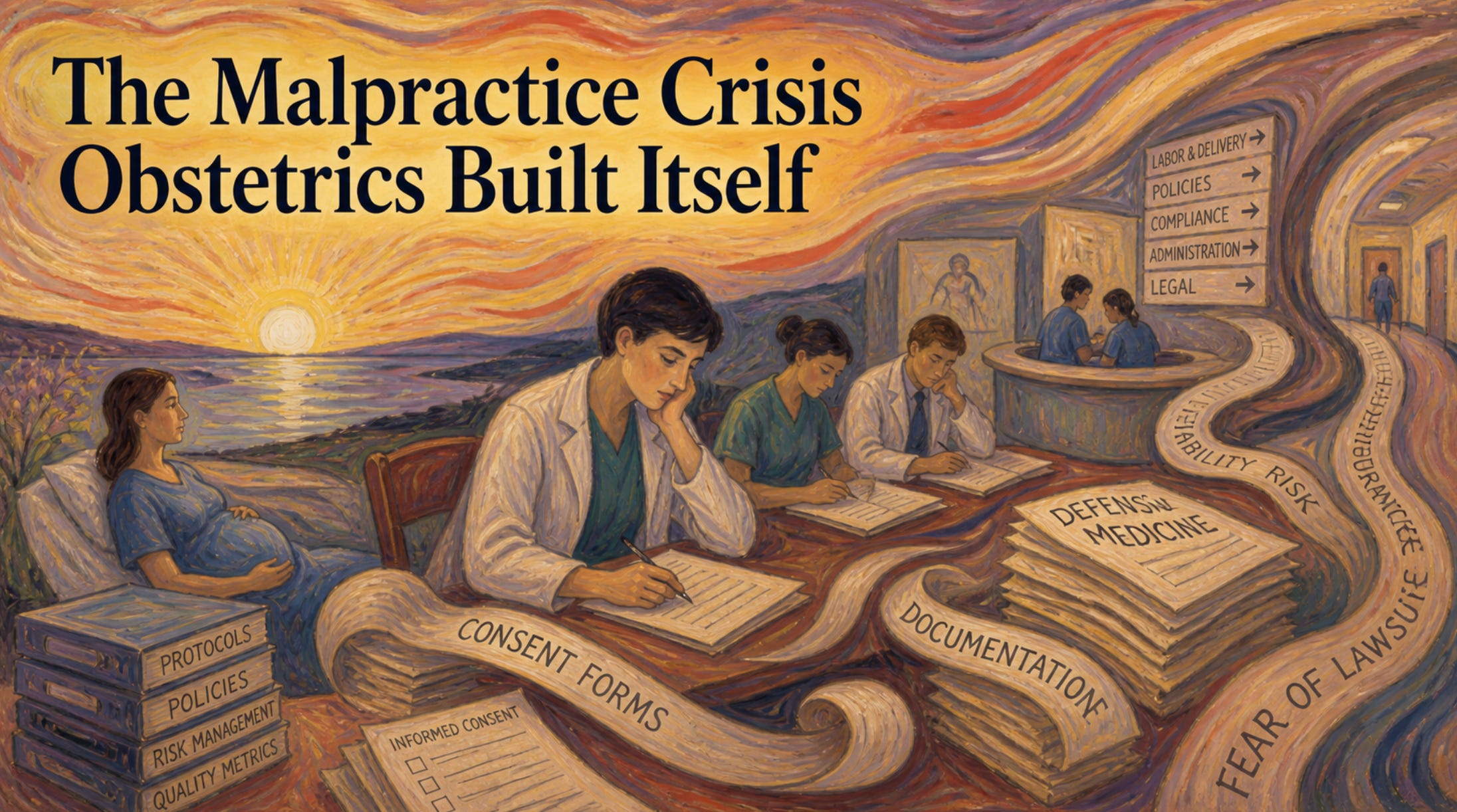
The Program
In 2011, we published the results of a comprehensive obstetric patient safety program we had implemented at Weill Cornell Medical Center starting in 2003 in the American Journal of Obstetrics and Gynecology (AJOG: The “Gray Journal”). It was not speculative. It was not a proposal. It was a report of what we had actually done, over six years, at one of New York City’s largest academic labor and delivery units, and what happened to malpractice payments and sentinel adverse events as a result.
What is strange is that liability lawyers hailed our paper. Hospitals disliked it.
The program was not a single intervention. It was a system. Multiple integrated components, each targeting a specific source of preventable harm. The components included:
Ban on misoprostol for labor induction. Misoprostol had never been approved by the FDA for this indication. Its use was entirely off-label. The clinical evidence — including our own data — showed it was associated with irreversible uterine tachysystole: contractions so frequent and sustained they cut off oxygen to the fetus. Unlike intravenous agents, a dissolved tablet cannot be removed. Once the overstimulation began, it could not reliably be reversed. Patients were not being told any of this. We stopped using it entirely.
A single, standardized oxytocin protocol. Oxytocin dosing on labor and delivery had been a matter of individual physician preference — every attending doing it differently, often without documentation, often without a ceiling. We implemented one protocol, institution-wide, with defined dose escalation, mandatory monitoring intervals, and required dose reduction or cessation criteria. Opponents predicted this would increase cesarean rates. The opposite happened: our cesarean rate fell from 41.6% in 2004 to 32.7% in 2012.
Structured communication protocols. The most common feature of obstetric adverse events is not clinical misjudgment in isolation — it is a communication failure. The nurse who cannot reach the attending. The resident who does not escalate. The consultant who was never called. We implemented mandatory communication structures: defined escalation pathways, required read-backs, and documentation of every clinical decision and the person who made it.
Required specialist consults. Not advisory. Not “consider consultation.” Required, documented, in defined clinical circumstances. If a patient met criteria, the consult happened. This removed the discretionary step where physicians, busy or overconfident, decided on their own that a consultant was unnecessary.
Mandatory team training and drills. Obstetric emergencies — shoulder dystocia, postpartum hemorrhage, eclampsia, cord prolapse — are low-frequency, high-stakes events. The team that has never practiced managing them together will not perform well under pressure. We required regular simulation drills. Not voluntary. Not optional for attendings with busy schedules. Required.
Daily safety huddles. Every shift, a brief structured review of the patients on the unit: who is high-risk, what is the plan, who needs to know what. This sounds simple. In a busy academic unit it requires discipline and leadership. It surfaces problems before they become emergencies.
Standardized shoulder dystocia protocols. Shoulder dystocia is unpredictable. It cannot always be anticipated. But the response to it — who does what, in what order, in what timeframe — can be standardized and drilled until it is automatic. We did this. The HELPERR mnemonic and structured maneuver sequences were required practice, not optional familiarity.
Additional staffing, reduced work hours, and a dedicated patient safety nurse. Fatigue produces errors. Understaffing produces errors. We added staff and reduced the excessive work hours that were then standard. We appointed a dedicated patient safety nurse whose sole responsibility was surveillance, documentation, and follow-through on safety protocols.
Electronic medical records with structured documentation. Not just a record system — a system that required complete documentation of clinical decisions, drug administration, fetal monitoring findings, and communication. A record that could not be left incomplete.
Fully informed consent. Patients were told what drugs were being used, including their regulatory status. Patients were told when a drug was off-label. Patients were told the risks. This was not negotiable and not optional.
What Happened
Malpractice compensation payments fell sharply. Sentinel adverse events — ZERO maternal deaths, less birth asphyxia, less hypoxic-ischemic encephalopathy, less Brachial Plexus injury. They all declined. Cesarean delivery rates went down, not up, refuting the central objection that safety protocols drive surgical delivery. The program worked.
We saved the hospital about $20-30 Million. Everyone’s insurance premium declined.
We published it. We presented it. We made the case that this was replicable at any institution with sufficient leadership and will.
What the Profession Did with It
Most hospitals did not implement it. Most did not come close.
Many doctors did not want to be told what to do.
Misoprostol continues to be used for labor induction at institutions across the country, without FDA approval, without disclosure to patients, and without the informed consent that patients are legally and ethically entitled to receive.
After we left, the hospital implemented misoprostol induction again with forseable results.
Oxytocin protocols remained non-standardized. Individual physician preference continued to govern dosing decisions that directly affect uterine activity and fetal oxygenation. The variation that produces inconsistent outcomes — and inconsistent outcomes are what fill plaintiff attorneys’ case files — was left in place.
Team training remained voluntary at most institutions. Shoulder dystocia drills were conducted where leadership demanded them and skipped where it did not. Communication protocols were adopted partially, inconsistently, or not at all. Safety huddles were implemented in some units and dismissed as an administrative burden in others.
The reasons given were consistent across institutions: cost, time, disruption to workflow, physician autonomy, and the reluctance to acknowledge — by implementing informed consent for off-label drugs — that previous practice had carried undisclosed risks.
These were choices. They were made with full knowledge that a published, evidence-based safety program existed and had demonstrated results.
Now They Want Caps
The AMA reported last week that approximately 40% of medical liability premiums rose from 2024 to 2025 — the seventh consecutive year of increases. In Miami-Dade County, obstetricians are paying nearly $244,000 annually. In New Jersey, approximately $94,600. The AMA’s president has called this a wake-up call and is pressing states without damage caps to enact them.
The financial pressure is real. Maternity unit closures are real. The access problem those closures create is serious and deserves attention.
But the AMA’s analysis does not ask the prior question: what is producing the verdicts that produce the premiums? The largest awards in obstetric malpractice are for neurologically injured children. Juries in those cases hear expert testimony about what the standard of care required and where it was not met. They hear about the oxytocin that was not managed to protocol. The drug that was administered without disclosure of its off-label status. The shoulder dystocia that was managed by a team that had never practiced together. The consult that was never called. The communication that never happened.
The verdict is the end of a story that began years earlier, when the institution decided not to implement a safety program it had been shown how to build.
What Caps Do and Do Not Do
Damage caps may modestly reduce premiums in some markets by making liability exposure more predictable for insurers. The evidence for this effect exists, though it is inconsistent across states and specialty types.
Damage caps do not reduce adverse outcomes. There is no mechanism by which limiting what an injured family can recover changes what happens in the labor room. The child with hypoxic-ischemic encephalopathy is not helped by a cap. The family providing lifetime care for that child absorbs the cost that the cap removes from the institution that produced the harm. This is a transfer of financial burden, not a safety improvement. It should not be presented as one.
My Take
We built the program. We ran it for six years. We published what it contained and what it produced. The components were not exotic: stop using an unapproved drug without informed consent, standardize oxytocin dosing, train your team, hold daily huddles, require your consults, practice your shoulder dystocia drills, communicate in a structure that leaves a record. These are not heroic interventions. They are basic systems, and any institution with leadership willing to require them could have implemented them.
Most chose not to. They chose convenience, autonomy, and the avoidance of the informed consent conversation that would have required acknowledging what patients had not been told. That is not a harsh characterization. It is a description of the choices that were made, documented in the pattern of practice that persisted for fourteen years after we showed a better way.
I have no principled objection to malpractice reform. Runaway verdicts are a real problem. Premium pressures are real. Maternity care access is a genuine crisis.
But before asking the legislature to cap what injured families can recover, the profession should answer this question honestly: did you implement the safety program? Did you ban the non-FDA-approved drug used without consent? Did you standardize your oxytocin protocol? Did you hold the daily huddles? Did you require the drills? Did you train the team?
For most institutions, the honest answer is no. Caps on damages may lower premiums. They will not lower the number of children born with preventable brain injuries. The profession that declined to do the work of prevention has not yet earned the legal protection from its consequences.
Citation: Grunebaum A, Chervenak F, Skupski D. Effect of a comprehensive obstetric patient safety program on compensation payments and sentinel events. Am J Obstet Gynecol. 2011;204(2):97-105. doi:10.1016/j.ajog.2010.11.009. [Author to verify and add co-author citation for 2013 J Perinat Med paper on cesarean reduction.]
Amos Grünebaum, MD, is Professor of Obstetrics and Gynecology at the Zucker School of Medicine at Hofstra/Northwell, and Senior Ethics Consultant at Northwell Health. He publishes at obmd.com.