

Imagine the standard prenatal visit.
The waiting room is crowded and loud. A television is playing. Fluorescent lights are overhead. The appointment is running 35 minutes late. A nurse asks a series of rapid questions while entering answers into a computer. The obstetrician arrives, explains several decisions in quick succession, changes one medication, orders three tests, discusses induction, and says, “Any questions?”
The patient says no.
Everyone thinks the visit went well.
It may not have.
For an autistic patient, someone with ADHD, or another neurodivergent patient, almost every element of that encounter may have made effective communication harder: sensory overload, an unexpected delay, rapid transitions, multiple verbal instructions, ambiguous language, pressure to respond immediately, and the social expectation that a “good patient” maintains eye contact, answers quickly, and does not appear difficult.
Then pregnancy amplifies the problem.
The body changes constantly. Sleep deteriorates. Appointments multiply. Plans change. New clinicians enter the room. Touch becomes unavoidable. Decisions become time-sensitive. Labor eventually adds pain, noise, monitors, alarms, unfamiliar people, loss of privacy, repeated examinations, and perhaps an emergency in which information must be processed in minutes.
We have spent decades building multidisciplinary pregnancy programs for diabetes, hypertension, congenital heart disease, substance-use disorders, and fetal anomalies.
It may be time to think seriously about the neurodivergent pregnancy team.
Not because neurodivergence is itself a pregnancy complication.
Because our maternity system is often poorly designed for neurodivergent people.
We recently proposed a different model
This is not simply a theoretical concern.
In our 2026 American Journal of Obstetrics & Gynecology Clinical Opinion, “Improving communication in pregnancy: a neurodivergent-responsive approach,” my colleagues and I argued that one of the core problems is a structural mismatch between how obstetric information is usually delivered and how some patients process it. We emphasized that failures in communication during labor, urgent consent, and inpatient care may contribute to delays in consent, distress, impaired clinical assessment, and suboptimal intrapartum management.
Our central proposal was deliberately practical. Obstetric clinicians should identify communication and sensory-processing differences during prenatal care, before urgency develops, and translate those findings into actionable intrapartum strategies. We suggested plain and concrete language, stepwise information delivery, written reinforcement, teach-back, advance warning before physical contact, and structured involvement of support persons.
Most importantly, we proposed a communication care plan.
That is not the same as a birth plan.
A birth plan usually describes preferences about management. A communication care plan tells the clinical team how the patient best receives information, what circumstances may impair communication or cooperation, what sensory issues matter, what de-escalation strategies are useful, and what role a support person should play. We argued that this plan should be developed prenatally and placed somewhere in the electronic record where clinicians can actually find it at triage.
That may sound simple.
It is.
The question is why we are not already doing it.
Neurodivergence is not one diagnosis
The term neurodivergent is broad. It includes distinct neurodevelopmental conditions such as autism spectrum disorder, ADHD, specific learning disorders, developmental coordination disorder, and Tourette syndrome. These conditions differ substantially in clinical features and in how they may affect communication, sensory processing, executive function, or procedural tolerance.
Two people with the same diagnosis may have entirely different needs.
An autistic patient may have major sensory sensitivities but excellent executive function. A patient with ADHD may struggle with scheduling, working memory, or multi-step verbal instructions while having no difficulty with sensory input. Some have both autism and ADHD. Others have coexisting anxiety, depression, obsessive-compulsive symptoms, learning differences, or previous trauma.
That is why simply placing AUTISM or ADHD in the problem list accomplishes very little.
The clinically useful question is:
What does this particular patient need in order to receive safe, comprehensible, respectful maternity care?
We are probably missing many of these patients
Another problem is recognition.
Neurodivergent women frequently enter obstetric care without a prior diagnosis. Historically, autism was more commonly recognized in boys and men, while many women developed compensatory or masking strategies that made recognition more difficult. Our AJOG paper emphasized that some women may first reveal their needs indirectly through repeated questioning, difficulty tolerating examination, distress with noise or unexpected touch, or unusually detailed written plans designed to create predictability.
Those behaviors are easy to mislabel.
“Anxious.”
“Difficult.”
“Noncompliant.”
“Refusing examination.”
“Needs a lot of reassurance.”
Perhaps.
But sometimes the more accurate description is that the patient is being cared for in a communication environment that does not work for her.
That distinction has consequences.
The first member of the team is the patient
A neurodivergent pregnancy team should not begin by assembling specialists.
It should begin by asking the patient.
Early in prenatal care, simple questions may identify what matters:
How do you prefer to receive information?
Would written instructions help?
Do you need more time to process decisions?
Are there sounds, lights, textures, or forms of touch that are particularly difficult?
Would you like us to explain before touching you?
Do unexpected changes cause significant distress?
When you are overwhelmed, how do you communicate?
Who helps you most effectively during stressful medical encounters?
These are not diagnostic questions.
Our AJOG framework explicitly cautioned against turning this into another screening mandate. The purpose is functional recognition: identifying communication or sensory needs relevant to clinical care, whether or not a formal neurodevelopmental diagnosis exists.
The objective is not to stereotype a neurodivergent patient.
It is to stop stereotyping every pregnant patient as neurotypical.
The obstetrician needs more than the diagnosis
The obstetrician or maternal-fetal medicine specialist remains responsible for pregnancy management.
But the chart should contain clinically useful communication information.
For example:
Prefers written information after visits. Needs direct, literal explanations. Ask permission before examination. Minimize the number of people speaking simultaneously. Unexpected changes should be explained explicitly. When overwhelmed, patient may become quiet and need additional processing time.
That is actionable.
“Autism” alone is not.
There is also a danger of diagnostic overshadowing.
A neurodivergent patient’s symptoms should not automatically be attributed to neurodivergence.
Pain is still pain.
Dyspnea still requires evaluation.
Hypertension is still hypertension.
A patient who has difficulty describing an internal sensation may need more careful clinical assessment, not less.
Communication difference must never become an excuse to discount symptoms.
Nursing and midwifery may determine whether the plan works
The physician may spend 20 minutes with a patient.
The nurse or midwife may spend hours with her during labor.
That makes bedside staff central to neurodivergent maternity care.
During one ordinary labor admission, a patient may encounter triage nurses, residents, attending physicians, anesthesiologists, anesthesia residents, obstetric nurses, phlebotomists, pediatric clinicians, lactation consultants, and multiple shift changes.
Each introduces herself.
Each asks questions.
Each may touch the patient.
Each may give slightly different instructions.
For some neurodivergent patients, this can produce sensory and communication overload.
Our paper therefore recommended simple bedside changes: announce examinations before touch, provide one instruction at a time, use consistent terminology, reduce unnecessary personnel and noise when possible, and include communication needs in standard handoff.
The solution does not require a specialized unit.
It requires consistency.
Anesthesia belongs on the team before labor
For some patients, prenatal obstetric anesthesia consultation may be particularly valuable.
This is especially true when sensory sensitivity, procedural anxiety, difficulty tolerating touch, previous traumatic medical experiences, or communication differences may complicate neuraxial placement or emergency anesthesia.
The first detailed discussion of an epidural should not necessarily occur while a frightened patient is contracting every two minutes.
A prenatal consultation can explain positioning, skin preparation, local anesthetic, pressure sensations, expected duration, the need to remain still, and what happens if placement is difficult.
Our AJOG recommendations for epidural placement were similarly practical: explain positioning and sensations stepwise, minimize background conversation, and maintain a single speaker.
Some patients want every step narrated.
Others find constant narration overwhelming.
There is no universal “autism-friendly epidural.”
There is individualized anesthetic care.
Informed consent may require changing how we speak
This may be the most important part.
Informed consent is not achieved merely because the physician spoke.
It requires that the patient understand the clinical problem, the proposed intervention, alternatives, and consequences.
Our AJOG paper proposed processing-adapted consent: concrete rather than euphemistic language, one decision at a time, written reinforcement when feasible, processing time before expecting a response, and teach-back to verify understanding.
That becomes especially important during labor.
Consider the difference between:
“The tracing is becoming somewhat concerning, and depending on how things evolve we may need to think about alternative delivery options.”
and:
“Your baby’s heart rate has remained abnormal. I recommend cesarean delivery now because I am concerned your baby may not be getting enough oxygen.”
One sounds softer.
The other may be much easier to understand.
During an emergency, clarity can be compassionate.
Labor needs its own neurodivergent plan
A conventional birth plan often emphasizes analgesia, mobility, monitoring, cord clamping, and newborn care.
A neurodivergent labor plan needs another layer.
What happens when the patient becomes overwhelmed?
How will staff recognize overload?
Does she become agitated, or does she become silent?
Does she want one person speaking during urgent decisions?
Can vaginal examinations be minimized?
Should every touch be announced?
Can lights or unnecessary alarms be reduced when clinically safe?
Can the same terminology be used throughout the admission?
Who should be present during an emergency explanation?
Our intrapartum framework proposed deliberately escalating communication strategies according to clinical urgency. During routine care, use short, direct language and allow processing time. During urgency, simplify to problem, action, reason. During emergency care, use one direct statement at a time and defer nonessential detail until after the emergency.
Urgency does not require chaos.
A cesarean can be urgent and still be explained.
A vaginal examination can be necessary and still require warning and consent.
A fetal heart-rate abnormality can require immediate action without five clinicians speaking simultaneously.
Postpartum communication may be just as important
Pregnancy at least has structure.
The postpartum period often does not.
Sleep fragments. Feeding occurs around the clock. Nurses enter repeatedly. Pediatricians arrive. Screening tests are performed. Lactation consultants give advice. Medication schedules change. Then the patient goes home with pages of instructions and responsibility for recognizing postpartum hemorrhage, hypertension, infection, thromboembolism, neonatal problems, and medication complications.
For someone with executive-function or information-processing differences, this transition can be particularly difficult.
Our postpartum framework therefore emphasized written instructions in addition to verbal counseling, teach-back before discharge, explicit explanation of warning signs, one medication at a time with dose and timing, and confirmation of follow-up before discharge.
This is not merely about patient experience.
It is patient safety.
The support person may be part of the clinical communication system
Obstetrics sometimes treats partners and family members as visitors.
For some neurodivergent patients, a trusted support person may serve a much more important function, provided the patient wants that involvement.
They may recognize early signs of overload.
They may know that silence does not mean agreement.
They may understand how the patient communicates when frightened.
They may reinforce instructions during an urgent situation.
Our framework specifically recommended defining the support person’s role prenatally and engaging that person during urgent communication when appropriate.
But this must remain patient-directed.
Neurodivergence does not diminish autonomy.
A support person should facilitate communication, not replace the patient.
This is not another high-risk pregnancy label
I would be concerned if “neurodivergent pregnancy” simply became another checkbox leading automatically to more visits, more specialists, and more surveillance.
That would misunderstand the entire concept.
Many neurodivergent people will have uncomplicated pregnancies and require no additional medical intervention.
What they may require is a healthcare system capable of changing how care is delivered.
That is why, in our paper, we argued that these adaptations should be incorporated into existing obstetric workflows rather than requiring a new clinical program, additional equipment, or additional personnel.
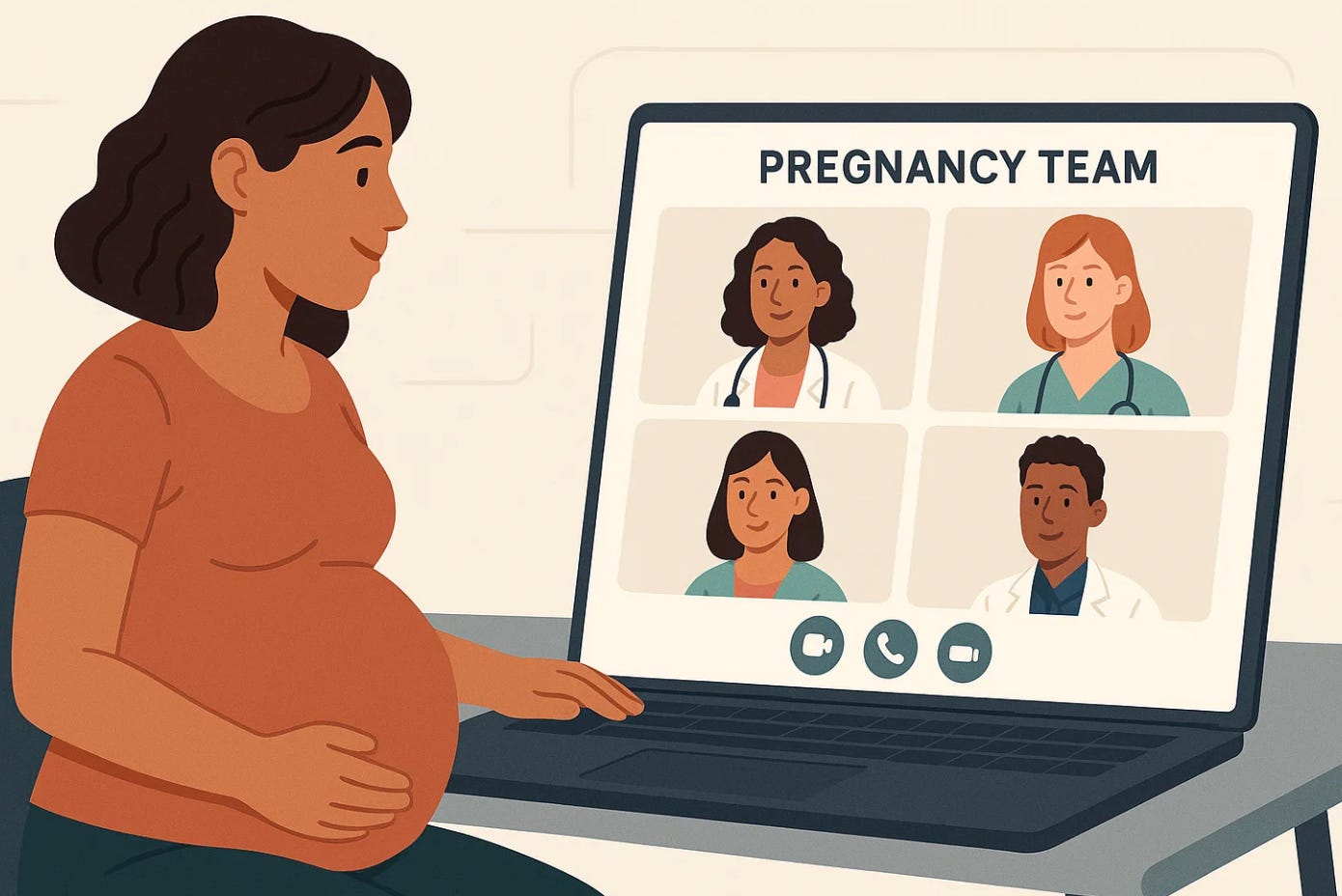
The neurodivergent pregnancy team is therefore not necessarily a literal team assembled around every patient.
It is a care architecture.
The patient is at the center.
The obstetric clinician identifies needs during pregnancy.
Nurses and midwives maintain communication consistency.
Anesthesia participates prospectively when procedural difficulties are foreseeable.
Psychiatry or psychology becomes involved when there is an actual psychiatric indication.
Lactation, pediatrics, social work, and other services are added when useful.
And the communication plan follows the patient from prenatal care through labor and postpartum care.
We need to be careful about the evidence
There is an important limitation.
The evidence base remains thin.
In our AJOG Clinical Opinion, we were explicit that much of the available evidence derives from qualitative studies and patient-reported experiences rather than randomized or robust obstetric outcome data. The recommendations are therefore clinically pragmatic and conceptually grounded, but they still require outcome-based validation.
That distinction matters.
We should not claim that a communication care plan has been proven to reduce cesarean delivery, neonatal morbidity, postpartum depression, or severe maternal morbidity.
It has not.
Those are research questions.
But randomized trials are not required to establish that obstetricians should communicate clearly, confirm understanding, obtain meaningful consent, warn before intimate examinations, and avoid mistaking sensory overload for refusal.
Those are already professional obligations.
The larger lesson
The deeper problem is that obstetric care has historically been designed around an imagined standard patient.
She tolerates noise.
She processes several verbal instructions rapidly.
She adapts immediately when the plan changes.
She identifies and describes internal symptoms easily.
She tolerates repeated touch.
She communicates distress in ways clinicians recognize.
She understands the first explanation.
And when the obstetrician asks, “Do you understand?” she says yes, and we accept the answer.
That patient does not reliably exist.
Neurodivergent pregnancy care forces us to confront something larger than neurodivergence.
It forces us to ask whether standardization of medical care has quietly become standardization of the patient.
Our AJOG paper ended with a deliberately modest proposal: identify communication and sensory-processing differences before they become barriers, document them, and make simple adjustments in how information is delivered, examinations are introduced, and consent is obtained.
That is not special treatment.
It is professional responsibility.
And perhaps the future does not require a separate neurodivergent maternity service at all.
It requires something more ambitious:
an obstetric service flexible enough that patients no longer have to become neurotypical before we know how to care for them.
This type of communication in a general way works for all patients