

A post making the rounds on social media says Anthropic named its AI, Claude, after Claude Shannon, an engineer who juggled while riding a unicycle and built a wearable computer to beat roulette in Las Vegas. It says his 1948 paper made phones, computers, the internet and AI possible.
I use Claude almost every day. So I did what I tell every clinician to do with a claim that sounds this tidy. I went to the original source.
Most of It Checks Out
Shannon was a mathematician and engineer at Bell Labs. The juggling, the unicycle and the roulette computer are all documented in his biography (1). One detail is off. He built the roulette computer with the mathematician Edward Thorp after he had moved to MIT, not as a Bell Labs hobby.
The naming is softer. A Michigan news outlet, citing the New York Times, reported that the name honors Shannon (2). I could not find a formal statement from Anthropic confirming it. “Reportedly named after” is the honest way to say it.
What the Paper Actually Says
“A Mathematical Theory of Communication” appeared in the Bell System Technical Journal in two parts, in July and October 1948 (3,4). Its central idea is easy to state. Information can be measured.
Shannon chose a unit for it, the bit, a word he credited to his colleague John Tukey (3). One bit is the answer to a single yes-or-no question. Once you can measure information, you can calculate how much any phone line, cable or radio signal can carry. You can also calculate how to send a message through static without losing it.
Here is the part that matters to anyone who uses AI today. Shannon built fake English using nothing but statistics. First he picked random letters. Then he picked letters by how often each appears in English. Then he picked each letter by which letter usually follows the one before it. Finally he moved to whole words, each chosen by which word usually follows the last one. With every step the text looked more like English. His word-level sample produced the phrase “attack on an English writer that the character of this,” which almost makes sense (3).
Predicting the next word from patterns in text is the basic idea behind today’s AI chatbots. They do it with vastly more text and far more powerful math. But the idea was in print in 1948.
Shannon also estimated that English is about 50% redundant (3). Half of what we write is dictated by the rules and habits of the language. The other half is free choice. That redundancy is why you can still read a text message full of typos.
The Paper Was Corrected
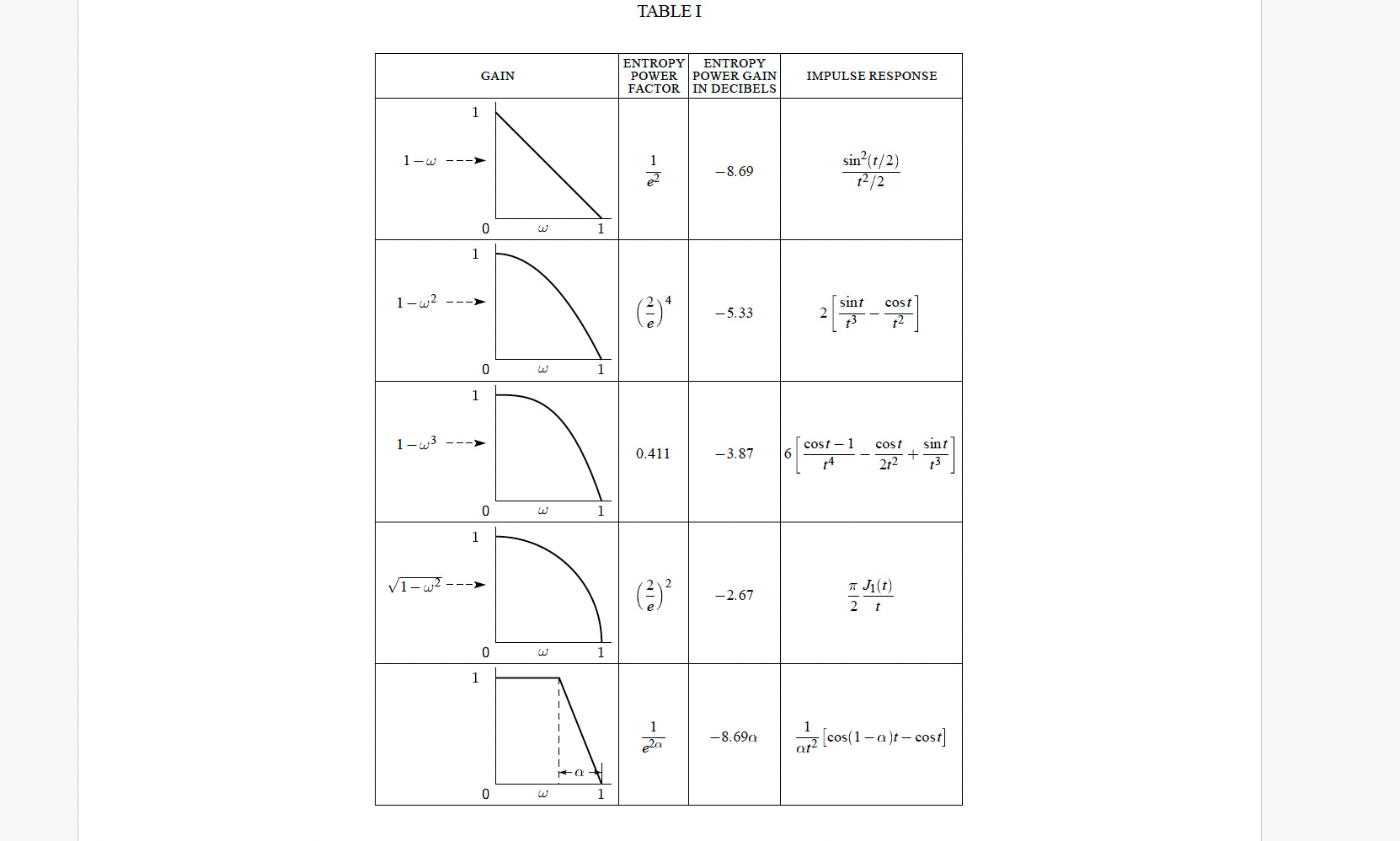
I found two versions. One is the original October 1948 issue, which I downloaded through my medical school library. The other is a later reprint labeled “reprinted with corrections.” I compared them, starting with Table I.
Table I shows how much certain electronic filters reduce a signal’s “entropy power,” a measure of how much information the signal can still carry. One row stood out. For one filter, the original printed a factor of 0.384, or a loss of 4.15 decibels (4). The corrected reprint prints 0.411, a loss of 3.87 decibels.
So which is right? I recalculated the value from Shannon’s own formula. The answer is 0.411. The original was wrong, and the correction was right. Three other values in the same table were off by a hundredth of a decibel, and those were fixed too. The text had small errors as well. The original says “phrases” where Shannon meant “phases,” and it sends the reader to the wrong appendix (4).
None of this changes the paper’s main results. But it means one of the most cited papers in the history of engineering went to press with mistakes, and someone took the trouble to fix them.
One More Correction
Another error turned up while I researched this post. I asked an AI to point me to a free copy of the paper. It gave me a university link that looked authoritative. The link was dead and led to a professor’s home page. The citation itself, with its DOI, was correct. The access link was not. When you check a reference, check both.
Conclusion
Shannon’s paper is about separating signal from noise. That is also the job of anyone who reads a viral post, a medical study or an AI answer.
The viral post about Shannon was mostly signal. Its noise was a confident claim about the naming that no primary source I could find supports, and a roulette computer placed at the wrong institution. The paper itself had noise too, and it was corrected.
Errors are not the scandal. Uncorrected errors are. In medicine we publish corrections, and we should never treat one as a mark of shame. A correction is proof that someone checked. Whether the source is a 1948 journal, a 2026 guideline or an AI chatbot, the rule is the same. Go to the original, check the numbers, and correct what you find.
If you want the evidence checked before it reaches you, subscribe to ObGyn Intelligence. And share this with a colleague who still trusts a link because it looks official.
References
1. Soni J, Goodman R. A mind at play: how Claude Shannon invented the information age. New York: Simon & Schuster; 2017. [Not verified in this session; run RefVerify]
2. Bridge Michigan. Ever tried Claude.AI? Meet the Michigander who inspired its name [Internet]. Bridge Michigan; 2026 [cited 2026 Oct 2]. Available from: https://bridgemi.com/business-watch/ever-tried-claude-ai-meet-the-michigander-who-inspired-its-name/ [Author and publication date not verified]
3. Shannon CE. A mathematical theory of communication. Bell Syst Tech J. 1948;27(3):379-423. doi:10.1002/j.1538-7305.1948.tb01338.x
4. Shannon CE. A mathematical theory of communication. Bell Syst Tech J. 1948;27(4):623-656. doi:10.1002/j.1538-7305.1948.tb00917.x