

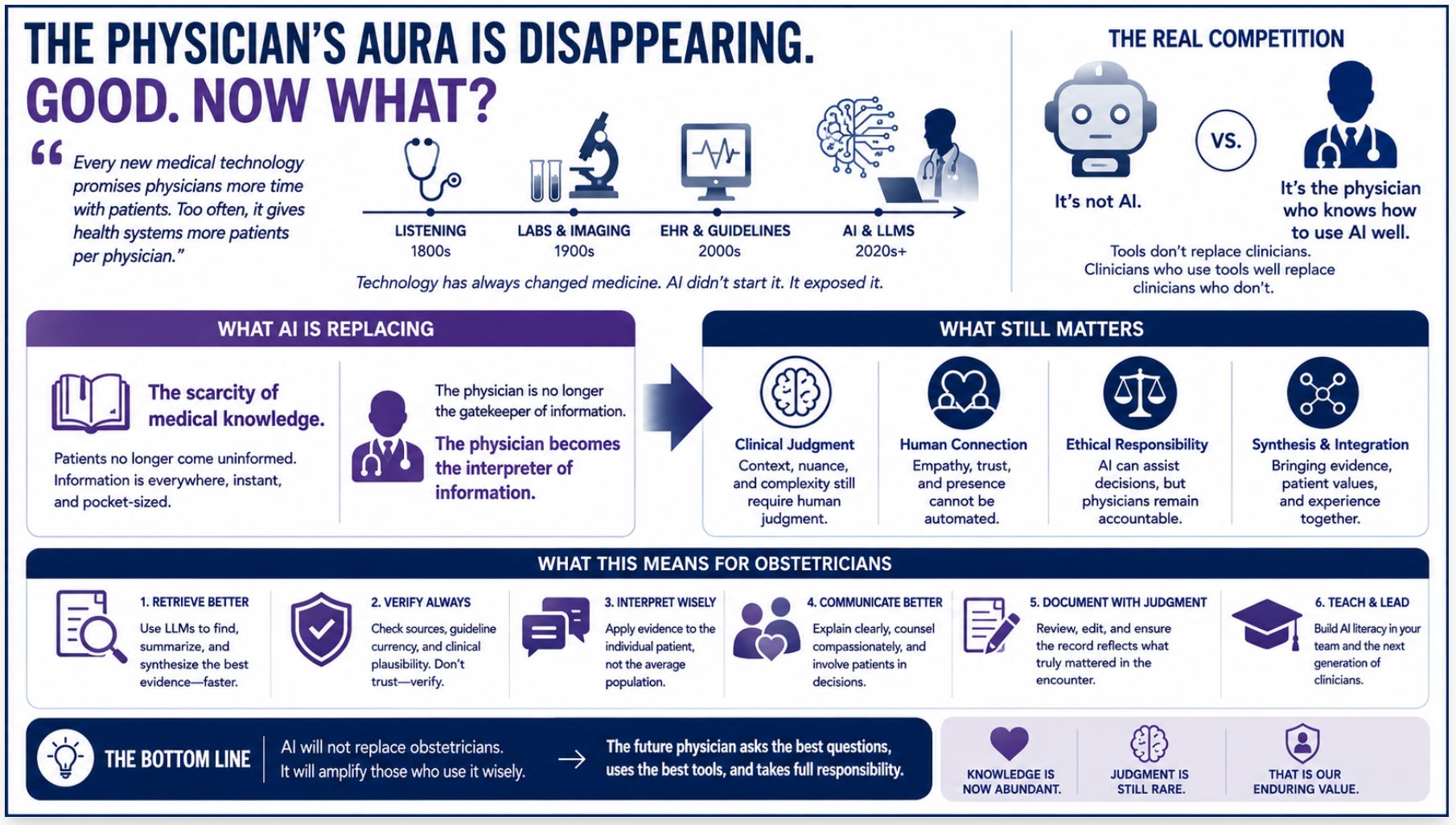
“Every new medical technology promises physicians more time with patients. Too often, it gives health systems more patients per physician.”
For two centuries, medicine has repeatedly declared that physicians were becoming obsolete.
The stethoscope would replace listening.
The laboratory would replace clinical judgment.
Radiology would replace physical examination.
Evidence-based medicine would replace experience.
Electronic health records would replace memory.
Now, according to many commentators, artificial intelligence will replace physicians.
I disagree.
What AI is replacing is something different.
It is replacing the scarcity of medical knowledge.
For most of history, physicians possessed something their patients could not access.
Knowledge.
Experience.
Interpretation.
If you wanted to understand preeclampsia, placenta accreta, or recurrent pregnancy loss, you had one realistic option.
Ask your doctor.
That monopoly has disappeared.
Today every patient carries an extraordinarily capable medical information system in a pocket.
Patients arrive already informed, sometimes correctly, sometimes incorrectly, but almost never uninformed.
That changes medicine forever.
The physician is no longer the gatekeeper of information.
The physician becomes the interpreter of information.
That is a profound difference.
A recent JAMA Perspective argues that physicians are losing their “aura,” the unique authority that historically surrounded medical expertise. The author compares today’s AI revolution with photography’s disruption of painting. When reproductions became possible, painters did not disappear. They reinvented themselves. Physicians, he argues, must now do the same.
I think that analysis is only half right.
Medicine has already been losing that aura for decades.
Evidence-based guidelines replaced individual authority with standardized recommendations.
Electronic health records transformed physicians into documentation specialists.
Quality metrics replaced professional discretion with measurable performance.
Artificial intelligence did not begin this process.
It simply exposed it.
The mistake many physicians are making is believing that the competition is AI.
It is not.
The competition is the physician who knows how to use AI well.
Throughout medical history, new technologies have never eliminated competent physicians.
They have eliminated physicians who refused to adopt better tools.
Ultrasound did not replace obstetricians.
Obstetricians who mastered ultrasound replaced those who did not.
The same happened with laparoscopy.
With fetal echocardiography.
With genomics.
Large language models are following exactly the same pattern.
For obstetricians, the implications are immediate.
Our specialty depends on enormous amounts of constantly changing information.
Guidelines.
Drug safety.
Genetics.
Ultrasound.
Ethics.
Population studies.
No physician can memorize all of it.
Nor should we try.
The new competency is no longer remembering every recommendation.
It is knowing how to retrieve, verify, interpret, and apply evidence better than anyone else.
That is not a technological competency.
It is a professional one.
This requires a different educational model.
Residency programs should no longer ask only whether trainees know the answer.
They should ask whether trainees know how to obtain the best answer.
Can they supervise an LLM?
Can they detect hallucinated references?
Can they recognize outdated guidelines?
Can they critically compare competing recommendations?
Can they explain the evidence to a frightened patient?
Those are becoming essential clinical skills.
Ironically, AI may make physicians more human.
If documentation, literature searches, and administrative writing increasingly become automated, physicians regain something far more valuable than efficiency.
Attention.
Listening.
Judgment.
Empathy.
Those were never threatened by AI.
They were threatened by paperwork.
The future obstetrician will not be remembered because they memorized the most guidelines.
They will be remembered because they asked the best questions, interpreted the evidence most wisely, recognized when the AI was wrong, and remained fully accountable for every decision.
That is why I do not believe physicians are losing their role.
Our role is becoming clearer.
Medical knowledge is no longer scarce.
Clinical judgment still is.
And that may become the most valuable skill of all.