

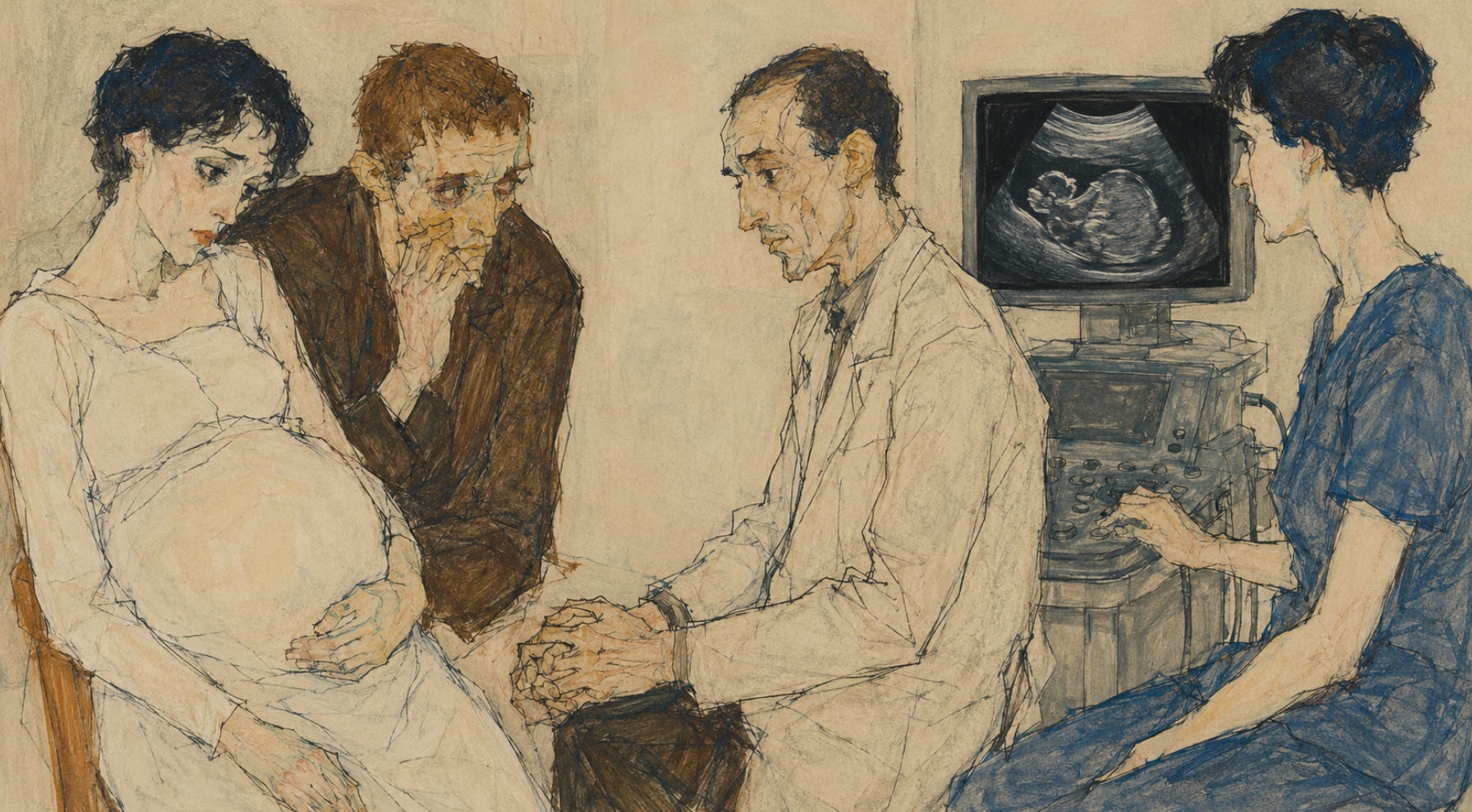
A woman at 19 weeks arrives for her anatomy scan. She has brought her partner. She has the gender reveal planned for Saturday. The sonographer takes longer than usual. She asks twice whether everything is okay. The sonographer says the doctor will come in to talk. The doctor comes in and begins explaining what she found. The patient hears the first sentence and stops hearing the rest.
That moment, when a normal pregnancy becomes a pregnancy with a diagnosis, is among the most demanding in all of perinatal medicine.
What happens in the next hour and the next 72 hours determines how a patient navigates a decision that is among the most consequential of her life.
The clinical system was not designed for that moment.
And the AI tools now entering prenatal diagnosis counseling have not reckoned with what it actually requires.
What the Moment Requires
Empathy in this room means recognizing the shock and being moved by it. Compassion means acting on that recognition: slowing down, checking what the patient has actually heard, deciding what information should come now and what should wait, and making clear that this is the beginning of a supported process and not the delivery of a verdict. Those are clinical judgments, not communication techniques.
Major structural fetal anomalies are identified in approximately 2 to 3 percent of pregnancies screened with detailed anatomy ultrasound.
The range is wide: from conditions compatible with normal life requiring postnatal surgery, to conditions incompatible with survival, to conditions whose prognosis is genuinely uncertain. What all of them have in common is that the patient was not prepared. No prenatal appointment prepares a woman for this conversation.
Research on patient experience after anomaly diagnosis consistently finds that what patients remember most is not the information they received but how they received it: whether the clinician was present to their shock, whether they were given time, and whether they felt the clinician cared about what the diagnosis meant for their specific lives.
Those are measures of compassion, not empathy.
Free readers see above. Paid subscribers continue below.
