

Black women die in childbirth at three times the rate of white women. Decades of publications cite this number. Almost none of them ask the question that changes everything: why does this gap persist even among the wealthiest Black women? The answer points not to racism in individual hearts, but to structural failures in how American medicine delivers care. obmd.com
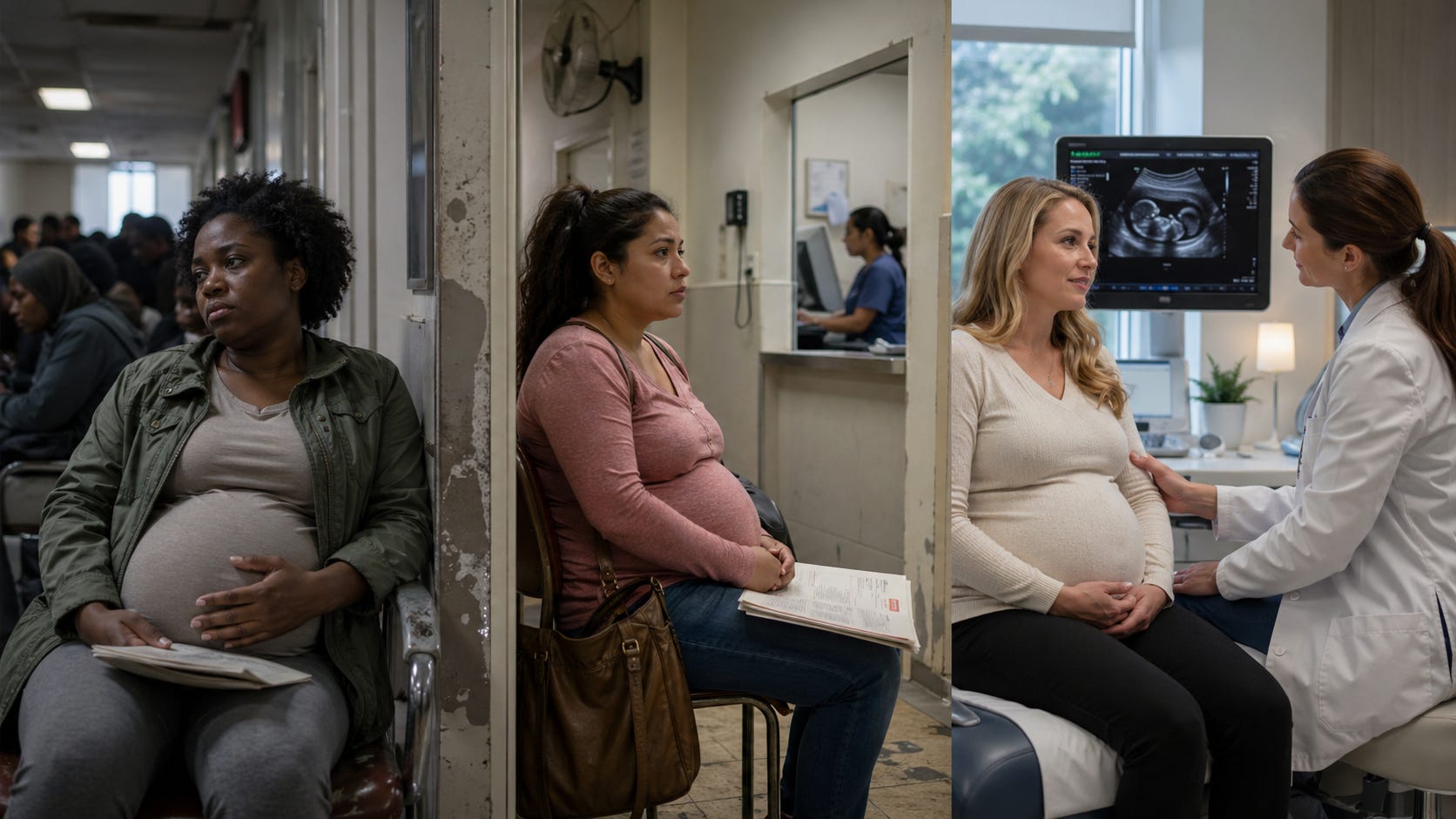
She is 34 years old. She has a graduate degree. She has private health insurance. She is Black. And according to the published data, her risk of dying from a pregnancy-related cause is comparable to that of a white woman living below the poverty line.
This is not a metaphor. It is a finding from population-level research. And it is the single most important data point in the maternal mortality debate that never receives the attention it deserves, because it is deeply inconvenient for the dominant narrative.
The dominant narrative goes like this: Black women die at three to four times the rate of white women in childbirth, and the cause is racism. Implicit bias in clinicians. Structural racism in society. Historical medical trauma. Chronic stress from discrimination. Fix the racism, fix the mortality.
I have spent 50 years in obstetrics. I do not doubt that racism exists in clinical settings. I have seen it. I have worked to address it. But I have come to believe, based on the evidence, that the solutions being deployed in the name of racial equity in maternal health are largely aimed at the wrong target. They are addressing attitudes while the structure does the killing. And that distinction matters enormously, because structural problems have structural solutions, while attitude problems are extraordinarily difficult to measure, modify, or hold accountable.
This series examines the evidence. All of it. Including the parts that make the mainstream conversation uncomfortable.
The Number
The mortality ratio is not disputed. In the United States, Black women die from pregnancy-related causes at approximately three to four times the rate of non-Hispanic white women. The Centers for Disease Control and Prevention reported a pregnancy-related mortality ratio of 69.9 per 100,000 live births for Black women in 2021, compared with 26.6 per 100,000 for white women. These are not statistical artifacts. They represent real deaths, real families, real failures of a medical system that is demonstrably not serving all patients equally.
The question is not whether the gap exists. It does. The question is what drives it. And the answer to that question determines what interventions could plausibly close it.
The Income Data That Changes the Argument
In 2022, researchers at Stanford published an analysis of maternal and infant health outcomes stratified by income. The findings deserve to be read carefully, because they disrupt several comfortable assumptions simultaneously.
Among the key findings: babies born to Black mothers in the top 5 percent of the income distribution are one and a half times more likely to be preterm and of low birthweight than infants born to white mothers in the bottom 5 percent of the income distribution. Read that again. The wealthiest Black mothers, producing children who are materially privileged from the first breath, have worse birth outcomes than the poorest white mothers. High-income Black mothers face the same risk of dying in the first year following childbirth as the poorest white mothers.
If poverty were the primary driver of the disparity, this finding would not exist. Wealth protects white women from bad outcomes. It does not protect Black women to the same degree. Something else is operating, and it operates across income levels.
This finding has profound implications for policy. It means that income transfers, educational interventions, and poverty reduction programs, while important for many reasons, should not be expected to close the racial maternal mortality gap. The structural mechanism causing excess deaths among Black women is not poverty alone. It is something embedded in the system of care delivery that persists even when individual economic barriers are removed.
What the Evidence Points Toward
When a disparity survives income adjustment, researchers look for what else is distributed unequally across race even among high-income individuals. The candidates are:
First, where women deliver. Hospital quality is not distributed randomly across race. A simulation analysis found that if Black mothers delivered at the same hospitals as white mothers, the Black maternal morbidity rate would decrease by 47.7 percent. This is not a small effect. This is nearly half the excess burden, addressable by changing which building a woman walks into when she begins labor, without changing any individual clinician’s attitudes or behaviors.
Second, what kind of prenatal care women receive before they ever walk into a delivery room. Access to continuous prenatal care from the same provider, access to faculty-level obstetric care in academic settings, access to timely specialist consultation. These are not uniformly available across insurance types. And insurance type is distributed along racial lines in ways that persist even among women who are not in poverty.
Third, the structure of the postpartum period. More than half of all pregnancy-related deaths in the United States occur after delivery. Among those, a significant proportion occur after the 60-day postpartum window during which Medicaid historically covered care. A woman who delivers safely can lose her coverage, lose her follow-up care, and die of a cardiovascular complication weeks later that was entirely preventable if anyone had seen her.
These are structural problems. They have structural solutions. They do not require waiting for racism to disappear from human hearts. They require policy changes, payment changes, and institutional accountability.
What the Evidence Does Not Clearly Show
It is worth being precise about what the evidence does and does not establish, because the conversation around Black maternal mortality has become susceptible to a particular form of intellectual slippage: the assumption that because racism causes other bad outcomes, racism must be the primary driver of this one.
A systematic review searching 2,394 studies examining the quantitative link between structural racism measures and maternal morbidity and mortality found that only 6 studies met the inclusion criteria for rigorous analysis. Six. From 2,394. The results of those six studies were heterogeneous, meaning they did not all point in the same direction, and the authors concluded that the evidence base required substantial methodological development before definitive conclusions could be drawn.
This does not mean structural racism does not affect maternal health. It means the evidentiary basis for the specific causal claim is far weaker than the confidence with which it is stated in most public health discourse. That gap between claim and evidence is a clinical problem, because interventions built on unverified causal models will not produce the expected results, and patients will continue to die while policymakers congratulate themselves on having addressed the right problem.
The Series Ahead
Over the next nine posts, this series will examine the specific structural mechanisms that the evidence points toward as drivers of the Black maternal mortality disparity. We will look at the insurance payment hierarchy that determines which patients get faculty care and which get residents. We will look at the academic medical institutions that publish on maternal health disparities while operating two-tier practice systems. We will look at the hospital quality data that shows where you deliver matters more than almost any other single variable. We will look at the evidence, or lack of it, behind the interventions that have been deployed most enthusiastically: implicit bias training and doula care.
And we will ask the question that the mainstream conversation consistently avoids: if the structural mechanisms driving Black maternal mortality are well understood, and the structural solutions are available, who benefits from keeping the focus on attitudes rather than systems?
The three-times number is real. The deaths behind it are real. What has not been real, in much of the policy response, is the connection between the proposed interventions and the actual mechanisms of harm. That disconnect is what this series is about.
My Take
I began my career in obstetrics in 1974. I have watched this field evolve through sonography, through the cesarean epidemic, through evidence-based medicine, through the ARRIVE trial, through the rise of social media misinformation, and through the arrival of large language models. I have seen many ideas celebrated before the evidence arrived and discarded after it did.
The current framework for addressing Black maternal mortality follows a familiar pattern. The disparity is real. The moral urgency is genuine. But the interventions being deployed, mandatory implicit bias training, doula programs with minimal regulatory oversight and no demonstrated mortality benefit, have been adopted with the speed and confidence of a field that has already decided on the answer and is selectively reading the evidence to support it.
I am not arguing that racism is irrelevant to this problem. I am arguing that a medical specialty that builds interventions on causal models that have not been rigorously tested is not practicing evidence-based medicine. It is practicing evidence-adjacent medicine, which looks like science from a distance and does not save lives up close.
The income data from Stanford should have reoriented this conversation two years ago. It did not, because it points toward structural solutions that are harder and more expensive than bias training. Raising Medicaid reimbursement rates costs money. Requiring faculty practices to accept Medicaid patients costs political capital. Holding academic medical centers accountable for their two-tier systems requires naming institutions that hold endowed chairs in health equity.
That is the work this series is asking for. Not the abandonment of the racial equity framework, but its honest application to the mechanisms that the evidence actually supports.
This series runs to ten posts. Posts 4 through 10, covering hospital quality, maternity care deserts, the implicit bias evidence, the doula data, the postpartum coverage cliff, and the closing argument on who benefits from the current policy response, are available to paid subscribers at obmd.com. Annual subscription: $60.
References
1. Centers for Disease Control and Prevention. Maternal Mortality Rates in the United States, 2021. NCHS Data Brief No. 469. Hyattsville, MD: National Center for Health Statistics; 2023.
2. Persson P, Rossin-Slater M. Family Ruptures, Stress, and the Mental Health of the Next Generation. Stanford Institute for Economic Policy Research Working Paper; 2022. [Stanford/SIEPR income-stratified maternal outcomes analysis].
3. Howell EA, Brown H, Brumfield C, et al. Reduction in Preterm Births at High-Volume Hospitals: Do Racial Disparities Disappear? Am J Obstet Gynecol. 2016;214(5):640.e1-640.e7.
4. Tangel V, White RS, Nachamie AS, Pick JS. Racial and Ethnic Disparities in Maternal Outcomes and the Disadvantage of Peripartum Black Women: A Multistate Analysis, 2007-2014. Am J Perinatol. 2019;36(8):835-848.
5. Crear-Perry J, Correa-de-Araujo R, Lewis Johnson T, McLemore MR, Neilson E, Wallace M. Social and Structural Determinants of Health Inequities in Maternal Health. J Womens Health (Larchmt). 2021;30(2):230-235.
6. Wallace ME, Mendola P, Liu D, Grantz KL. Joint Effects of Structural Racism and Income Inequality on Small-for-Gestational-Age Birth. Am J Public Health. 2015;105(8):1681-1688.
7. Njoku A, Evans M, Nimo-Sefah L, Bailey J. Listen to the Whispers Before They Become Screams: Addressing Black Maternal Morbidity and Mortality in the United States. Healthcare (Basel). 2023;11(3):438.