

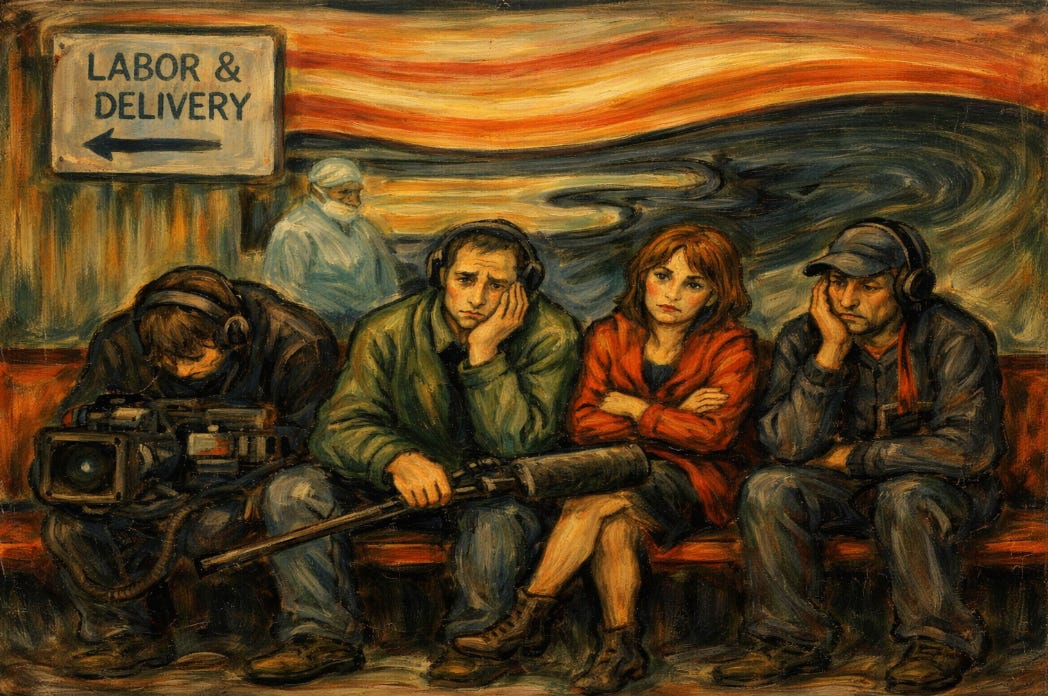
A television crew came to film on our labor and delivery unit.
They had cameras. They had microphones. They had, I assume, a vision of what a hospital birth looks like: the shouting, the sprinting, the near-misses, the dramatic save. The kind of footage that earns a time slot.
What they found instead was a quiet unit running well.
The only noise was that of healthy babies crying.
A nurse was adjusting pitocin, watching the contraction pattern, keeping the uterus from doing too much at once.
Nobody placed misoprostol, so no tachysystole, fetal bradycardia, and drama.
Another was reading a tracing, noting a variable deceleration, repositioning the patient, watching it resolve.
A resident was reviewing a cervical exam and documenting her findings.
An attending was on the phone with a patient who had called from home.
Nobody was running. Nobody was shouting. There was no dramatic rescue, no split-second intervention, no moment where one person’s heroics pulled a life back from the edge.
There was just protocol. Followed.
Quiet huddles.
The crew stayed for a few hours, filmed some hallways, asked a few polite questions, and left. The producer met with me afterwards asking me what was “wrong”. He wanted action, drama, bad outcomes, blood on the floors. I told him to go somewhere else. No apology.
They went to another hospital.
Our administration was disappointed (THAT IS THE TRUTH).
We had not given them what they came for. I was not disappointed.
At the other place a resident was filmed behaving inappropriately. When the documentary showed it, she was fired.
A patient filed a malpractice suit in that other hospital because what was shown in the documentary.
What the cameras could not film was what was actually happening. They could not film the tachysystole that was caught before it became a category III tracing.
They could not film the baby who did not have a shoulder dystocia because the nurse recognized the warning signs in time. They could not film the hemorrhage that did not happen because someone had already ordered the oxytocin before it was needed.
The absence of drama is not the absence of work.
It is the proof that the work was done.
Television needs the emergency. It needs the moment when something goes wrong and a human being fixes it with their hands and their knowledge and their nerve. That is the story it knows how to tell. I understand this. It is not a criticism of television.
But it is worth noticing what that story leaves out.
It leaves out the fact that the best outcomes in obstetrics are almost always invisible. The baby who was never in danger because the pitocin was titrated carefully. The patient who did not need an emergency cesarean because someone was watching her tracing closely enough, early enough, to avoid the sequence of events that leads to one. The postpartum hemorrhage controlled in the first minute because the team had already prepared.
Good obstetric care looks boring from the outside. It is supposed to. I want it to be that way. We all should.
The goal of a well-run labor and delivery unit is not to be ready for the emergency. It is to make the emergency less likely to happen in the first place.
That is called preventive ethics.
Our administration wanted the cameras. I understand that too. Visibility matters. A hospital that appears in a documentary attracts patients, attracts donors, attracts residents who want to train somewhere with a name. These are not trivial things. Institutional survival depends on them.
But I kept thinking about what it would mean if a unit’s best argument for being on television was that things go wrong there dramatically and frequently enough to fill an episode.
The crew found another hospital.
I hope the patients at that hospital are doing well.
I hope ours are too. Quietly.