

78% of academic health centers in the United States maintain at least two primary care clinics distinguishable by insurance mix. The clinics with more Medicaid patients are more likely to use residents as providers and more likely to serve Black and Hispanic patients. The physician whose name is on the research does not see these patients in her own practice. This is the two-tier system, documented in the published literature, operating inside institutions that publish on maternal health disparities. obmd.com
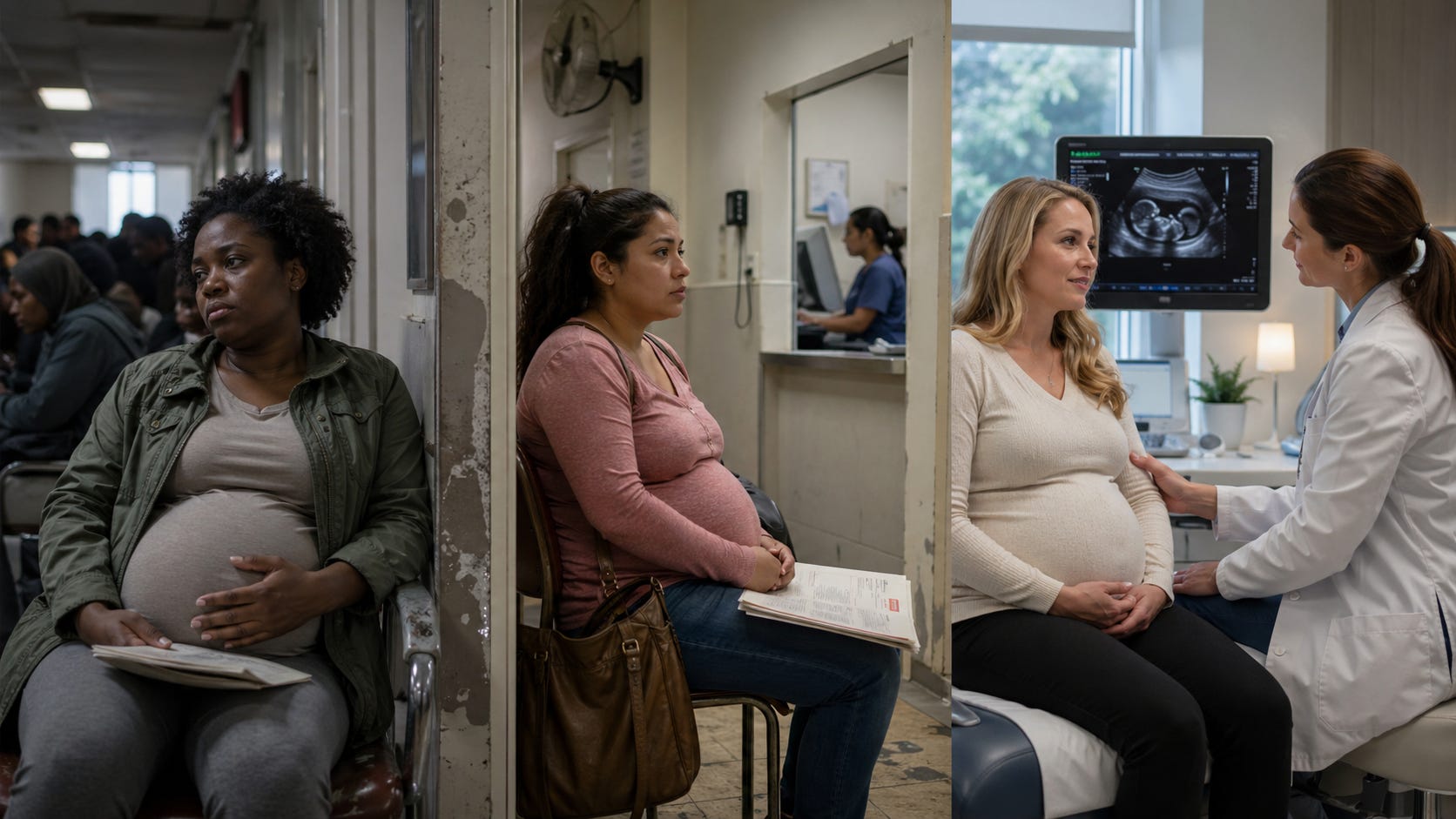
The building is on the Upper East Side of Manhattan. The address appears on federal grant applications, on faculty appointments, on papers published in the American Journal of Obstetrics and Gynecology. The department chair holds an endowed professorship. The division chief sits on national guidelines committees. The attendings publish on maternal health disparities, on racial inequity in obstetric outcomes, on the obligation of academic medicine to serve underserved populations.
There are two ways to receive prenatal care in this building.
The first way: you call the faculty practice. You ask about your insurance. If you have Aetna PPO, or Cigna, or United commercial, or Oxford, an appointment is scheduled. You will see an attending physician. She knows your name before you sit down. She will be at your delivery.
The second way: you have Medicaid. You are directed to the resident clinic. You will receive care. It will be clinically supervised. The resident who examines you in week 12 will likely not be the resident who examines you in week 28. The attending supervising the clinic that day may not have supervised your previous visits. When you arrive in labor, the team that receives you will not know you.
These are not two philosophies of care. They are two systems of care, operating in the same building, serving populations that differ substantially by race and insurance status, and producing graduates who have been trained on patients their supervisors will not see in their own offices.
The Published Evidence
This two-tier structure is not an allegation. It is a documented phenomenon in the peer-reviewed literature.
A cross-sectional study examining primary care practices at academic health centers across the United States found that 78 percent of participating institutions maintained at least two clinics distinguishable by the proportion of patients with Medicaid insurance. Of those, 38 percent had clinics differing by 20 percentage points or more in Medicaid patient share, and 10 percent had clinics differing by 40 percentage points or more. The clinics with higher proportions of Medicaid patients were more likely to employ resident physicians as providers of longitudinal care and more likely to serve patients who were Black or Hispanic. Faculty physicians were significantly less likely to provide continuity of care in the high-Medicaid clinics.
The phenomenon operates not only at the clinic level but at the individual physician level within the same practice. A 2023 study published in JAMA Network Open, using 2017 claims data from approximately 134 million patients and 200,000 physicians, examined differences in patient panel demographics between senior and junior physicians in the same practices. The lead author, Michael Barnett of the Harvard T.H. Chan School of Public Health, described the finding as a widely known secret: senior physicians, who in an academic setting are also the researchers and the committee members and the named faculty, tend to see fewer Medicaid-insured patients and fewer racial and ethnic minority patients than junior physicians and residents in the same practice.
Barnett called this a two-tiered system by physician seniority that promotes racial and economic segregation. He was careful to note that it is far from clear that senior physicians provide higher-quality care than junior physicians in absolute terms. But to the extent that patients value continuity, experience, and personal relationships with their providers, the distribution of that access along racial and economic lines is a structural form of inequity regardless of absolute quality differences.
The Billing Mechanism Nobody Discusses
There is a dimension of this two-tier system that has received almost no attention in the health equity literature, and it involves the way obstetric care is billed.
Until January 2027, when a new CPT code structure takes effect, obstetric care in the United States is billed under a global package system. A single code covers all routine prenatal visits, the delivery itself, and postpartum care within six weeks of delivery. The global package is a bundled payment: the physician who delivers the baby collects a single fee that nominally encompasses the entire pregnancy.
This creates a specific and powerful financial incentive that shapes how Medicaid participation actually works in obstetric practice. An obstetrician can enroll in a state Medicaid program, appear in that program’s provider directory, be counted in access statistics as a participating Medicaid provider, and still provide essentially no prenatal care to Medicaid patients. She enrolls to capture delivery billing. The prenatal care, the routine visits, the relationship-building that defines pregnancy management, flows to the resident clinic. The delivery, which happens once, represents a discrete revenue event that the enrolled attending can capture without having managed the pregnancy at all.
This is not a hypothetical. It is the economic logic underlying a pattern that every obstetrician in a large academic medical center recognizes: Medicaid enrollment rates among OB/GYNs look reasonably healthy in national statistics, but those statistics conflate enrollment with participation in prenatal care. The two are not the same thing. A 2026 Health Affairs study found that more than one quarter of physicians enrolled in Medicaid did not treat a single Medicaid patient in the year studied. In obstetrics, the global billing structure provides the specific mechanism by which a physician can be enrolled and present for deliveries while absent for prenatal care.
The patient in this system has a Medicaid provider on paper. She does not have a doctor.
What the Prenatal Data Shows
The clinical consequences of this two-tier structure are measurable in the obstetric literature. A retrospective cohort study comparing prenatal care at a resident clinic versus an attending clinic within the same large midwestern healthcare system found that 63 percent of prenatal patients were served by the resident clinic. The two patient populations differed significantly by insurance status, race and ethnicity, partnership status, and age. Despite being scheduled for approximately the same number of prenatal appointments, resident clinic patients attended 1.13 fewer appointments than attending clinic patients, a statistically significant difference with meaningful clinical implications for continuity and outcome.
Among Black patients with public insurance, the attendance gap was particularly pronounced: they attended an average of 2.04 fewer appointments than white patients with public insurance at the same clinic. The study’s authors concluded that the resident care model, with its inherent discontinuities and care delivery challenges, may be underserving the patients who are most vulnerable to prenatal care non-adherence from the outset.
This finding points to a compounding effect. The patients routed to resident clinics by their insurance status are also the patients for whom continuity of care is most clinically important, because they tend to carry more risk factors, face more logistical barriers to attendance, and benefit most from a care relationship that does not require re-establishing context at every visit. The two-tier system concentrates discontinuity precisely where continuity matters most.
The Coming Billing Reform and Its Limits
ACOG has announced a significant restructuring of obstetric billing codes, effective January 1, 2027. The global package codes will be eliminated and replaced with unbundled evaluation and management codes billed per visit. ACOG anticipates this change will allow more comprehensive and tailored billing of prenatal services, including social needs screening, mental health visits, and telehealth encounters that the global package structure poorly accommodates.
This reform addresses a genuine problem. The global package is an artifact of a care model that assumed a single provider managing a single uncomplicated pregnancy, a model that has not reflected the reality of academic or even group practice obstetrics for decades. Unbundling the code will make prenatal care individually billable and will make the economics of prenatal care more transparent.
What it will not do, by itself, is change the reimbursement rate. An unbundled prenatal visit billed to Medicaid at 72 percent of the Medicare rate for an evaluation and management code is still a Medicaid visit at 72 percent of the Medicare rate. The faculty obstetrician who declined Medicaid patients under the global package will have the same financial incentive to decline them under the per-visit structure unless the underlying reimbursement changes. The mechanism of exclusion shifts; the economics that drive it do not.
The Institutional Contradiction
The most challenging aspect of this two-tier system is not its existence. It is its location. It operates inside the institutions that have simultaneously positioned themselves as the national leaders on maternal health equity. The same departments that hold NIH grants for research on racial disparities in obstetric outcomes are operating faculty practices that concentrate those disparities. The same attendings who are listed as investigators on health equity studies are the attendings whose private practices do not accept Medicaid.
This is not hypocrisy in the crude sense. It reflects a system in which individual physicians make economically rational decisions within a structure that produces collectively inequitable results, and in which institutions have not been required to reconcile those results with their stated commitments. Publishing on health equity is compatible, in the current environment, with operating a health-inequitable practice. No accreditation body, no NIH grant review, no journal editor has made those two things incompatible.
Until they are made incompatible, the two doors will remain.
My Take
I checked the faculty practice websites of the major academic obstetric programs in Manhattan. I looked for Medicaid on their insurance lists. It was not there. This is not a generalization. It is an observation. I checked each one.
I want to be precise about what this means and what it does not mean. It does not mean that the attendings at these institutions are bad physicians or that they do not care about their patients. It means that they are operating within a reimbursement structure that makes accepting Medicaid economically irrational for a private faculty practice in a high-overhead urban market, and that no institutional policy requires them to do otherwise.
The fix is not complicated at the level of mechanism. It is complicated at the level of institutional will. Require faculty practices at academic medical centers that receive federal research funding to accept Medicaid. Tie NIH funding eligibility to demonstrated equitable access across insurance types. Make the two-tier system visible by requiring public disclosure of insurance acceptance by practice type, not just by institution. Enforce the mission statement.
Academic medicine says it is committed to health equity. The faculty practice roster is an annual audit of whether that commitment is real. At most major academic obstetric programs in this country, that audit currently fails.
Coming Next Week — For Paid Subscribers
Post 4: The “Own Doctor” Problem. A Black woman on Medicaid in a large American city will see an average of four to six different providers across her prenatal visits. She arrives in labor as a stranger to the team that receives her. The care is clinically supervised. But nobody knows her. National data covering 922,000 pregnancies found that continuity of care reduces stillbirth rates specifically for Black women — the only demographic group in which the difference reached statistical significance. What does that mean for the rotating-provider model that Medicaid patients are routed into by default? What would it cost to fix? That post publishes next week.
Posts 4 through 10 are available to paid subscribers at obmd.com. An annual subscription is $60 per year, less than $1.20 per week. The series covers hospital quality stratification, maternity care deserts, the implicit bias training evidence, the April 2026 JAMA doula review, the postpartum coverage cliff, and the closing argument about who benefits from keeping the focus on attitudes rather than systems. If you have been reading ObGyn Intelligence and finding it useful, this is the series that makes the subscription worth it.
References
1. Mafi JN, Vangala M, Yazdany J, et al. Separate But Not Equal? A Cross-Sectional Study of Segregation by Payor Mix in Academic Primary Care Clinics. J Gen Intern Med. 2023;38(11):2537-2545.
2. Barnett ML, Olenski AR, Jena AB. Differences by Physician Seniority in Race and Ethnicity and Insurance Coverage of Treated Patients. JAMA Netw Open. 2023;6(12):e2347082.
3. Essien UR, He W, Ray A, et al. Disparities in Quality of Primary Care by Resident and Staff Physicians: Is There a Conflict Between Training and Equity? J Gen Intern Med. 2019;34(7):1184-1191.
4. Vanjani R, Pitts A, Aurora P. Dismantling Structural Racism in the Academic Residency Clinic. N Engl J Med. 2022;386(21):2054-2058.
5. Wallis CJD, Jerath A, Coburn N, et al. Association of Surgeon-Patient Sex Concordance With Postoperative Outcomes. JAMA Surg. 2022;157(2):146-156.
6. Vasan A, Flores LE, Adamson AS. Resident Versus Attending Prenatal Care Models: An Analysis of the Effects of Race and Insurance on Appointment Attendance. Matern Child Health J. 2023;27(8):1388-1396.
7. Dunn RA, Kaczynski L, et al. One-Quarter of Medicaid Doctors Do Not Actually Treat Medicaid Patients. Health Aff (Millwood). 2026;45(2). doi:10.1377/hlthaff.2025.01234.
8. ACOG. Payment for Obstetric Services. ACOG Practice Management; 2024. Available at: acog.org/practice-management/coding.
You definitely get what you pay for. If you pay extra, you get concierge medicine, but everyone should have adequate care with good outcomes. The problem is reimbursement as you know.