

Reddit is where patients go at 2 a.m. when scared. I monitor dozens of communities for clinically meaningful posts: dangerous myths, gaps between belief and evidence, stories guidelines cannot capture. This series -- ObGyn Intelligence on Reddit -- dissects them against the literature, because ObGyns who ignore social media ignore the most unfiltered window into what patients think, fear, and do between appointments.
Summary
A first-time mother at 37 weeks and 6 days posted to r/BabyBumps about getting a Brazilian wax before delivery -- and deeply regretting it.
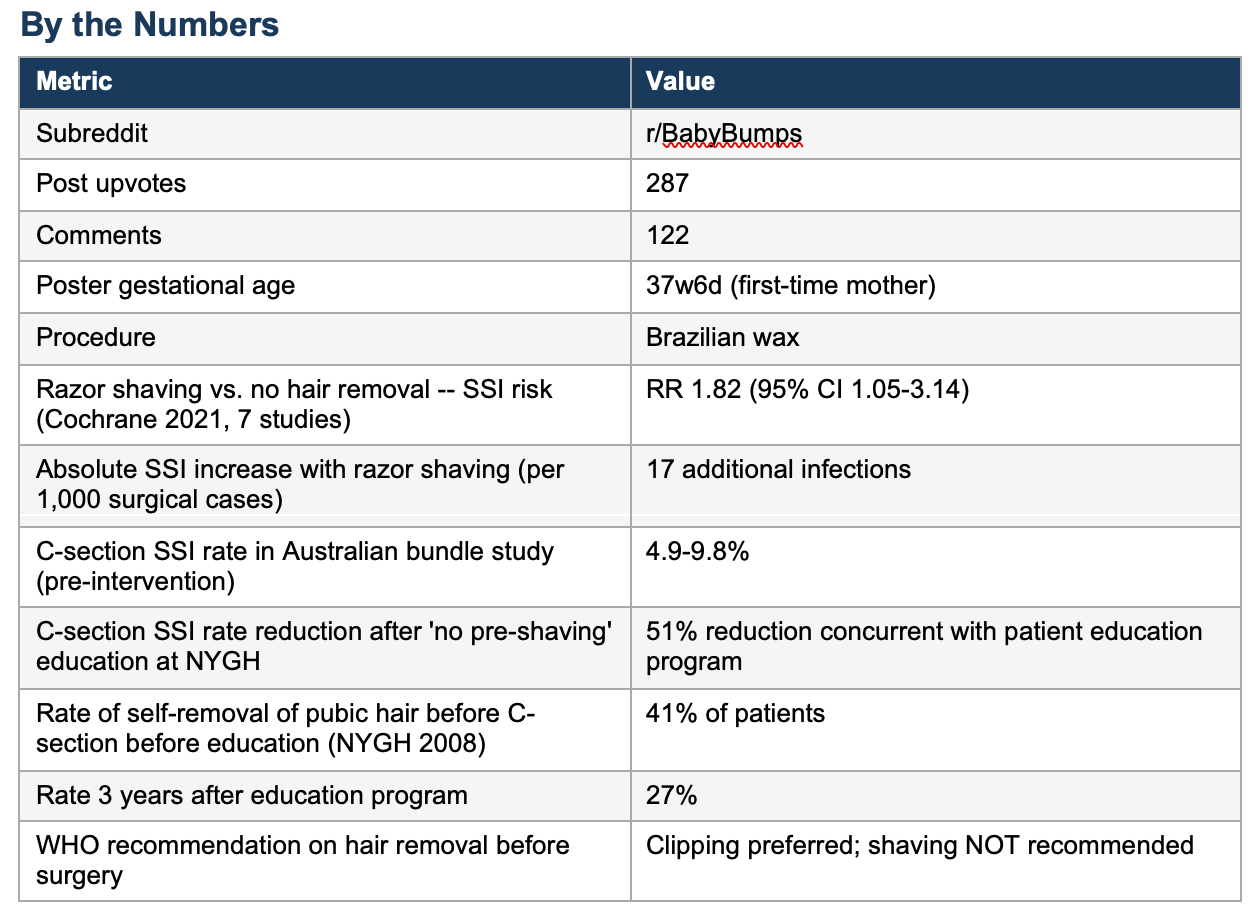
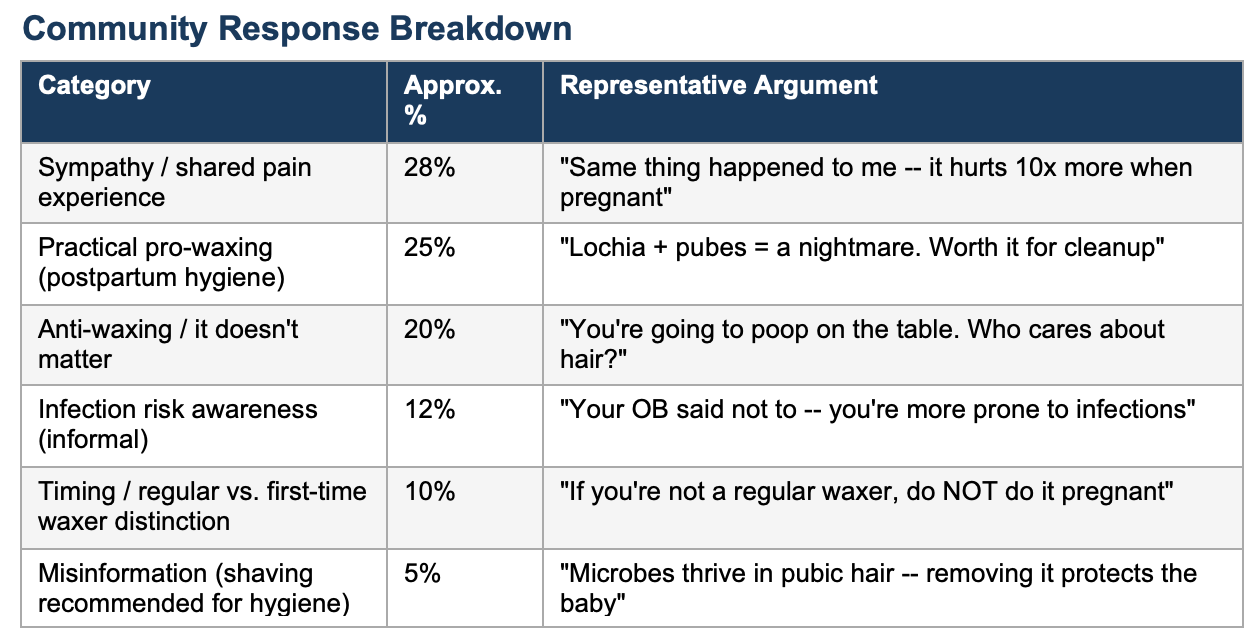
The post got 287 upvotes and 122 comments. Reactions ranged from sympathetic (it hurts even more in pregnancy because blood flow to the skin is dramatically increased) to practical (waxing before delivery can actually make postpartum cleanup easier) to clinical (shaving or waxing near your due date raises your infection risk). What struck me was not the pain story -- that part everyone can figure out the hard way. What struck me was what was missing: evidence-based guidance from clinicians. These women are making decisions that affect surgical site infection rates, and most of them have never been told what the data actually show.
Commentary
What the research actually shows
Pubic hair removal before labor has a long and embarrassing history in obstetric practice. For decades, hospitals routinely shaved laboring women -- not because of evidence, but because it seemed logical. It was not logical. A 2021 Cochrane systematic review of 25 trials with nearly 9,000 participants found that shaving with a razor compared to no hair removal probably increases surgical site infection risk (RR 1.82). In absolute terms, that translates to roughly 17 additional infections per 1,000 cases -- a meaningful number when you scale it to the 3.6 million US births per year, nearly one-third of which are cesarean deliveries.
Clipping, by contrast, appears neutral -- no significant difference in SSI compared with no hair removal. The WHO and SHEA guidelines both recommend against razor shaving before surgical procedures, including cesarean section. StatPearls (NCBI) is explicit: patients should be advised not to shave their pubic area as they approach their due date, because shaving causes microscopic skin breaks that raise infection risk rather than reduce it.
Why waxing near term deserves special caution
Waxing is not exactly the same as shaving -- it removes hair at the root rather than cutting at the surface. However, waxing also causes skin microtrauma, follicular disruption, and temporary breaks in the epithelial barrier. In pregnancy, blood volume increases by 40-50%, driving dramatically higher skin perfusion and sensitivity. Any barrier disruption in a highly vascularized region near the vaginal introitus and perineum creates a more favorable environment for bacterial colonization.
The concern is not theoretical. A quality improvement study at North York General Hospital found that 41% of patients undergoing elective cesarean sections had self-removed pubic or lower abdominal hair before arriving at the hospital -- 83% of them by shaving, the rest by waxing or other methods. When the hospital implemented patient education about not removing hair in the final month of pregnancy, the self-removal rate dropped significantly and the concurrent SSI rate fell by 51%. Causality is hard to establish in a quality improvement design, but the signal is real enough that multiple institutions have adopted formal patient education programs around this.
What doctors are not telling their patients
The Reddit thread is clinically revealing precisely because of what is absent. In 122 comments from real patients, the conversation is dominated by pain tolerance stories, postpartum hygiene preferences, and anecdotes about individual midwives. Almost no one mentions the infection data. One commenter cites a vague “7 days before delivery” rule; another mentions her OB recommended trimming. No one frames it in terms of surgical site infection risk, microtrauma, or the specific recommendations of WHO, Cochrane, or SHEA.
This is a counseling failure. If 41% of patients preparing for cesarean section are still self-removing pubic hair at home -- a behavior associated with increased SSI risk -- it is because the clinical encounter has not made the stakes clear. ACOG’s own patient-facing language says “you don’t need to shave before giving birth” and favors trimming. That is accurate but insufficient. Patients are making active decisions about waxing at 37-38 weeks without knowing that even one week before delivery, a shave or aggressive waxing session could matter to their wound healing. The data exist. The guidelines, to their modest credit, are largely aligned. What is missing is the communication.
What It Means
This Reddit thread is a window into a counseling gap that has real clinical consequences.
Patients are making decisions about pubic hair removal in late pregnancy -- including Brazilian waxes at 37 weeks -- without any understanding of the evidence.
Some of those patients will go on to have cesarean deliveries.
The Cochrane evidence is unambiguous that razor shaving raises SSI risk. The evidence on waxing-related microtrauma is biologically plausible and supported by the NYGH quality improvement data. At minimum, every patient who might deliver by cesarean -- which in practice means every pregnant patient -- should be told clearly and early: in the last month of pregnancy, skip the wax, skip the razor. Trim if you want. The clinical encounter is the right place for this. Reddit is where they are going instead.
My Take
I have delivered more than 10,000 babies. I cannot recall a single prenatal visit where I counseled a patient about pubic hair removal and surgical site infection. That is on me, and on our specialty. We spend enormous energy on birth plans, feeding choices, and epidural preferences -- things that matter but that patients often research themselves. Meanwhile, a behavior that plausibly raises the risk of a postoperative infection after one of the most common surgeries in the United States goes routinely undiscussed.
The 41% self-removal rate before elective cesarean sections at NYGH in 2008 did not happen because patients were being reckless.
It happened because no one told them not to.
The Reddit poster at 37w6d was not making a bad decision by her own lights -- she had read previous posts, consulted community wisdom, and made an informed choice within the information she had. The information she had was incomplete.
The fix is not complicated. It is a paragraph in the prenatal visit, a line in the hospital preparation instructions, a poster in the waiting room. We already know it works -- NYGH showed us that in 2012. Thirteen years later, a first-time mother is still going to a wax salon at 37 weeks and finding out the hard way that pregnancy physiology is not forgiving. We can do better than that.