

The country just found about $150 billion for a war and immigration enforcement. The same money would keep every at-risk rural hospital in America open for 25 years. We are not short on cash. We are short on priorities.

A woman goes into labor in a rural county.
The nearest hospital that still delivers babies is 90 minutes away, because the one in her town closed its maternity ward two years ago.
She makes the drive. Most times it ends fine.
Sometimes it does not. This is no longer a rare story. It is the map of American maternity care.
In 2023, 669 women died from causes tied to pregnancy in the United States. That is a rate of 18.6 deaths for every 100,000 births. It is better than the year before, and still worse than almost every other wealthy country. Most of them sit between 3 and 7 deaths per 100,000. We are two to five times higher — and we spend more per person on health care than anyone on earth.
The deaths are not spread evenly. For Black women the rate was 50.3 per 100,000. For white women it was 14.5. Same country, same year, a gap of more than three to one.
The easy explanation is racism. Racism is real. But it is not the main lever here, and treating it as the only cause lets the real problem hide. The real problem is money. Medicaid pays hospitals and doctors about half what private insurance pays for the same birth. When a service loses money, hospitals stop offering it — and maternity is usually first to go. So the women with public insurance, who are more likely to be Black and more likely to be rural, lose access first. In countries with universal coverage, where that payment gap does not exist, the racial gap in maternal deaths largely disappears. That tells you what is actually driving it.
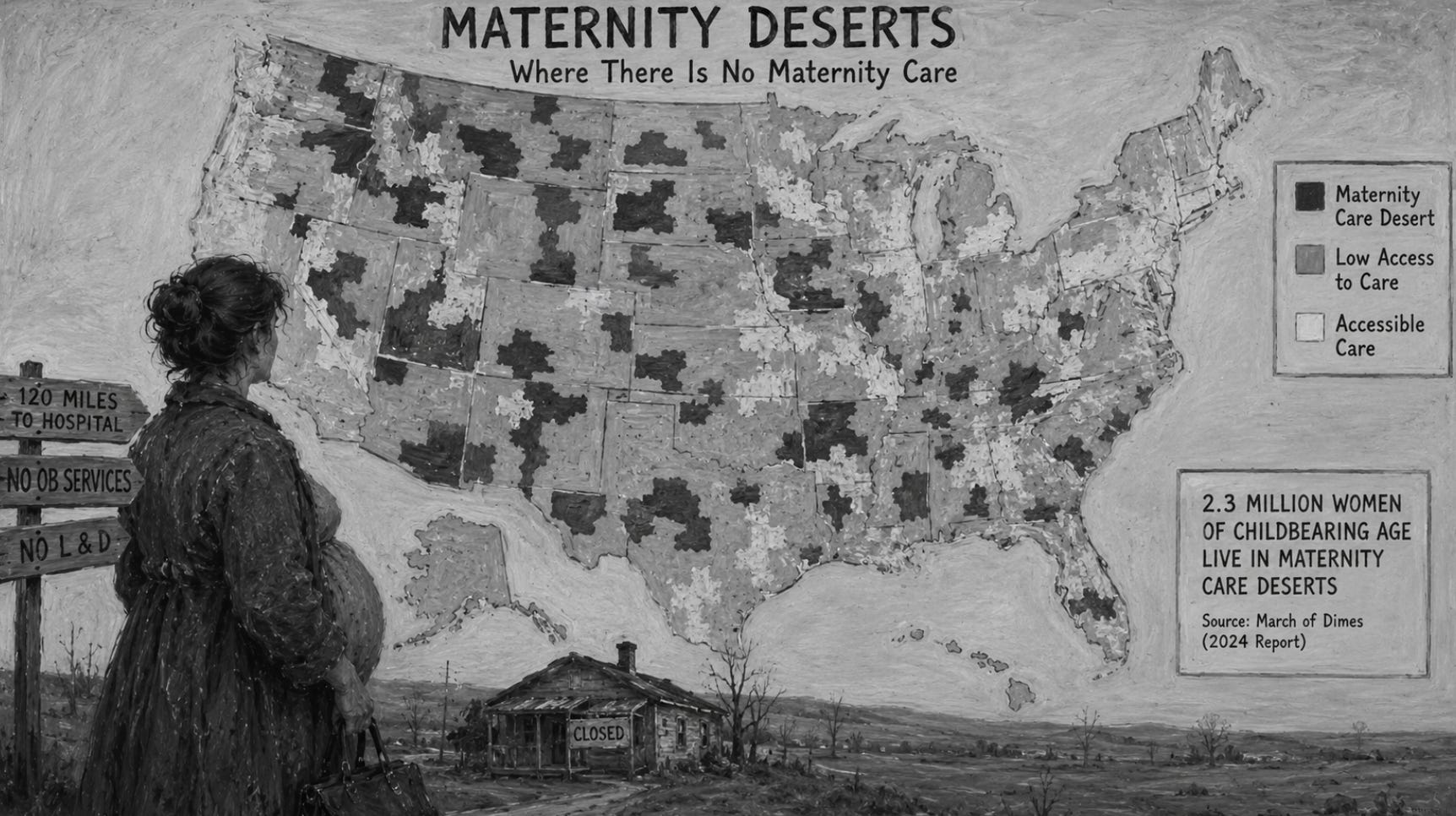
Maternity care deserts continue to expand across the United States, leaving many pregnant patients to travel long distances or deliver without timely access to obstetric services. Hospital closures disproportionately affect rural communities, where loss of local labor and delivery units can delay emergency care and worsen maternal and neonatal outcomes.
The closures are speeding up. Since the end of 2020, 139 rural hospitals have stopped delivering babies — about two a month. More than a third of all US counties are now maternity care deserts: 1,104 counties with no hospital, no birth center, and no obstetric provider. About 2.3 million women of childbearing age live in them.
Hospitals do not close maternity wards out of cruelty. A labor and delivery unit runs 24 hours a day, 7 days a week, whether it delivers 400 babies a year or 40. At low volume, the payments do not cover the cost of simply being ready. So the doors close.
Here is the part that should make you angry. Keeping every financially at-risk rural hospital in America open — all services, maternity included — costs about $6 billion a year. That is one-tenth of one percent of what the country spends on health care. We are choosing not to spend it.
Now look at what we did choose.
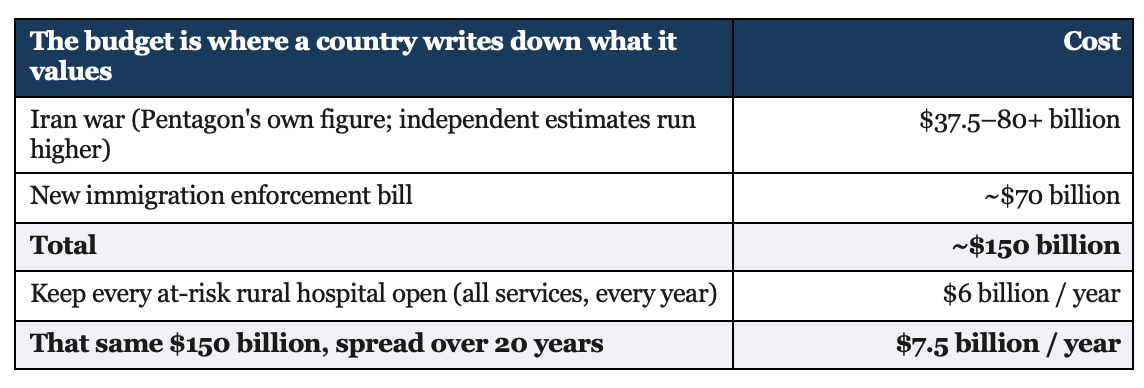
Read that last line again. Spread over 20 years, $150 billion is $7.5 billion a year, or if invested in Treasuries at 4% it’s $6 Billion a year.
More than enough to keep every at-risk rural hospital open the entire time, reopen the maternity wards that already closed, and still have money left over to start closing the payment gap that drives the deaths in the first place.
For a woman in a rural county, this is not abstract. It is the difference between a 10-minute drive and a 90-minute one when her labor goes wrong. In obstetrics, distance kills. The math above is measured in minutes on a dark highway.
My Take
We are not a poor country that cannot afford to keep mothers alive.
We are a rich country that decided mothers are not the priority.
When we want $150 billion for a war or for enforcement, we find it in weeks.
When mothers need $6 billion a year to keep the lights on in the hospital where they deliver, we are told it is not in the budget.
That is not an economics problem.
It is a values problem.
A budget is not a spreadshee, it is a moral document. It is where a country writes down, in numbers, who it is willing to protect.
Fixing this does not take a miracle. Pay for maternity care the way we pay for a fire department: you fund it to be ready, not per fire. Close the Medicaid payment gap so a hospital is not punished for taking a woman with public insurance. Both are affordable. Both are choices we keep refusing to make.
The next time someone tells you the country cannot afford to keep mothers safe, ask them to explain the $150 billion. The money exists. The will does not.
If this made you think, subscribe. It is free, and the evidence here is better than what you will get from the people who found the money for everything except mothers.
References
1. National Center for Health Statistics. Maternal mortality rates in the United States, 2023 [Internet]. Hyattsville (MD): NCHS; 2025 [cited 2026 Jul 22]. Available from: https://www.cdc.gov/nchs/data/hestat/maternal-mortality/2023/maternal-mortality-rates-2023.htm
2. March of Dimes. Nowhere to go: maternity care deserts across the US (2024 report) [Internet]. Arlington (VA): March of Dimes; 2024 [cited 2026 Jul 22]. Available from: https://www.marchofdimes.org/maternity-care-deserts-report
3. Center for Healthcare Quality and Payment Reform. Stopping the loss of rural maternity care [Internet]. CHQPR; [cited 2026 Jul 22]. Available from: https://ruralhospitals.chqpr.org/Maternity_Care.html
4. Center for Healthcare Quality and Payment Reform. Rural hospitals at risk of closing [Internet]. CHQPR; [cited 2026 Jul 22]. Available from: https://chqpr.org/downloads/Rural_Hospitals_at_Risk_of_Closing.pdf
5. Centers for Medicare & Medicaid Services. National health expenditure data: historical [Internet]. Baltimore (MD): CMS; [cited 2026 Jul 22]. Available from: https://www.cms.gov/data-research/statistics-trends-and-reports/national-health-expenditure-data/historical
6. Hegseth says Iran war has cost $37.5 billion. Bloomberg. 2026 Jul 21 [cited 2026 Jul 22]. Available from: https://www.bloomberg.com/news/articles/2026-07-21/hegseth-says-iran-war-has-cost-37-5-billion
7. What’s in the $70 billion bill funding immigration enforcement. Time. 2026 Jun 10 [cited 2026 Jul 22]. Available from: https://time.com/article/2026/06/10/house-passes-secure-america-act-senate-reconciliation-bill-funding-immigration-enforcement-trump/