

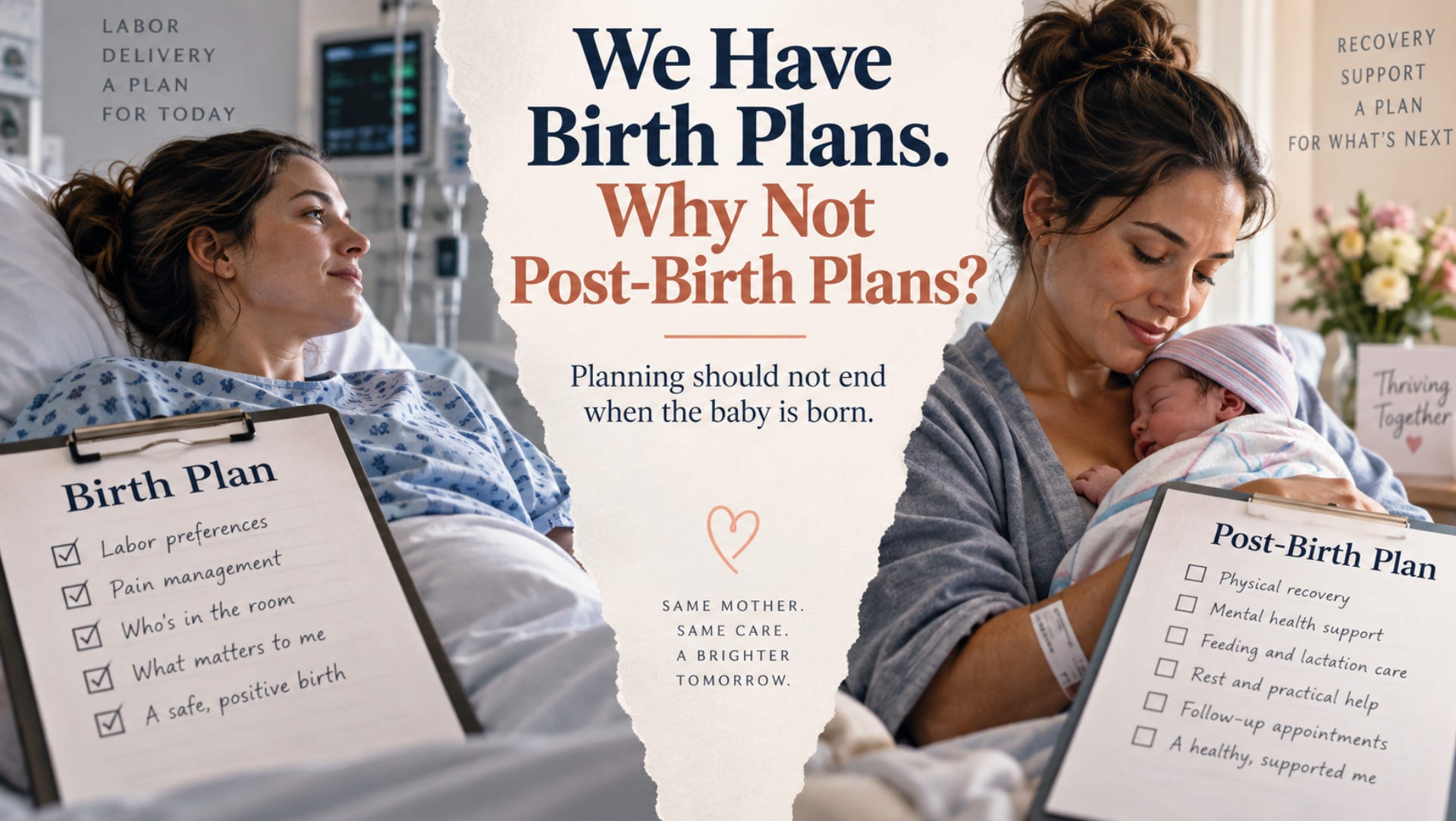
We plan prenatal visits, screening, induction, cesarean delivery, pain relief, who should be in the room, delayed cord clamping, skin-to-skin contact, and feeding preferences. Many women arrive at the hospital with a detailed birth plan.
Then the baby is born.
And, strangely, the planning often stops.
That makes no clinical sense.
The hours and days after birth are not an afterthought. They are a major transition in care, and for some women they are among the most medically vulnerable days of the entire pregnancy-related episode. Hypertension may worsen. Hemorrhage may recur or become apparent. Infection, thromboembolism, cardiomyopathy, wound complications, urinary problems, breastfeeding difficulties, depression, anxiety, and other serious problems may emerge after delivery, including after discharge.
Yet we have no equivalent of the birth plan for what comes next.
We give discharge instructions. That is not the same thing.
A discharge sheet is information. A post-birth plan is prospective. It asks what this particular woman needs after delivery, what risks should be anticipated, what symptoms should trigger action, who is responsible for follow-up, and what should happen if something changes after she leaves the hospital.
That distinction matters.
We have created a strange imbalance
Modern obstetric care may devote substantial attention to the details of labor and delivery. Patients are encouraged to consider preferences about analgesia, mobility, fetal monitoring, visitors, cord clamping, newborn procedures, and the atmosphere of the delivery room.
These discussions can be valuable.
But why do we plan so carefully for a few hours of labor and so much less carefully for the days and weeks afterward?
The imbalance is difficult to justify.
After delivery, responsibility often becomes fragmented. The obstetric team discharges the mother. The pediatric team assumes responsibility for the newborn. Primary care may not yet be involved. The woman goes home tired, in pain, sleep-deprived, caring for a newborn, often unsure which symptoms are expected and which are dangerous.
This is exactly when a plan is needed.
A woman should know who is following her blood pressure, when she should be seen, which medications continue, who to call after hours, what symptoms require urgent evaluation, what support is available for feeding and mental health, and what to do if recovery is not going as expected.
These are not minor logistical details.
They are part of patient safety.
Planning should not end with delivery
That is why I developed a Post-Birth Plan.
The concept is simple: every birth plan should be followed by a plan for what happens after birth.
The Post-Birth Plan is designed to make postpartum care more explicit, more organized, and less dependent on chance. It creates a structured way to think about maternal recovery, warning signs, medications, follow-up, support, feeding, newborn care, and continuity between hospital and home.
It does not replace clinical judgment.
It does not replace individualized discharge counseling.
It does not replace the obstetrician, midwife, nurse, pediatrician, or primary care clinician.
It does something more basic: it makes us ask, before discharge, whether there is actually a plan.
That question is more important than it sounds.
The patient should not become the handoff
One of the most vulnerable moments in medical care is the transition between teams.
Postpartum care contains several of them at once.
Hospital to home.
Obstetrics to primary care.
Maternal care to newborn care.
Daytime clinicians to after-hours coverage.
In an ideal system, these transitions are seamless. In real life, the patient often becomes the person carrying the information between clinicians.
That is not continuity.
That is a handoff failure waiting to happen.
A Post-Birth Plan cannot solve every systems problem. But it can make responsibilities visible. It can clarify what comes next. It can help ensure that follow-up is not merely recommended, but anticipated.
And perhaps most importantly, it can change the way we think about the end of pregnancy.
Delivery is not the end of obstetric care.
It is a transition.
We should stop treating postpartum care as the appendix
The language we use matters.
“Birth plan” is familiar. “Post-birth plan” is not.
That alone tells us something.
We have normalized the idea that birth deserves advance planning. We have not normalized the same expectation for the postpartum period.
We should.
A woman should not leave the hospital knowing exactly how she wanted the lights dimmed during labor but not knowing whom to call for a severe headache, shortness of breath, heavy bleeding, fever, rising blood pressure, worsening pain, or profound emotional distress.
That is the wrong hierarchy of priorities.
A birth plan is often about preferences.
A post-birth plan is about continuity, preparation, responsibility, and safety.
We need both.
I developed the Post-Birth Plan here:
https://tools.obmd.com/post-birth-plan/
I would welcome criticism and suggestions from obstetricians, maternal-fetal medicine specialists, midwives, nurses, pediatricians, primary care clinicians, and patients.
The central idea is simple:
We plan for birth. We should plan just as carefully for what happens after it.
And perhaps the real question is not why we need a Post-Birth Plan.
It is why we have gone this long without one.