

Medical education built doctors into human databases for a century. 40,000 biomedical journals later, no physician can keep up — and pretending otherwise has cost patients something real.
In 30 years of clinical practice, I will encounter perhaps 6 of the 47 causes of lymphadenopathy I memorized in medical school. The other 41 occupy space where something more useful could live.
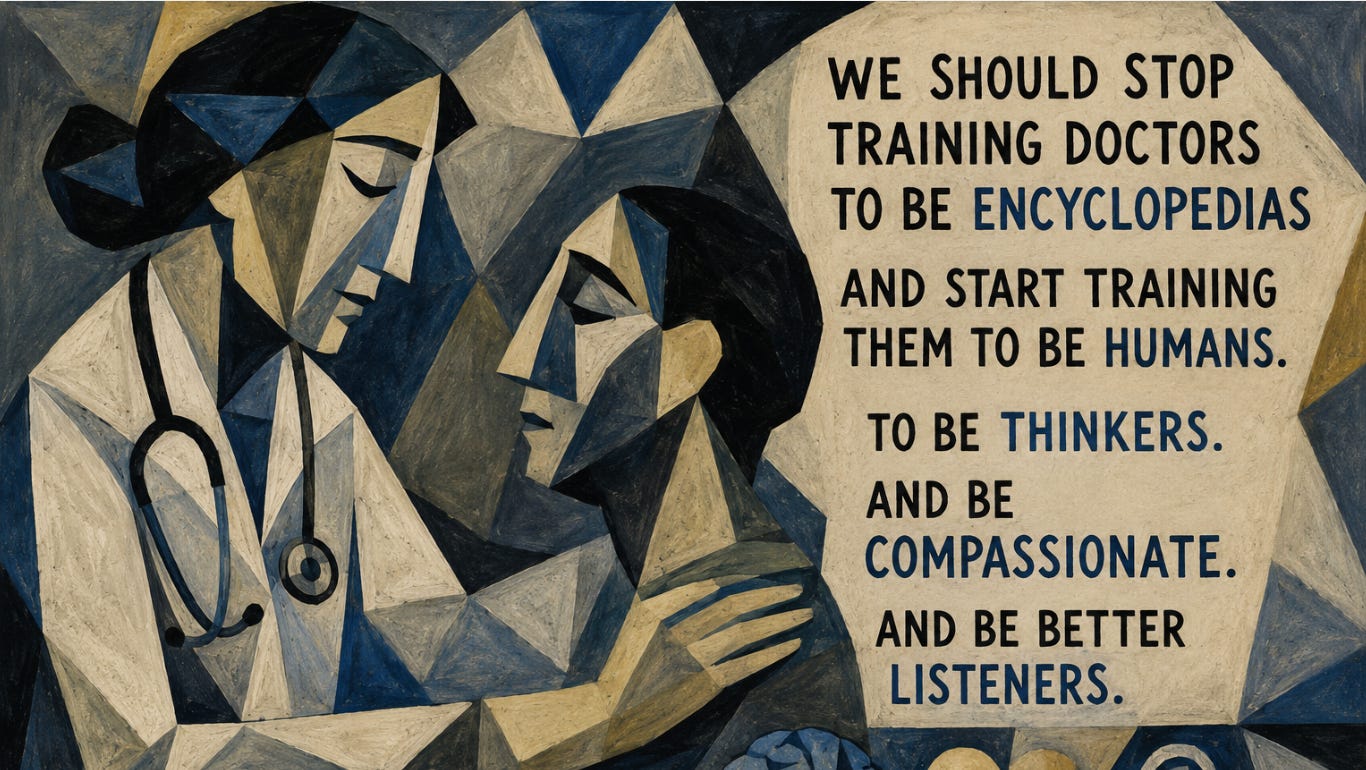
That is not a flaw in my memory. It is a design flaw in how we trained a profession.
For more than a century, medical education has rested on a single assumption: the doctor is the database. Every diagnosis, every drug interaction, every rare syndrome stored in one human brain. Exams rewarded recall. Residency rewarded the speed of recall.
The best doctor was the one who remembered the most.
For most of that century, this made sense. If you did not know it, you could not look it up at the bedside. The encyclopedia model was the only model available.
That era is over. And medicine has been slow to notice.
The Scale of the Problem
There are now more than 40,000 active biomedical journals. PubMed adds more than one million new citations every year. No physician has ever been able to keep up with this volume. We have known this for decades. We just pretended otherwise, and patients paid for the pretense with care shaped by what their doctor happened to have memorized last.
Daniel Kahneman spent a career documenting how human judgment fails under conditions exactly like these. Physicians over-rely on what they have seen most recently. They anchor on the first diagnosis they consider. They remember dramatic cases and forget base rates. This is not a moral failure. It is how human cognition works under cognitive load and information overload.
AI does not have these biases. Used properly, it is not a replacement for physician judgment. It is a check on the ways physician judgment goes wrong.
What AI Actually Changes
Tools like Claude and ChatGPT can retrieve drug interactions, diagnostic criteria, guideline updates, and rare disease presentations in seconds, with citations. This does not replace the physician. It replaces the part of the job that was never really medicine: storage and retrieval of facts.
What medicine actually requires at its best is something different. A physician listens to a patient’s story. She notices what does not fit. She weighs risks against benefits for this specific patient, not the average patient in a trial population. She explains a difficult diagnosis to a frightened family. She makes a judgment call when the evidence is incomplete.
None of that requires memorizing 47 causes of lymphadenopathy. All of it requires presence, reasoning, and relationship. Those are the capacities medical training has historically crowded out in favor of encyclopedic recall.
When a physician does not have to spend half the appointment recalling whether a medication is safe in pregnancy, she can ask how the patient is actually doing. The doctors who embrace AI will not be lazier. They will be more present.
The Predictable Objection
Every time I raise this argument, someone says: doctors need to know things. You cannot just look everything up.
My father, who had to leave school at age 14, told me when I entered medical school: you do not need to remember everything, just know where to find the answer. That was in 1968, more than 50 years before ChatGPT.
He was right then. He is more right now.
Of course, core knowledge matters. A surgeon needs anatomy. An obstetrician needs fetal physiology. I am not arguing for ignorance. I am arguing for a different kind of knowledge: frameworks for thinking, not warehouses of facts. The ability to reason through a problem is not the same as the ability to recall a list.
What This Means for You
If your doctor uses AI-assisted tools to check a drug interaction or look up a rare presentation during your visit, that is not a sign of incompetence. It is a sign of good judgment. It means she is not relying on a memory formed years ago. It means she is checking current evidence for your specific situation.
The physicians who resist these tools are not protecting their patients. They are protecting the identity they built around memorizing things. These are not the same thing. Ask your doctor whether they use AI tools in your care. The answer will tell you something important.
Conclusion
I have practiced medicine for more than 50 years. I have forgotten more facts than most young physicians have yet learned. I am a better clinician now than I was at 40, not because I remember more, but because I know what questions to ask and how to reason toward an answer. AI handles the memory. The physician handles the medicine. These are not competing claims. They are a division of labor that medicine has needed for decades and that education has refused to acknowledge. The profession will come around. The technology does not wait for permission.
Bottom Line
Medical training built doctors into hard drives when it should have built them into processors. AI now gives us a better hard drive. The question is whether medical education has the courage to retrain for the job that has always actually mattered.