

Yesterday I showed that JAMA’s new patient page on this stomach bug reads at a college level. A patient page should read at a 6th to 8th grade level. That is the standard the AMA and the NIH set for patient education.
JAMA’s new patient page on the cyclosporiasis outbreak reads at a college level — so here is the same page, same facts, rewritten the way a patient page should be written.
I ran JAMA's new patient page on this outbreak through six standard readability formulas. Every one puts it at a college reading level — far above the 6th-to-8th-grade level the AMA and NIH set for patient education.
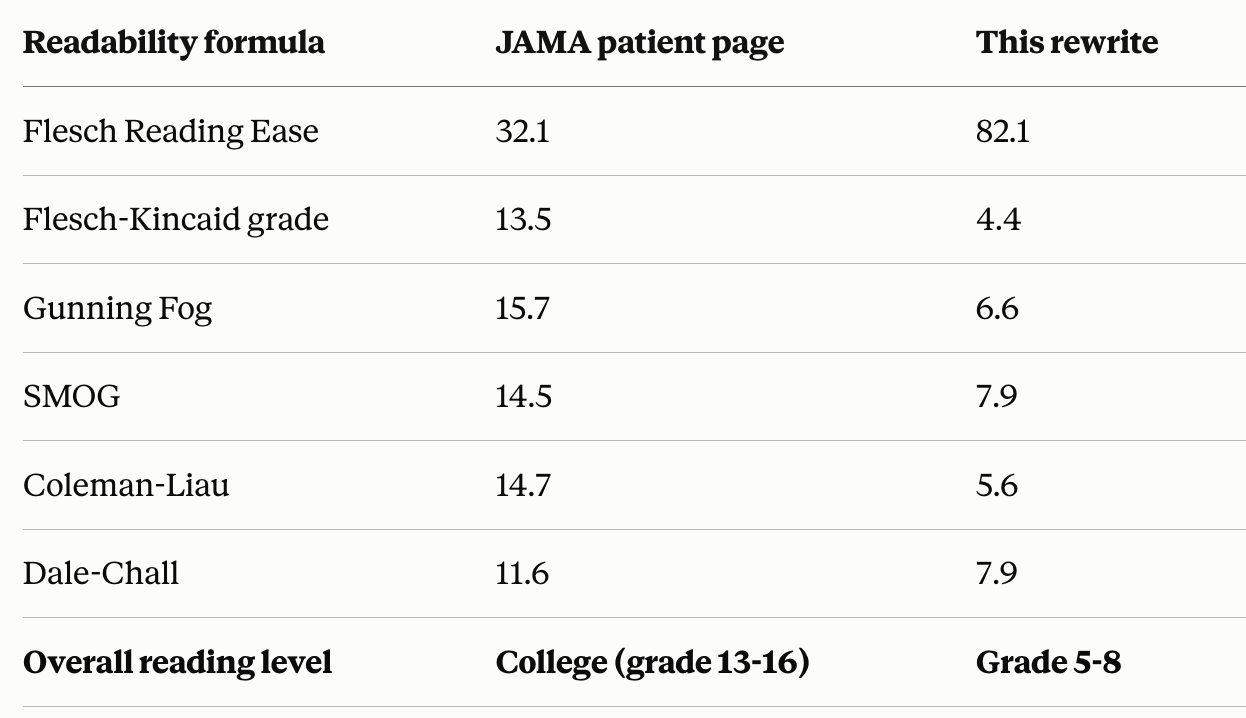
Higher Flesch Reading Ease means easier; higher grade scores mean harder. The JAMA page lands at a college sophomore-to-junior level. The rewrite below sits in the middle-school target range.
So here is the same page, rewritten the way a patient page should be written. Same facts. Same numbers. Fewer big words.
What is cyclosporiasis?
It is a stomach and gut infection. A tiny parasite causes it. The parasite is called Cyclospora. It is too small to see. It infects the small bowel and gives you watery diarrhea.
How do you get it?
You get it by eating food or drinking water that has the parasite in it. The parasite passes out in the stool of people who are already infected. From there it can end up on food.
The foods most often to blame are fresh fruits and vegetables that are eaten raw. Foods with bumps and grooves are the worst, because they are hard to clean. Think raspberries, leafy greens, and herbs.
You cannot catch it straight from another person. It has to pass through food or water first.
What does it feel like?
The main sign is watery diarrhea. You go often, and it can come on fast and hard. This usually starts 2 to 12 days after the parasite gets into your body.
You may also lose your appetite. You may feel cramps or bloating. You may have more gas, lose weight, or feel very tired.
If you do not treat it, it can last for weeks or even months. Some people feel better for a while and then get sick again.
What is going on with the outbreak?
An outbreak happens when a large batch of produce gets the parasite on it. This can happen while the food is being picked or packed. Food ships all over the country, so people in many states can get sick from the same source.
Past outbreaks have been traced to romaine lettuce, sugar snap peas, raspberries, and fresh herbs like cilantro and basil.
This outbreak was first spotted in mid-June 2026. As of July 17, the CDC had counted 1,645 confirmed cases and more than 5,100 likely cases across 34 states. The real number is probably much higher. Many people have mild symptoms and never see a doctor.
On July 16, the CDC said one part of the outbreak, in 5 states, was linked to shredded iceberg lettuce. The CDC is still looking into other cases that may come from a different food.
How do doctors find it and treat it?
A doctor tests a sample of your stool. They look at it under a microscope for the parasite’s eggs. Or they run a lab test that finds the parasite’s DNA. The eggs are hard to spot, so you may need to give more than one sample.
The usual treatment is an antibiotic called trimethoprim-sulfamethoxazole. You take it for 7 to 10 days. Most people feel better within a few days. People with a weak immune system may need it longer. Drink plenty of fluids so you do not get dried out from the diarrhea.
How can you prevent it?
The best way is to keep the parasite out of your food and water. Heat kills it, so cooked food is safe. Freezing lowers the risk but does not remove it fully.
Wash raw fruits and vegetables well under running water. Peel off or throw away the outer layer when you can, such as the outer leaves of a head of lettuce. The parasite usually sits on the outside. And wash bagged salad even if the label says it was already washed.
My take
None of this is hard to say in plain words. The facts did not change. The parasite is still the same parasite. The lettuce is still the same lettuce. All that changed is that a worried person can now read it.
A patient page that a patient cannot read is not doing its job. If we call something a public service, it should serve the public. Writing clearly is not dumbing down the medicine. It is respecting the reader.
If this was useful, subscribe. ObGyn Intelligence is free because the work matters, and clear writing should not be a luxury.
Reference
1. Linder KA, Malani PN. What Is Cyclosporiasis? JAMA. Published online July 21, 2026. doi:10.1001/jama.2026.14866. (All facts and outbreak figures in this rewrite are drawn from this JAMA Patient Page, which attributes the case counts to the US Centers for Disease Control and Prevention.)
Readability of this rewrite (body text): Flesch Reading Ease 82, Flesch-Kincaid grade 4.4, Gunning Fog 6.6, SMOG 7.9, Coleman-Liau 5.6, Dale-Chall grade 7-8. Target for patient education is 6th to 8th grade.